Best AI Coding Agent Tools in 2026: Complete Comparison

Compare AI coding agent tools and frameworks — from Claude Code and Codex to OpenClaw and Hermes. Find the right agent and tool stack.
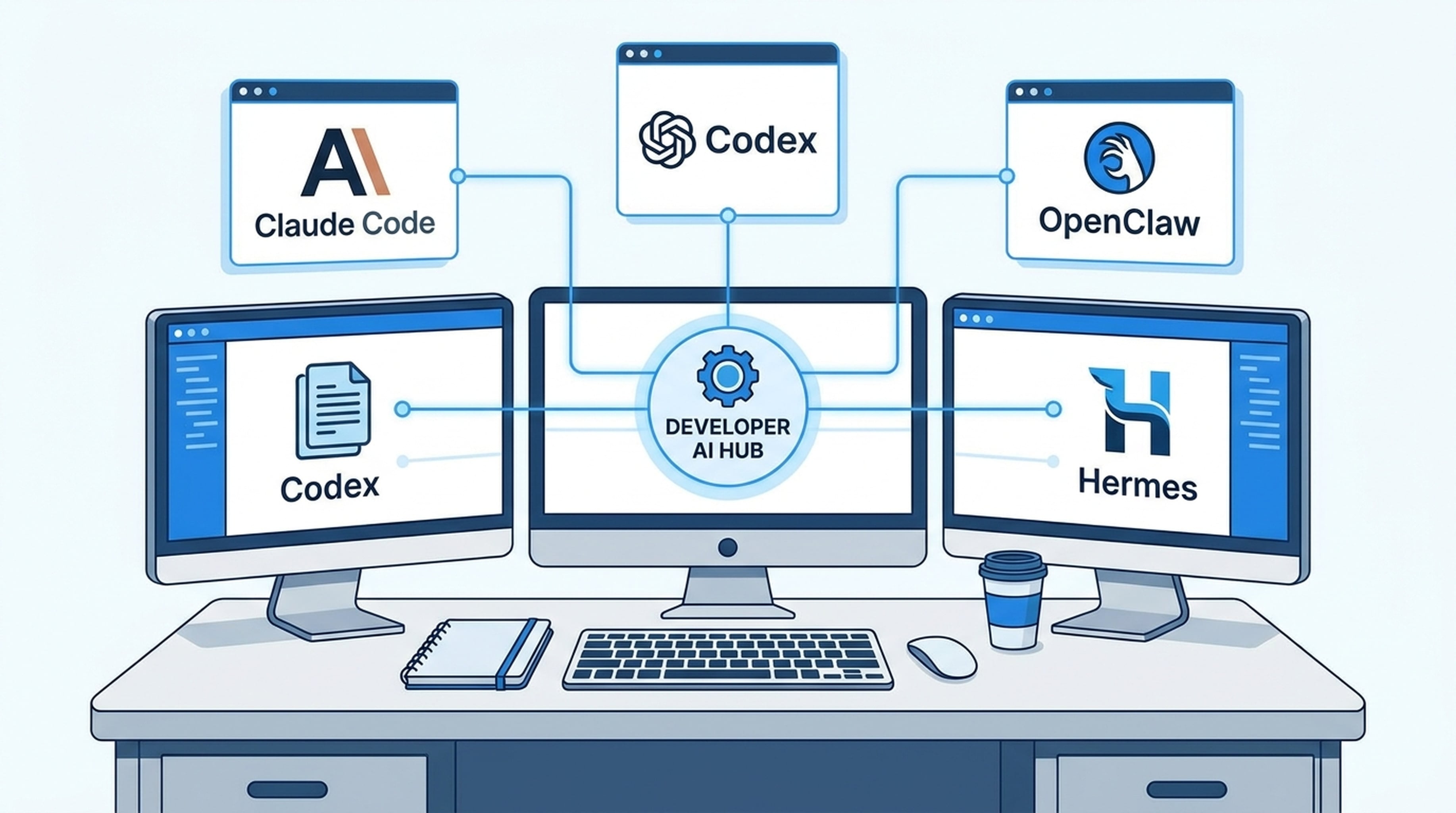
AI coding agents have evolved from code autocomplete to full workflow engines. The best ones don't just write code — they research, test, document, and present.
Here's a comparison of the top AI coding agents and what they need to be truly effective.
Top AI Coding Agents Compared
Claude Code
Strengths: Strong reasoning through Claude Opus 4.8 and Claude Sonnet 4.6. Excellent instruction following. Good at multi-step debugging and architectural decisions.
Best for: Complex code tasks, architectural planning, debugging sessions.
What it needs: Live web search, documentation access, and output generation to go beyond code chat.
Codex
Strengths: Fast code generation with GPT-5.6 Sol and GPT-5.6 Terra. Broad language support. Strong ecosystem compatibility.
Best for: Quick code generation, scaffolding, boilerplate, and multi-language projects.
What it needs: External APIs for research, verification, and deliverable output.
OpenClaw
Strengths: Flexible agent framework. Custom workflows. Strong tool integration support.
Best for: Teams building custom agent workflows and automation pipelines.
What it needs: A comprehensive tool layer — search, memory, output — to reach full potential.
Hermes Agent
Strengths: Purpose-built for automation. Multi-step task execution. Streaming support.
Best for: Automated workflows, scheduled tasks, and batch processing.
What it needs: Access to model APIs and tool APIs through standard protocols.
What All AI Coding Agents Are Missing
Every coding agent faces the same gaps without external APIs:
1. Live Knowledge
Coding agents work from training data. Frameworks change. APIs deprecate. Best practices evolve. Without live search, agents give outdated advice.
Solution: Connect agents to AI Search (POST /v2/chat) and Web Fetch (POST /v2/web/extract) for real-time documentation and best practices.
2. Persistent Memory
Agents forget between sessions. They don't remember what your team decided last week, what architecture was chosen, or what sources were relevant.
Solution: LiveDocs gives agents shared memory — file storage, URL resources, semantic retrieval, and collaboration.
3. Output Beyond Code
Coding agents produce code. But real work also needs:
- Presentations for team meetings
- Documentation pages
- Architecture diagrams
- Campaign materials for product launches
Solution: PPT API (POST /v2/ppts), Landing Page API (POST /v2/landing_page), Mindmap API (POST /v2/mindmap), Image Generation.
4. Cost-Effective Model Access
Strong models cost more. Agents that make many calls per workflow burn through budgets fast.
Solution: Access Claude Opus 4.8, GPT-5.6 Sol, Claude Sonnet 4.6, GPT-5.6 Terra, Claude Haiku 4.5, and Grok 4.5 through one platform at lower rates.
The Tool Stack Every AI Coding Agent Needs
| Tool Category | Purpose | Felo API Endpoint |
|
--------|---------|------------------|
| AI Search | Real-time web search | POST /v2/chat |
| Web Fetch | Page extraction | POST /v2/web/extract |
| X Search | Social signals | POST /v2/x/tweet/search |
| YouTube Subtitles | Video content | GET /v2/youtube/subtitling |
| PPT API | Slide generation | POST /v2/ppts |
| Mindmap API | Visual structure | POST /v2/mindmap |
| Landing Page API | Web page draft | POST /v2/landing_page |
| Image Generation | Visual assets | Image API |
| LiveDocs | Shared memory | LiveDocs CRUD |
AI Coding Agent Workflow Examples
Code Review With Live Documentation
- Agent reads the codebase
- Calls AI Search for latest framework documentation
- Calls Web Fetch to read specific API docs
- Produces a review backed by current best practices
Architecture Presentation
- Agent analyzes the codebase structure
- Generates a mindmap of the architecture (
POST /v2/mindmap) - Calls PPT API to create a presentation (
POST /v2/ppts) - Returns a deck explaining the architecture
Product Launch Documentation
- Agent researches the product and market
- Generates a landing page (
POST /v2/landing_page) - Creates visual assets (Image Generation)
- Produces a launch-ready documentation set
How to Connect Your Agent to the Full Tool Stack
Felo OpenAPI gives all AI coding agents access to the complete tool layer:
- Create your API key
- Open your agent's setup guide
- Configure, verify, and test
AI Coding Agent FAQ
Which AI coding agent is best in 2026?
It depends on your needs. Claude Code for complex reasoning. Codex for fast code generation. OpenClaw for custom workflows. Hermes Agent for automation. All are strong — the differentiator is the tool stack you connect them to.
Can AI coding agents access live documentation?
Yes, when connected to a search API. Felo OpenAPI provides AI Search (POST /v2/chat) and Web Fetch (POST /v2/web/extract) for real-time documentation access.
How much does it cost to run an AI coding agent?
Model costs vary. Through Felo OpenAPI, you can use Claude Haiku 4.5 for simple tasks (lowest cost), Claude Sonnet 4.6 or GPT-5.6 Terra for general work, and Claude Opus 4.8 or GPT-5.6 Sol for complex reasoning (premium cost).
Can I use multiple coding agents together?
Yes. Each agent can connect to Felo OpenAPI through the same API key, sharing access to models, tools, and LiveDocs memory.
Getting Started
Your coding agent knows how to write code. Give it the tools to do the rest.