Claude Opus 5 Now on Felo: Features, Pricing & 7-Day Free Trial

Felo now supports Claude Opus 5. Explore features, benchmarks, safety, and pricing, then try Anthropic's agentic coding model free for 7 days.
Felo now supports Claude Opus 5, Anthropic's new Opus-tier model for agentic coding, professional analysis, and long-running work. Choose it in Felo when a task needs more than a strong first answer: it needs research, verification, iteration, and a result you can confidently review.
To mark the launch, Felo Pro subscribers can use Claude Opus 5 at no additional cost for seven days beginning on its release date. Bring it a stubborn bug, a research brief with conflicting evidence, a multi-step analysis, or a document that needs more than one pass to get right—and judge it on work that actually matters to you.
Cover image: original artwork from Anthropic's Claude Opus 5 announcement. The visual content is unchanged; Felo added only the gray border.
This is more than a release note. Below is a visual guide to what Opus 5 is designed for, what Anthropic reports in its evaluations, where its limits remain, and how to test it with real work in Felo.
Ready to test it? Start your 7-day Claude Opus 5 trial in Felo ->
Claude Opus 5 features: what the model is built to do
Anthropic released Claude Opus 5 on July 24, 2026, positioning it as an everyday high-capability model for long-running agents, software engineering, and professional knowledge work. In Anthropic's own description, the key change is not simply a better first response. Opus 5 is intended to work more deliberately: verify intermediate results, preserve the thread of a complex task, and iterate when the first attempt does not solve the real problem.
That distinction matters in practical work. A routine question may only need a fast, concise answer. A larger assignment may require the model to read source material, decide what it still needs to know, run a calculation or tool, compare alternatives, check its output, and explain the result. Those are the cases where an Opus-tier model is most worth selecting.
Anthropic highlights three overlapping strengths:
- Agentic coding: larger features, difficult debugging, root-cause analysis, refactors, and tasks that span more than one file or tool.
- Knowledge work and analysis: structured reasoning over dense material, numerical and table work, due diligence, research, and decision support.
- Computer-use and automation workflows: completing a sequence of steps rather than producing a single isolated answer.
None of these claims mean a model should be left unchecked. They do mean that it can take on a more complete draft of difficult work before a person reviews the decision, evidence, and final action.
Claude Opus 5 benchmarks and capabilities
Model benchmarks are useful signals, not a guarantee that a model will perform the same way in every project. They depend on the task, harness, settings, and scoring method. Still, Anthropic's release gives a helpful picture of the problems Opus 5 targets.
For software engineering, Anthropic reports that Opus 5 leads its internal run of Frontier-Bench v0.1 and more than doubles the reported performance of Opus 4.8 at a lower cost per task. The chart below is useful because it makes the trade-off concrete: the orange Opus 5 series rises above prior Opus results across its effort settings, rather than only at its most expensive point.
Source: Anthropic, Introducing Claude Opus 5. Original chart shown unchanged; gray border added by Felo. The chart notes that the Frontier-Bench run used a mini-SWE-agent harness, GKE backend, and mean reward over five attempts per task.
On CursorBench 3.2, Anthropic says the model comes within 0.5% of Claude Fable 5's peak score at maximum effort, while costing half as much per task. That is why Opus 5 is most interesting for tasks where a low-quality first attempt creates more work: debugging across a codebase, building an end-to-end feature, or tracing the root cause rather than patching the symptom.
For broader problem solving and office-style work, the company reports that Opus 5:
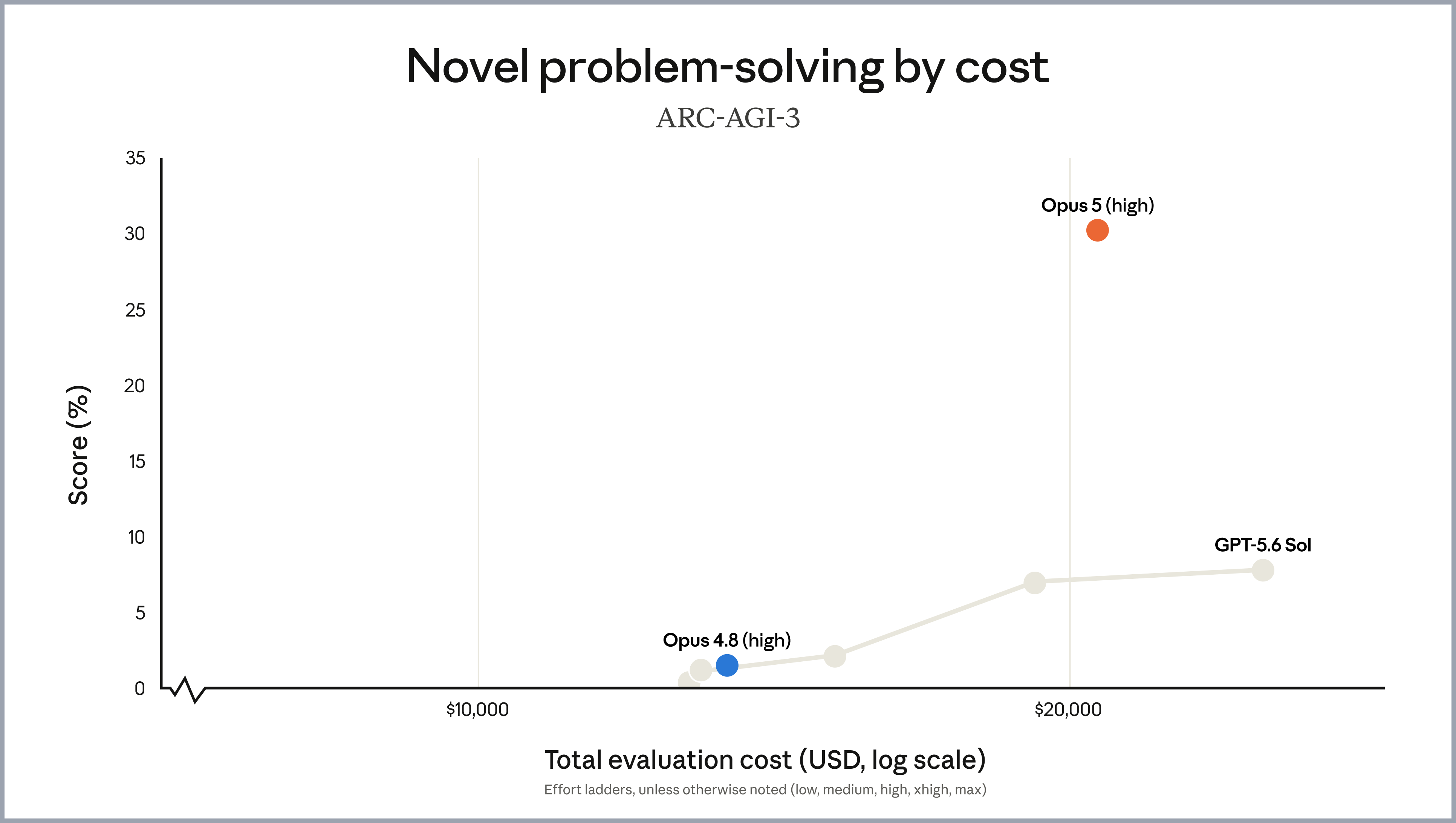
- scored three times higher than the next-best model on ARC-AGI 3, an evaluation of novel problem solving;
- achieved about 1.5 times the next-best pass rate at the same cost per task on Zapier AutomationBench, which tests end-to-end business automation;
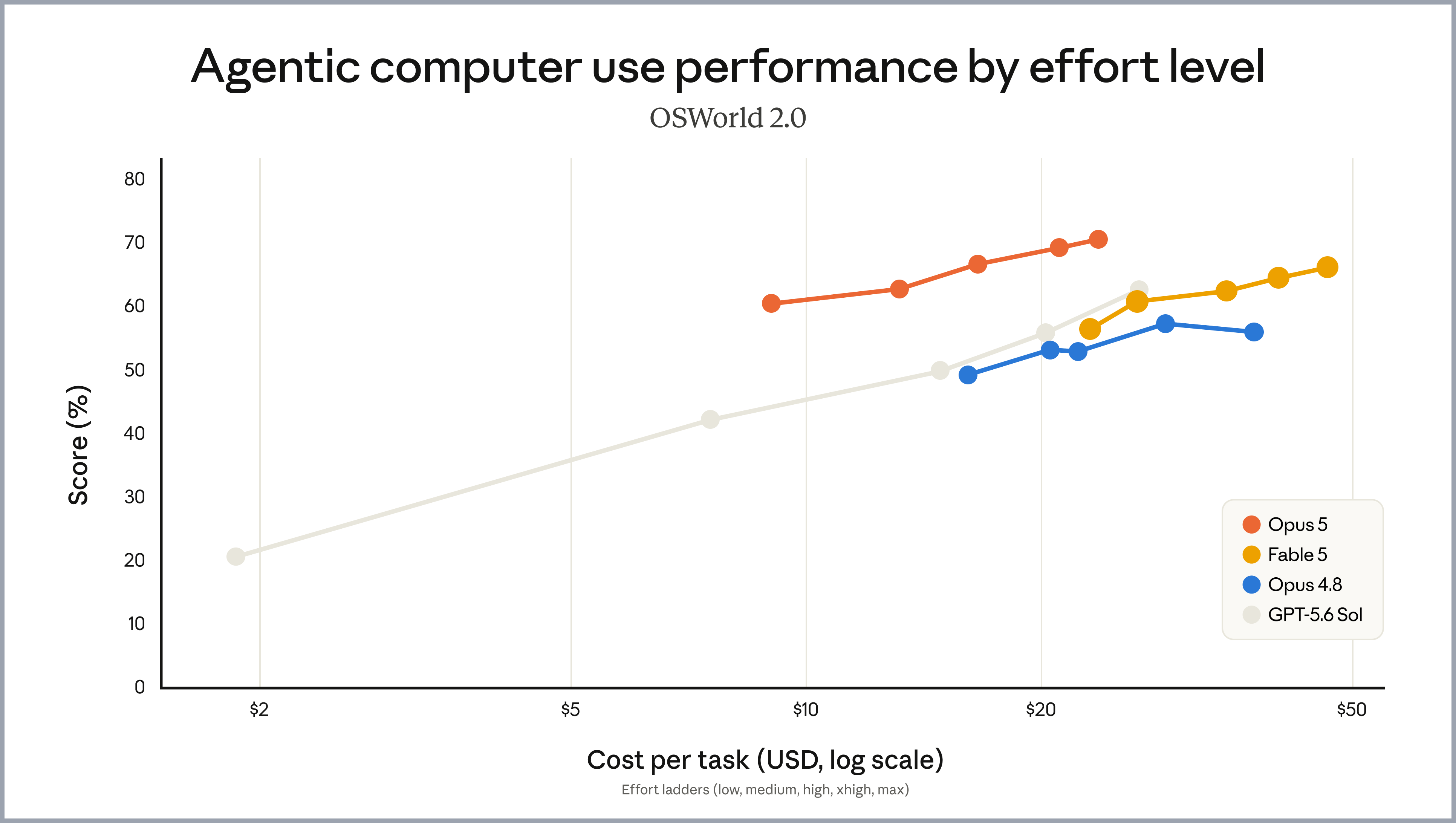
- outperformed other models at comparable cost on OSWorld 2.0, a computer-use benchmark; and
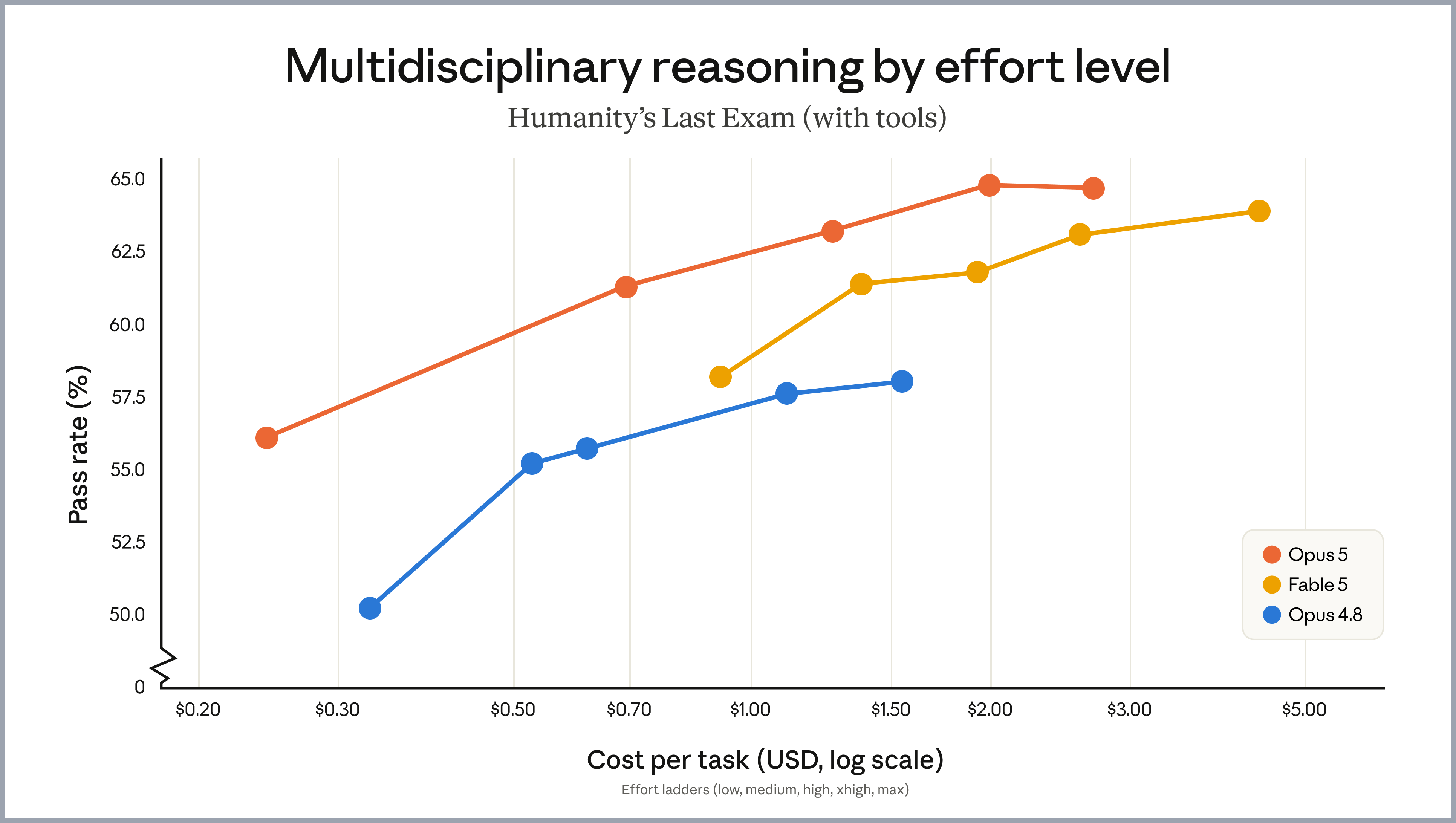
- is its best and most cost-efficient model across the related ARC-AGI 3, GDPval-AA v2, HLE, AutomationBench, and DeepSearchQA evaluations.
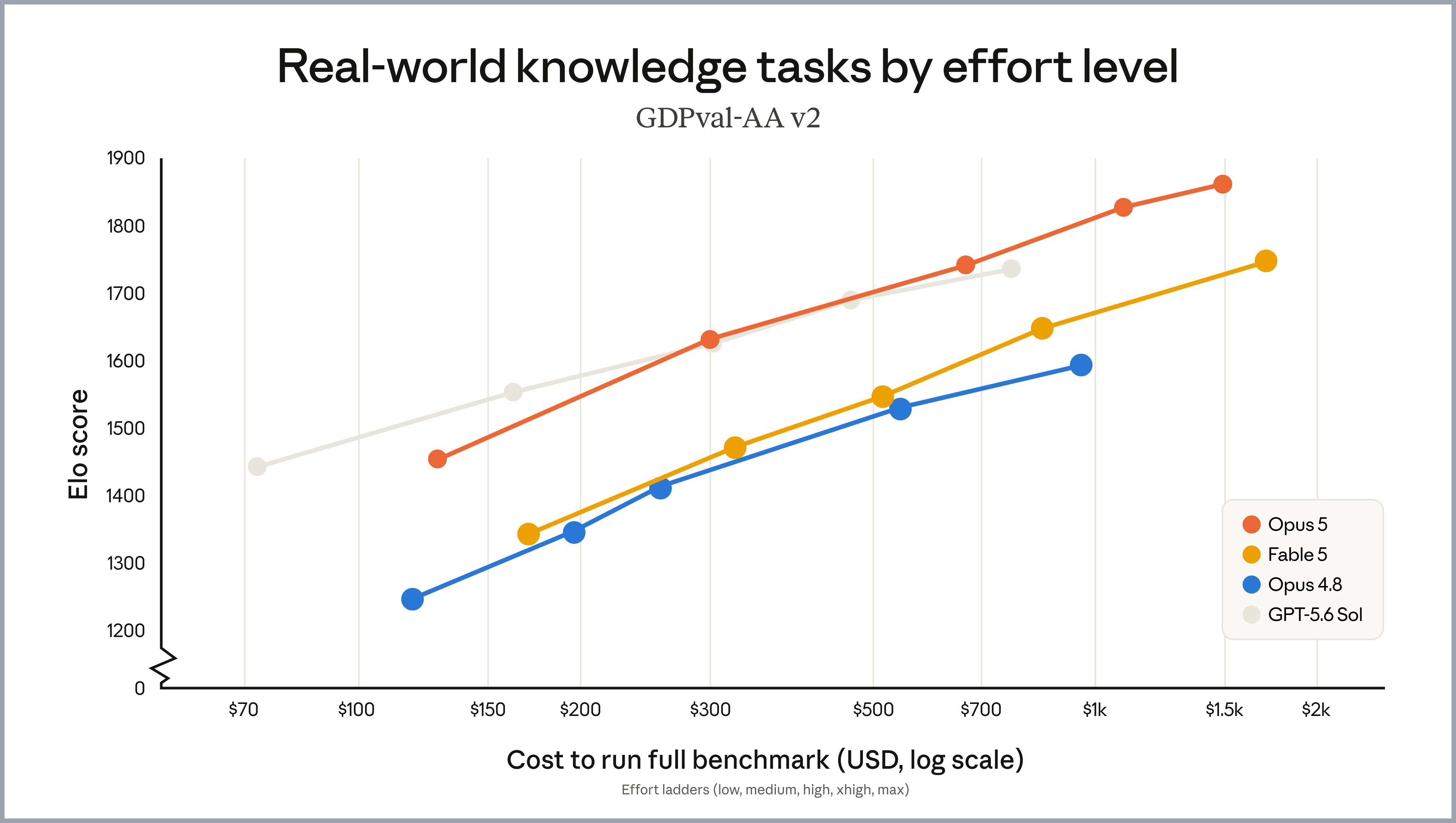
The picture is not limited to code. Anthropic's GDPval-AA v2 chart tracks real-world knowledge tasks across different effort levels. It helps explain why Opus 5 can be relevant to research, finance, legal, operations, and other work where an answer needs to hold up through review, rather than merely read well on the first pass.
Source: Anthropic, Introducing Claude Opus 5. Original chart shown unchanged; gray border added by Felo.
These are Anthropic-published results, including internal evaluation runs and selected early-access feedback, rather than independent universal rankings. The most productive way to read them is as a guide to where to test the model yourself: tasks with long dependency chains, ambiguous requirements, tool use, verification, and meaningful consequences if a shallow answer slips through.
Claude Opus 5 features: why “effort” changes the experience
Opus 5 supports different effort settings. Put simply, effort gives you a way to trade response speed and token use against additional reasoning time. Anthropic's charts compare the model at several effort levels, from lower-effort settings designed to conserve tokens through high, xhigh, and maximum effort.
This is useful because not every request deserves the same budget. Use a lower setting for a quick classification, an outline, or a narrow revision. Increase effort when the assignment has multiple constraints, when the model must reconcile sources, or when it must diagnose why an earlier attempt failed. For high-stakes output, spend the saved time on a review step too: ask the model to identify assumptions, cite its sources, test edge cases, or explain what would change its recommendation.
The launch also introduces an optional Fast mode through Anthropic's own platform. Anthropic says it runs at roughly 2.5 times the standard speed and costs twice the base rate there. Availability and controls can vary by product surface, so in Felo you should use the settings shown in your workspace rather than assuming every Anthropic option appears in the same form.
The difference shows up in how it checks itself
The release's most interesting theme is verification. Anthropic describes an evaluation in which Opus 5 received a drawing of a machine part but had no direct way to view it. Instead of stopping there, the model reportedly wrote a computer-vision pipeline to recover geometry from raw pixels, then rebuilt the part as a 3D FreeCAD model. In another example, Anthropic says the model found the root cause of a real package-manager bug and addressed an edge case missed by a community patch.
Examples like these should be treated as demonstrations from the model maker, not as promises. But they suggest a concrete prompting pattern for Felo: do not only ask for the answer. Ask for the work loop.
Investigate the issue, then propose a fix.
Before finalizing, verify the fix against the stated requirements,
list any assumptions, and identify tests or evidence that could disprove it.
Return the final recommendation separately from the working notes.
For research, the same approach can turn a broad prompt into a reviewable process: gather current sources, distinguish facts from inferences, look for counterevidence, and produce a concise decision brief. Felo's multilingual workflow is especially helpful when relevant material appears across languages; ask for the source language to be preserved alongside a clear English synthesis when needed.
Anthropic also reports strong results on OSWorld 2.0, a benchmark for operating a computer through multi-step interfaces. This is a useful reminder that agentic work is often not “one prompt, one answer.” It is a sequence of checking state, choosing the next action, and validating whether the result actually meets the goal.
Source: Anthropic, Introducing Claude Opus 5. Original chart shown unchanged; gray border added by Felo.
Performance is not the only consideration: safety and limits
Anthropic reports that its pre-deployment behavioral audit found Opus 5 to be its most aligned recent model. It says the model showed lower overall misaligned behavior, lower deceptive behavior, and greater resistance to misuse prompts than several other recent Claude models. The company also says Opus 5 does not extend the frontier of risky dual-use capabilities in its biology and offensive-cybersecurity testing.
The following audit chart is the clearest visual summary of that claim. On Anthropic's 1-10 misaligned-behavior scale, lower is better; Opus 5 is shown at 2.30, below the other recent models in the comparison. It is an internal safety evaluation, so it should inform—not replace—careful human controls around consequential work.
Source: Anthropic, Introducing Claude Opus 5. Original chart shown unchanged; gray border added by Felo.
The important practical point is that safeguards remain part of the product. Anthropic says Opus 5 can help find vulnerabilities in source code but places stronger guardrails around certain cyber activities, including binary-based vulnerability scanning, penetration testing, and exploit generation. Requests that trigger those safeguards may be blocked or, in some Anthropic products, fall back to another model.
For all other work, keep the same good habits you would use with any capable model:
- Review factual claims, calculations, citations, code, and final actions before relying on them.
- Do not treat fluency as evidence. Ask for primary sources and inspect them.
- Keep a human responsible for legal, financial, medical, security, and other consequential decisions.
- Give the model a clear success condition and the boundaries it must not cross.
Anthropic also notes that Opus 5 still has important limitations on long-running autonomous research tasks. Capability is not autonomy, and a well-designed human review loop remains part of a strong workflow.
Claude Opus 5 pricing and the Felo free trial
Anthropic lists Claude Opus 5 at $5 per million input tokens and $25 per million output tokens through the Claude API, the same base rates it lists for Opus 4.8. Pricing on third-party platforms, subscriptions, and features can differ, so use the pricing and usage information shown in the product where you work.
For Felo Pro subscribers, the immediate point is simpler: Claude Opus 5 is free to try for seven days from its release. That lets you evaluate it with real assignments before deciding where it belongs in your regular model mix. A sensible comparison is not just “Which model wrote the nicest first draft?” Try the same difficult task with the model you use today, then compare completeness, error rate, need for follow-up, quality of source handling, and how much review time each result needs.
How to try Claude Opus 5 free for 7 days in Felo Pro
- Sign in to your Felo Pro account.
- Start a new task in the Felo workspace you normally use for research, writing, analysis, or agentic work.
- Select Claude Opus 5 in the model picker.
- Give it a task with a clear deliverable, relevant files or context, and an explicit verification step.
- Review the result, refine the instruction where needed, and compare it with your current workflow during the seven-day launch offer.
Start with work that reveals the model's strengths: a project plan that requires trade-offs, a complex spreadsheet or report, a difficult code review, a multi-source research question, or an analysis that must survive follow-up questions. The aim is not to make a model look impressive with a clever prompt. It is to find out whether it makes your real work clearer, more reliable, and easier to finish.
Use the offer on a task that matters: Start your Claude Opus 5 trial in Felo ->
Is Claude Opus 5 worth trying?
Claude Opus 5 brings a new option to Felo for tasks that reward persistence, careful reasoning, and verification. Its published results point to meaningful progress in agentic coding, automation, computer use, and professional analysis, while its safety constraints and limitations remain important context.
For the next seven days, Felo Pro subscribers can assess it without an additional model charge. Bring a task that genuinely matters, ask it to show and check its work, and decide from the result whether Claude Opus 5 earns a permanent place in your workflow.
Start your 7-day Claude Opus 5 trial in Felo ->
Sources and further reading
- Anthropic, "Introducing Claude Opus 5", July 24, 2026.
- Anthropic, "Prompting Claude Opus 5".
- Anthropic, Claude Platform pricing.