Claude Opus vs Sonnet for Coding: Which Model Should You Use?

Opus and Sonnet power Claude Code differently. This guide compares speed, reasoning, cost, and real coding performance to help you pick the right model for your tasks.
Claude Code lets you switch between Opus and Sonnet mid-session. Most developers pick one and never think about it again. That is a mistake — the two models have meaningfully different strengths, and using the wrong one for a task costs you either money or quality.
Opus is the larger, more capable model. Sonnet is faster and cheaper. But "more capable" and "faster" mean different things depending on what you are asking the model to do. A 200-line refactor and a quick variable rename do not need the same brain.
This guide breaks down when each model actually matters, based on real coding tasks — not abstract benchmarks.
The Quick Answer
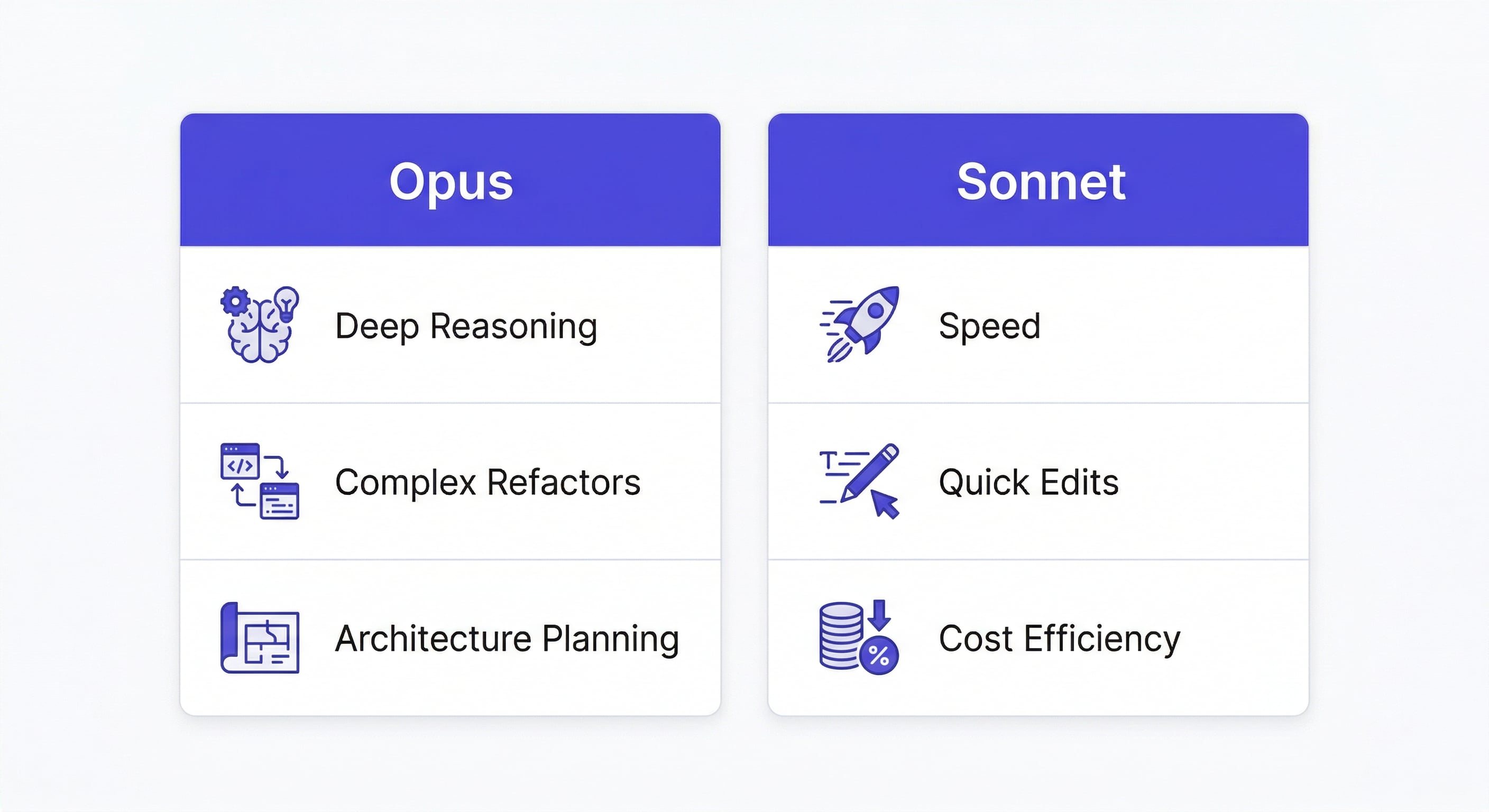
For most daily coding work — writing functions, fixing bugs, generating tests — Sonnet is the better default. It is fast, cheap, and good enough for 80% of tasks.
Switch to Opus when the task requires multi-step reasoning: large refactors across many files, architectural decisions, debugging complex race conditions, or understanding unfamiliar codebases. Opus makes fewer mistakes on tasks where getting it wrong means redoing significant work.
The practical rule: start with Sonnet. If the output is not good enough, switch to Opus for that specific task. Do not pay Opus prices for Sonnet-level work.
Speed and Latency
Sonnet responds noticeably faster. For interactive coding — where you ask a question, read the answer, and ask a follow-up — the speed difference changes how you work. Sonnet feels like a conversation. Opus feels like waiting for a colleague to think.
In Claude Code specifically, the latency difference compounds. A multi-file edit that requires 5 back-and-forth tool calls takes meaningfully longer with Opus. If the task is straightforward (and most are), Sonnet finishes while Opus is still processing the second step.
Where Opus speed is acceptable: tasks where you fire off a request and go do something else. "Refactor the entire auth module" is a 3-minute wait regardless — the difference between 3 minutes and 4 minutes does not matter.
Where Sonnet speed matters: rapid iteration. Writing code, testing it, adjusting, testing again. The tight feedback loop breaks when each response takes 15 seconds instead of 5.
Reasoning and Accuracy
This is where Opus earns its cost. On tasks that require holding multiple constraints in mind simultaneously, Opus makes fewer errors.
Examples where Opus outperforms Sonnet:
- Refactoring a function that is called in 12 places with different argument patterns. Opus tracks all the call sites. Sonnet occasionally misses edge cases.
- Debugging a race condition that involves three async processes. Opus reasons through the timing. Sonnet tends to suggest fixes that address symptoms rather than root causes.
- Planning a migration from one database schema to another. Opus considers the data transformation, the rollback strategy, and the application code changes together. Sonnet handles them sequentially and sometimes contradicts itself.
Examples where Sonnet matches Opus:
- Writing a new React component from a description. Both produce equivalent code.
- Generating unit tests for a pure function. The logic is straightforward enough that both get it right.
- Fixing a typo, updating a dependency version, adding a field to a form. Opus is overkill.
The pattern: if you can describe the task in one sentence and the solution is obvious to a senior developer, Sonnet is fine. If the task requires a paragraph to explain and the solution involves tradeoffs, Opus is worth the cost.
Cost Comparison
Opus costs roughly 5x more than Sonnet per token. In Claude Code, where the model reads your codebase and generates multi-file edits, token usage adds up fast.
A typical 30-minute coding session with Claude Code might use:
- Sonnet: $0.50–$2.00 depending on codebase size and task complexity
- Opus: $2.50–$10.00 for the same session
On the Max plan ($100/month or $200/month), you get higher usage limits that absorb most of this. On the Pro plan ($20/month), heavy Opus usage hits the ceiling quickly.
The cost-effective approach: use Sonnet as your default model. Switch to Opus for specific tasks where you have already tried Sonnet and the output was not good enough, or where you know upfront the task requires deep reasoning.
Claude Code makes this easy — you can switch models mid-session with /model.
Context Window and Memory
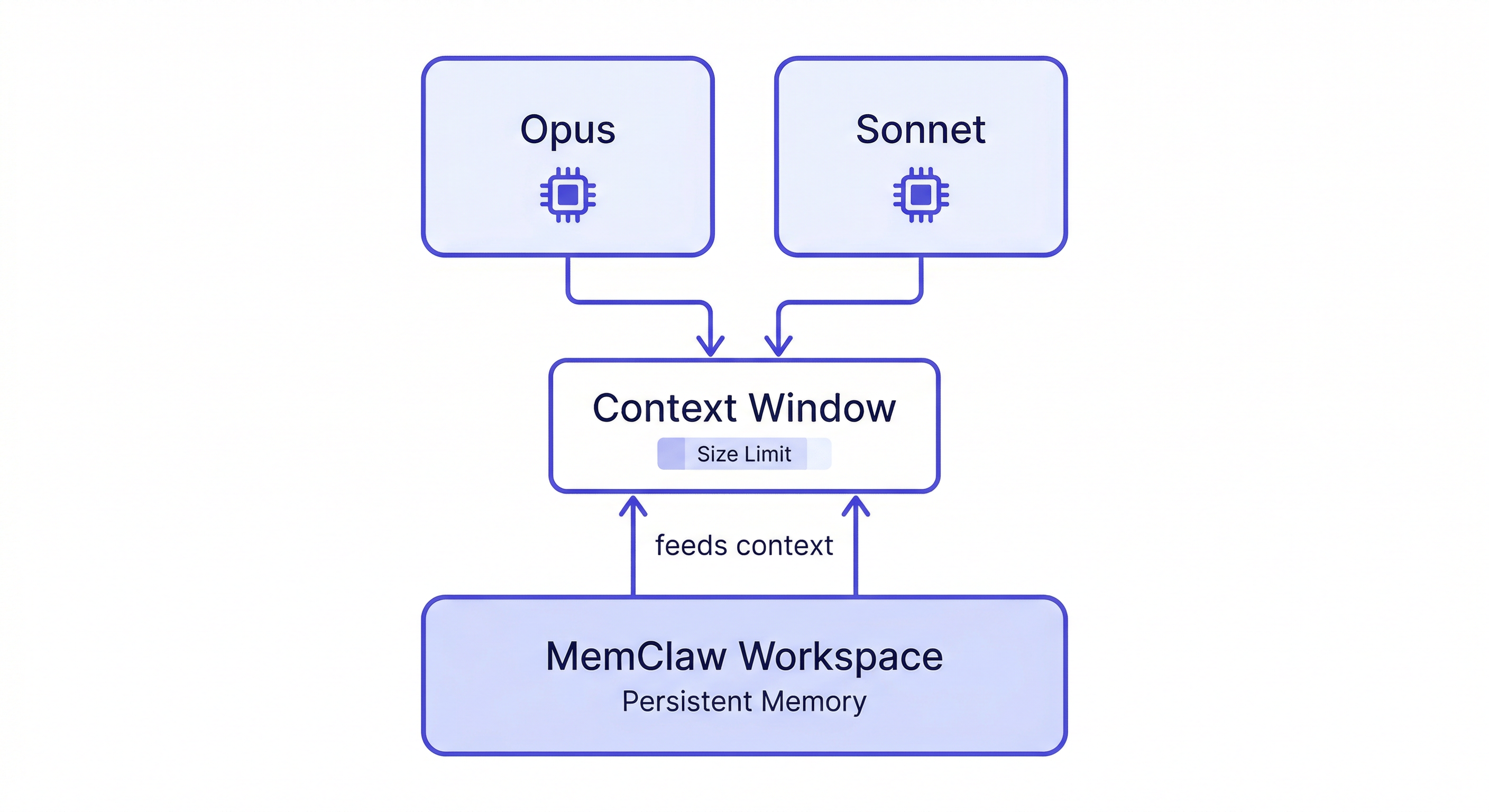
Both Opus and Sonnet share the same context window size in Claude Code. The model you choose does not change how much of your codebase fits in context.
This matters because the biggest limitation in AI-assisted coding is not model intelligence — it is context. A brilliant model that cannot see the relevant code is worse than a good model that has full context.
Both models lose all context between sessions. Your architecture decisions, coding conventions, and project history disappear when you close the terminal. This is true for Opus and Sonnet equally.
Persistent memory tools like MemClaw address this by storing project context in workspaces that load automatically at session start. The model gets your full project context in 8 seconds regardless of whether you are running Opus or Sonnet. claude-code-memory
In practice, good context management matters more than model selection for most coding tasks. A Sonnet session with full project context outperforms an Opus session where you spend the first 10 minutes re-explaining your codebase.
When to Switch Models
Build this into your workflow:
Stay on Sonnet for:
- Writing new code from clear specifications
- Bug fixes where you know the cause
- Test generation
- Documentation
- Small refactors (single file, clear scope)
- Code review and explanation
Switch to Opus for:
- Multi-file refactors with complex dependencies
- Architectural planning and design decisions
- Debugging issues you cannot reproduce or explain
- Migrating between frameworks or major versions
- Security audits and vulnerability analysis
- Understanding unfamiliar, poorly documented codebases
The switching cost is zero. Claude Code preserves your session context when you change models. You do not lose anything by starting with Sonnet and escalating to Opus.
The Real Bottleneck Is Not the Model
Developers spend hours debating Opus vs Sonnet. The actual productivity bottleneck for most teams is not model quality — it is context loss.
Every session starts from zero. Every project switch requires re-explanation. Every Monday morning means re-teaching the AI what you spent Friday building. This problem is identical whether you run Opus or Sonnet.
Solving context persistence — through project workspaces, session history, and structured memory — delivers a larger productivity gain than upgrading from Sonnet to Opus. The model matters. The context matters more.
Add persistent project memory to Claude Code → memclaw.me
export FELO_API_KEY="your-api-key-here"
/plugin marketplace add Felo-Inc/memclaw
/plugin install memclaw@memclaw
claude-code-vs-cursor | claude-code-hooks-guide | claude-code-context-window