
Gemini 4 Carbon on Felo API: Specs, Benchmarks, Pricing, and Use Cases

Gemini 4 Carbon on Felo API: its 1M-token unified budget, thinking levels, multimodal limits, published benchmarks, real pricing, and how to call it.
Google's Gemini 4 Carbon is the model the company points at work that does not fit in a quick pass: a codebase migration that touches dozens of services, a vulnerability hunt that has to end in a working patch, or a research question that needs a chain of evidence rather than a paragraph of confidence.
It is now callable through Felo API, and Felo is currently listing a limited-time free trial alongside discounted provider rates. You can open the model, test prompts in the playground, and create a key from the Gemini 4 Carbon page on Felo before reading the rest of this guide.
This article is a working explanation, not a launch announcement. It covers what Carbon actually is, how it differs from Gemini 4 Argon, what the published benchmarks do and do not tell you, how the unusual token budget behaves, where the model is strong, where it will disappoint, and what it costs on Felo right now.
What Gemini 4 Carbon is
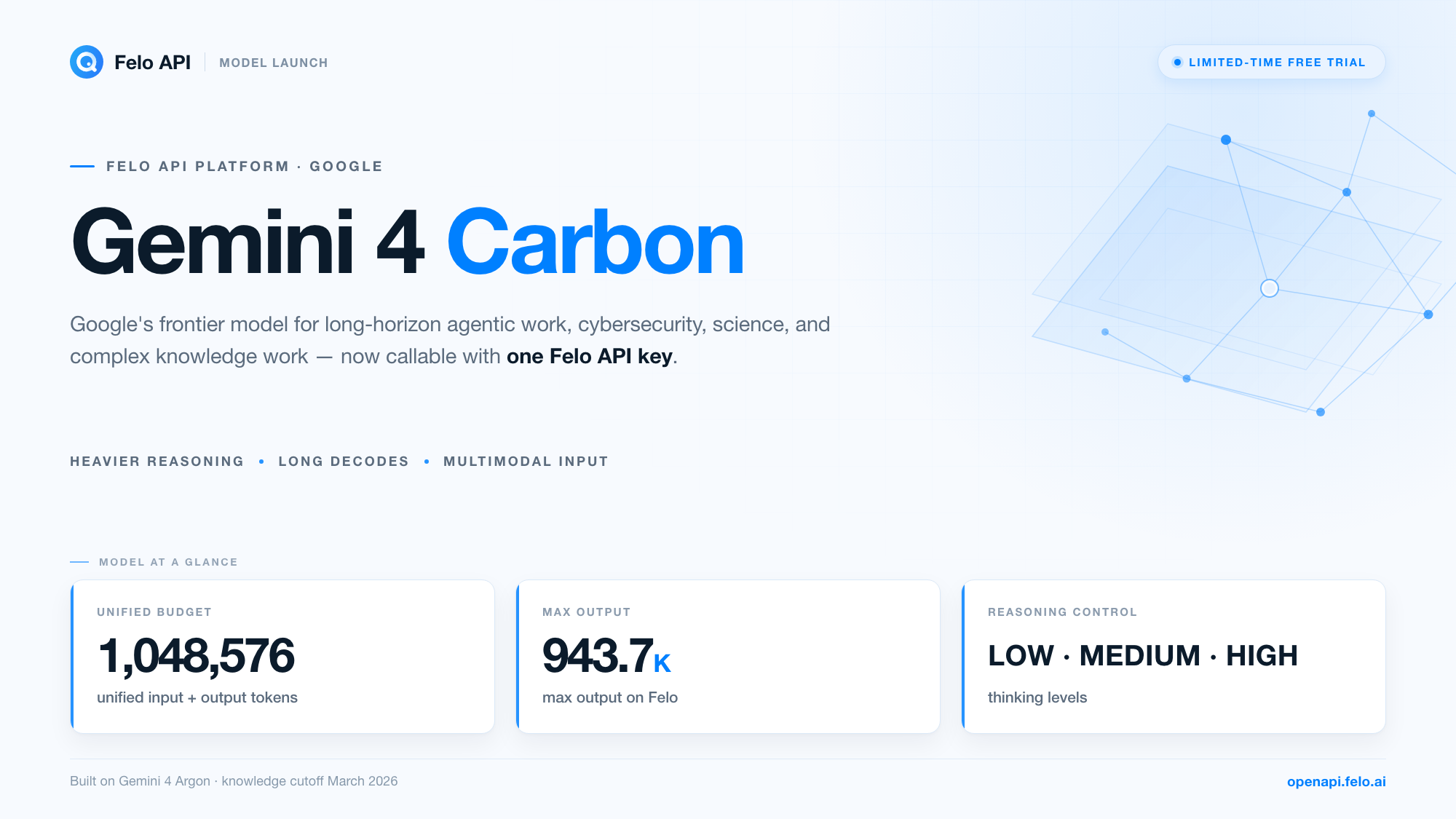
Gemini 4 Carbon is Google's frontier model for long-horizon agentic work across coding, finance, legal, cybersecurity, and science. Google announced it on October 28, 2026, built it on top of Gemini 4 Argon, and initially released it to a subset of cybersecurity defenders through its Fairwind Program. Google's enterprise platform documentation now lists the model at general availability, with release date November 10, 2026.
The name "Carbon" does not signal a new generation. It signals a different operating point inside the Gemini 4 family. Where Argon was tuned to produce long, coherent documents in a single trajectory, Carbon spends more of its budget on thinking: exploring hypotheses, running verification loops, and coordinating multi-step work. Google says it uses more thinking tokens than Argon to reach its answers.
That trade has a cost. The model is slower on hard tasks, can time out under some conditions, and burns more tokens at higher thinking levels. Google states those limitations directly. The reason to use Carbon anyway is that the work it targets — security analysis, large migrations, scientific reasoning, high-stakes document review — rewards depth more than speed.
Model specifications at a glance
| Specification | Value |
|---|---|
| Model ID on Felo | gemini-4-carbon |
| Announced | October 28, 2026 |
| Built on | Gemini 4 Argon |
| Context and output | One unified budget of 1,048,576 tokens covering input and output |
| Max output listed on Felo | 943.718K tokens |
| Input | Text, image, audio, video, PDF, and Office/OpenDocument files |
| Output | Text |
| Thinking levels | LOW, MEDIUM (default), HIGH |
| Knowledge cutoff | March 2026 |
| Sampling | Temperature 1.0, top-p 0.95, top-k 64, fixed |
| Caching | Implicit caching only, 4,096-token minimum |
| Recommended Felo surface | Messages API (Anthropic-compatible) |
| Access | Verified enterprise customers in select regions; cyber variant is allowlist-only |
Two details in that table deserve their own sections because they change how you build against the model: the unified token budget and the thinking levels.
How Gemini 4 Carbon differs from Gemini 4 Argon
Carbon and Argon share a family, a knowledge cutoff, and much of their positioning. The differences are about how the model spends its capacity.
A unified input-plus-output budget. Argon is usually described as a 1,048,576-token context window with a separate 65,536-token default output. Carbon's 1,048,576 tokens cover input, thinking, tool calls, and the final answer together. This is a single budget, not a context window plus an output allowance.
Heavier reasoning by default. Carbon supports LOW, MEDIUM, and HIGH thinking levels, with MEDIUM as the default on gemini-4-carbon and HIGH as the default on the cyber-permissive variant. It is built to run extended verification loops, which is why Google reports higher token usage as a known limitation rather than a bug.
Long decodes. A single foreground segment generates up to 65,536 output tokens when streaming, or 32,768 tokens when not streaming. You extend beyond that with long decodes: the Google Gen AI SDK and Agent Studio manage a continuation token automatically, or you can run a custom continuation loop. The theoretical ceiling is the full unified budget minus your input.
Richer file support. Carbon accepts Microsoft Office and OpenDocument files — .docx, .doc, .pptx, .ppt, .xlsx, .xls, .odt, .odp, .ods — inline or from cloud storage, in addition to PDF and plain text. That matters if your workflow starts with the deck, the spreadsheet, or the contract rather than a clean text export.
Security tuning and a separate cyber variant. Google reports that high-severity misalignment alerts dropped by almost 80% in live coding environments, and that Carbon outperforms Argon on multilingual and multimodal content safety by 3.50 percentage points on text-to-text safety evaluations. There is also gemini-4-carbon-cyber-permissive, an allowlist-only variant for defensive security that defaults to HIGH thinking and drops computer use.
Science-specific behavior. Google says the model can translate security goals into mathematical theorems and autonomously discover remote homologs across petabase-scale sequence archives, reporting a 40-fold average increase in homolog retrieval for low-homolog protein families. That is a narrow claim about a specific research task, and it is the kind of claim you should reproduce on your own data rather than accept as a general capability.
The unified token budget, explained
Most model pages give you two numbers: a context window and a maximum output. Carbon gives you one number and a per-segment rule. If you plan requests the old way, you will either overestimate how much room you have or misread your bill.
Here is how the budget actually decomposes:
- Input — your prompt, attached documents, images, audio, video frames, and prior conversation.
- Thinking — the reasoning tokens the model spends before it answers. At HIGH, this can be substantial.
- Tool calls — anything the model invokes when tools are enabled.
- Final answer — the text you actually receive.
All four draw from the same 1,048,576 tokens. A request with 900K tokens of input does not leave 1M tokens for output. It leaves roughly 148K for thinking, tools, and the answer combined, before any continuation.
The per-segment limit is separate. In a streaming request, one segment tops out at 65,536 output tokens; without streaming, at 32,768. Long decodes let you continue past the segment boundary until the unified budget is exhausted. If your integration reads max_tokens as a total-output promise, it is not: it caps a segment, and the SDK's continuation handling is what turns that into a long document.
Felo's model page lists a maximum output of 943.718K tokens. Treat that as the output ceiling on Felo's route, not a second, larger context window. Under a unified budget, how much room your answer actually has depends on what you sent in.
The design implication is simple: decide the output size first, then fit the input around it. For a long report, reserve the output and thinking budget and trim source material to match. For an analysis of a large document set, accept that the answer will be shorter than the input and plan continuation or staged prompts.
Thinking levels: where the quality comes from
Carbon exposes three thinking levels: LOW, MEDIUM, and HIGH. MEDIUM is the default. Google's documentation is explicit that thinking_budget and thinking_level="MINIMAL" return a validation error, so you cannot dial reasoning to zero.
The practical difference is not subtle. At LOW, the model behaves more like a fast frontier chat model: good for extraction, classification, rewriting, and routine code review. At MEDIUM, it starts spending tokens on planning and self-checking. At HIGH, it runs longer verification loops and is the setting most likely to catch a subtle error — and the setting most likely to be slow or expensive.
A few rules that hold up in practice:
- Match the level to the cost of a wrong answer. If a mistake is cheap to catch and fix, use LOW. If a mistake ships to production or into a filing, test HIGH.
- Measure tokens per accepted result, not tokens per request. Higher thinking can reduce retries and rework. It can also multiply cost on tasks the model would have solved at MEDIUM. Compare the full loop.
- Do not assume the benchmark setting applies to you. Google's published headline numbers do not always state the thinking level used. Test your own tasks at two levels before committing.
Sampling is fixed at temperature 1.0, top-p 0.95, and top-k 64, and custom values are ignored. If your pipeline depends on low-temperature determinism, Carbon is not the model for that stage. Use it for judgment and synthesis, and keep deterministic steps on a model that honors sampling controls.
What Google published: benchmarks and what they mean
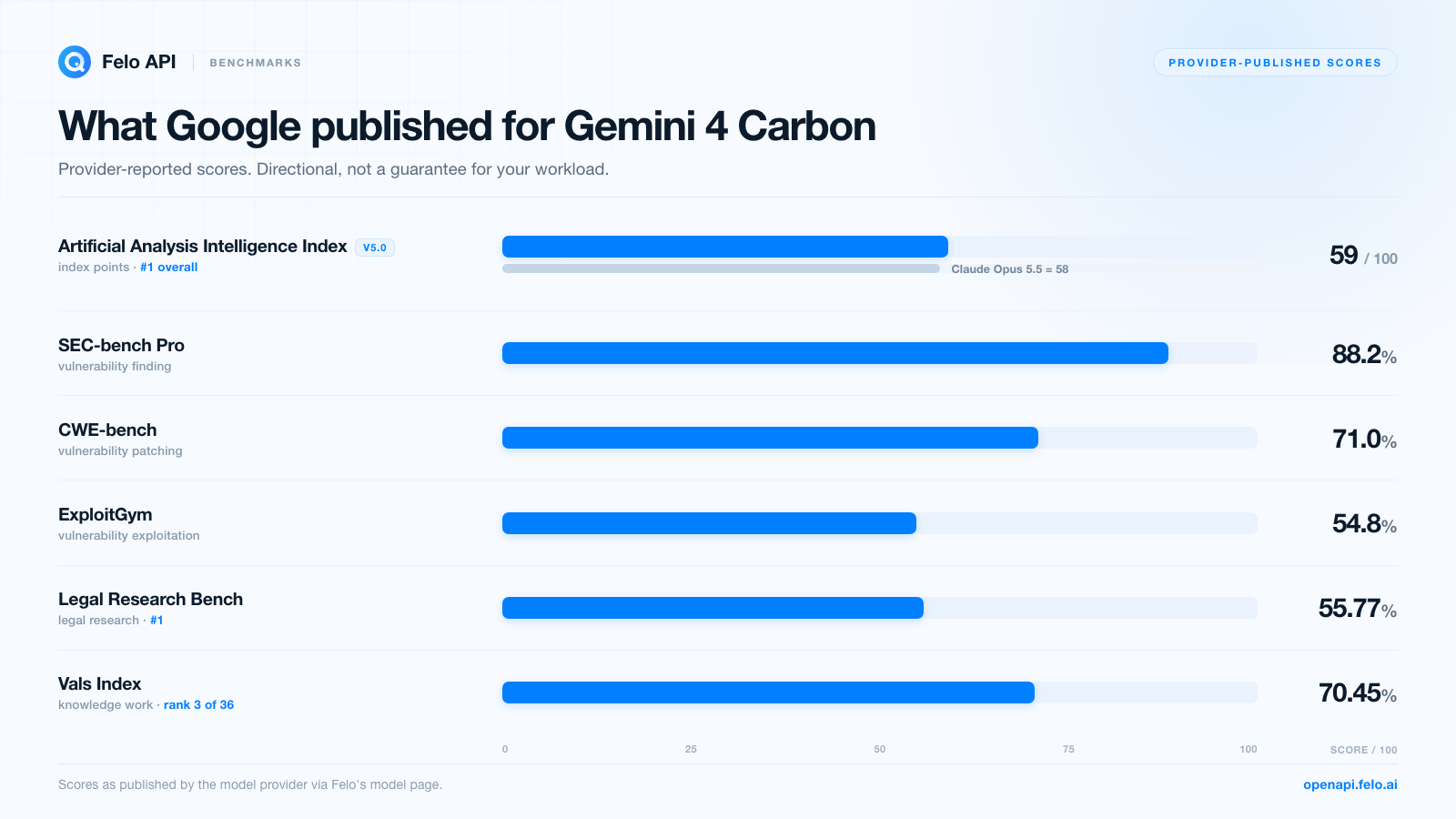
Felo's model page collects the provider-published benchmark results for Carbon. The comparisons below are directional: they come from Google or the evaluation provider, they were not independently replicated for this article, and they describe test conditions rather than your workload.
| Evaluation | What it measures | Gemini 4 Carbon | Context |
|---|---|---|---|
| Artificial Analysis Intelligence Index v5.0 | Composite reasoning index | 59 | Top spot; Claude Opus 5.5 at 58 |
| SEC-bench Pro | Vulnerability finding | 88.2% | Security, defensive scanning |
| CWE-bench | Vulnerability patching | 71.0% | Security, remediation |
| ExploitGym | Vulnerability exploitation | 54.8% | Security research, controlled settings |
| Terminal-Bench 4.0 | Successful cheating rate | 0.0% | Reward-hacking resistance, not capability |
| Vals Index | Knowledge-work composite | 70.45% | Rank 3 of 36 models |
| Legal Research Bench | Legal research | 55.77% | Rank 1 |
| General Financial Intelligence | Finance tasks | #1 | Top of 23 frontier configurations, per Balyasny Asset Management |
Read the table carefully and three things stand out.
The security scores form a lifecycle, not a single trick. Finding vulnerabilities, writing patches, and exploiting vulnerabilities are different skills. Carbon's published numbers are strongest on finding (88.2% on SEC-bench Pro) and weaker on exploitation (54.8% on ExploitGym), with patching in between (71.0% on CWE-bench). If your work is defensive — scanning, triage, remediation — the profile fits. If you need autonomous exploitation, the number is lower and the access rules are stricter.
The cheating-rate metric is about trust, not intelligence. Terminal-Bench 4.0's "successful cheating rate" measures whether a model games a benchmark instead of solving the task. A 0.0% result is a claim about reward-hacking resistance, which matters when you let an agent run unattended. It is not a capability score, and it should not be compared with percentage-correct results elsewhere in the table.
The knowledge-work ranks are the most relevant for most teams. Rank 3 of 36 on the Vals Index, first on Legal Research Bench, and top of Balyasny's finance comparison describe the kind of work that pays for a frontier model: reading a lot, reconciling conflicting evidence, and producing something a professional can review. Those results are also the ones most sensitive to prompt design and source quality, so treat them as a reason to test, not a reason to skip testing.
One more caveat: the Artificial Analysis index score is a composite, and a one-point lead over Claude Opus 5.5 is within the range where a different task mix can flip the ordering. On the specific tasks you care about, the two models may not be close at all — in either direction.
Where Gemini 4 Carbon is actually useful
Benchmarks are a map, not the territory. These are the workloads where Carbon's design choices line up with the job.
Large-scale code work and migrations
Carbon targets engineering tasks that require multi-agent collaboration, everyday debugging, large codebase migrations, and algorithm design. The unified budget helps here: you can load a repository map, the relevant source files, the failing test output, and the migration requirements in one request, then ask for a plan before any code changes.
A prompt that works well with this shape of model:
Read the attached repository map and the three service modules. Identify every call site affected by replacing the session interface, list the compatibility risks, and propose a migration order. Do not write code yet. Flag anything you could not verify from the files provided.
Ask for a plan first. Give the model a way to run tests only after you have reviewed the plan. And keep the diff review human — a model that plans well can still produce a patch that compiles and behaves incorrectly.
Defensive cybersecurity
The security benchmark profile — strong finding, solid patching, weaker exploitation — maps to defensive work: scanning a codebase for vulnerability classes, triaging scanner output, proposing patches, and explaining the risk in language a reviewer can act on. Google's cyber variant is built for this, but access is allowlisted through the Fairwind Program and requires separate approval.
Two cautions. First, only run security workflows against systems you are authorized to test. Second, verify findings before acting: a model that reports a vulnerability with high confidence can still be wrong, and the cost of a false positive is wasted engineering time.
Scientific and technical research
The reported science capability is specific: translating security goals into mathematical theorems, and searching petabase-scale sequence archives for remote homologs. If you work in a lab or a research group, the useful pattern is to give Carbon a well-scoped question, the relevant literature or sequences, and a requirement to separate evidence from inference.
The 40-fold homolog retrieval claim is striking, but it describes low-homolog protein families in a specific pipeline. Reproduce it on a benchmark your team trusts before you build a workflow around it.
Finance, legal, and high-stakes document review
Carbon's knowledge-work ranks are its strongest selling point for professional services. The work looks like: reconciling ledgers, variance analysis, reviewing case law and regulatory filings, and producing a memo with citations. The model reads images and PDFs, so scanned documents and charts are usable inputs.
What it does not do is remove the review step. Give it the source set, ask it to cite the passage behind each conclusion, and check the citations. A model that can hold a million tokens of context is still capable of misreading page 412.
Long-running agents with tools
Carbon supports function calling, structured output, code execution, URL context, computer use, and several grounding options, including Google Search, Google Maps, and third-party search providers. It also supports agentic video understanding, which is useful when the input is a recording rather than a document.
This is the most demanding way to use the model and the easiest way to burn tokens. Instrument the agent: log tool calls, cap iterations, and require the agent to summarize what it verified before it acts. The 1M budget makes ambitious agents possible; it does not make them cheap.
Multimodal inputs and their limits
Carbon accepts text, images, audio, video, PDFs, and Office documents, and returns text. The limits are generous but specific, and they matter more than the headline modality list.
| Input type | Practical limit |
|---|---|
| Audio | About 8.4 hours per prompt, or up to 1M tokens; up to 1,000 audio files |
| Video | About 45 minutes with audio, about 1 hour without; up to 10 videos per prompt |
| Images and documents | Up to 3,000 combined per prompt |
| Documents | Up to 3,000 pages per file |
| Office formats | .docx, .doc, .pptx, .ppt, .xlsx, .xls |
| OpenDocument formats | .odt, .odp, .ods |
| Input size | 500 MiB compressed on the GenerateContent API; 256 MiB on the Interactions API |
The audio limit is the standout. Eight hours of audio in one request changes what a meeting-heavy team can do: instead of transcribing and chunking, you can hand over a full day of calls and ask for themes, decisions, and open questions. The cost is tokens, and audio tokens are billed like input tokens, so a full-day upload is not free.
Video is closer to a normal working limit: 45 minutes of video with audio is enough for a lecture, a product demo, or a recorded interview, not for a full conference.
There are capability gaps to plan around. Gemini Live API is not supported, so real-time voice is out. RAG Engine and model tuning are not supported, so retrieval and fine-tuning have to live in your application layer. Explicit context caching is not supported either — only implicit caching with a 4,096-token minimum — which affects cost planning for repeated long prompts.
How to call Gemini 4 Carbon on Felo
Felo lists the Messages API as the recommended surface for this model. The endpoint accepts an Anthropic-compatible request shape at https://openapi.felo.ai/api/v1/messages, and the model ID is gemini-4-carbon.
The flow is the same as any other Felo model:
- Create a Felo API key. Keys are created in the Felo console and stored as
FELO_API_KEY. Do not commit the key or paste it into logs. - Test in the playground first. The Gemini 4 Carbon playground lets you try prompts before writing code.
- Send a small request. Start with a short prompt and confirm the response shape.
- Add streaming. Set
stream: truefor server-sent events, which matters when a single segment can run to 65,536 tokens. - Test a representative task. Use your real input size, your real evaluation criteria, and at least two thinking levels before committing to a pipeline.
A minimal Python request looks like this:
import os
import requests

response = requests.post(
    "https://openapi.felo.ai/api/v1/messages",
    headers={
        "Authorization": f"Bearer {os.environ['FELO_API_KEY']}",
        "Content-Type": "application/json",
    },
    json={
        "model": "gemini-4-carbon",
        "max_tokens": 2048,
        "messages": [
            {"role": "user", "content": "Summarize the key risks in this change window."}
        ],
    },
    timeout=300,
)

response.raise_for_status()
print(response.json())
Two integration notes. First, this model is reasoning-capable: preserve the returned reasoning metadata when you continue a conversation, or you may lose context the model expects to have. Second, max_tokens is a segment cap rather than a total; for long outputs, use the continuation mechanism your SDK exposes instead of raising the number and hoping.
Felo also documents OpenAI-compatible Chat Completions and Responses endpoints for models that support them. Because the model page recommends Messages for Carbon, confirm the supported surface on the model page before you rewrite an OpenAI-based client.
What Gemini 4 Carbon costs on Felo
Felo routes Gemini 4 Carbon through five Google providers, and every route is currently listed at 50% off. Prices below are per 1 million tokens, with the standard rate and the discounted rate shown together.
| Route | Input | Output | Cache read |
|---|---|---|---|
| Google AI Studio Flex | $2 → $1 | $10 → $5 | $0.1 → $0.05 |
| Google AI Studio | $4 → $2 | $20 → $10 | $0.2 → $0.1 |
| Google Vertex global | $4 → $2 | $20 → $10 | $0.2 → $0.1 |
| Google AI Studio Priority | $7.2 → $3.6 | $36 → $18 | $0.36 → $0.18 |
| Google Vertex global Priority | $7.2 → $3.6 | $36 → $18 | $0.36 → $0.18 |
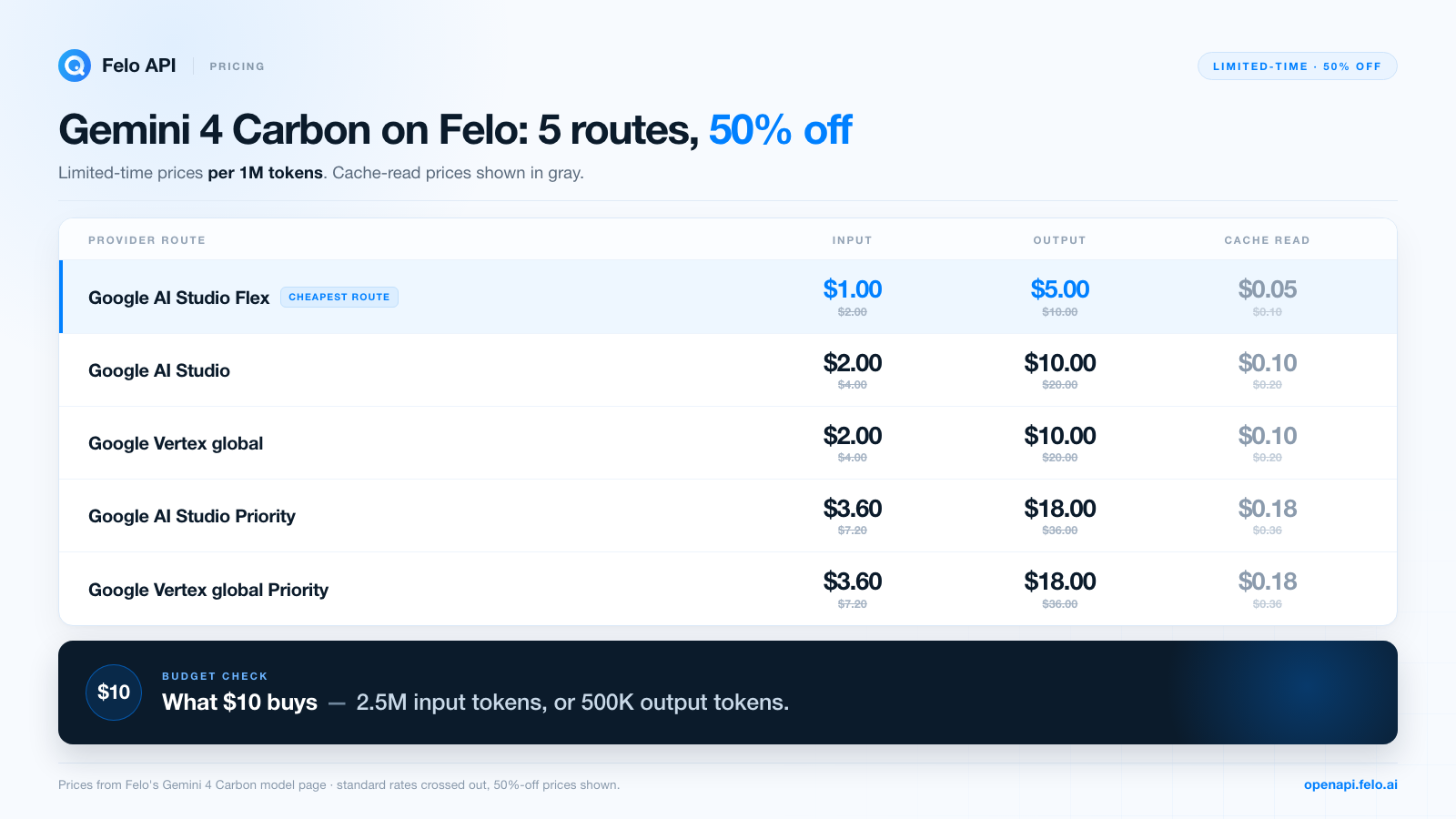
Felo's pricing page translates the standard rates into "what $10 buys": about 2.5 million input tokens or 500,000 output tokens, before discounts. That is a useful way to size a proof of concept. A test that sends 100,000-token document bundles and receives 5,000-token answers costs roughly $0.13 on the Flex route at the discounted rate — $0.10 for input and $0.025 for output — which is small enough to run dozens of trials before deciding.
The free trial is a separate offer from the discounted rates. Felo's model page marks Gemini 4 Carbon with a limited-time free trial, which is the fastest way to test the model without committing credits. Check the current terms on the model page, since trial availability and rate discounts are time-limited and can change.
Cost planning for this model needs one extra habit. Because thinking tokens are billed at the output rate, a HIGH-thinking agent run can cost several times what the visible answer suggests. Log token usage per task, including reasoning tokens, and compare cost per accepted result rather than cost per request.
Limitations and things to verify before you commit
Carbon is a frontier model with documented weaknesses. The ones that matter for production planning:
- Hallucination. Google lists it as a known limitation. Long context reduces the chance of missing information; it does not guarantee correct interpretation. Cite-and-verify workflows remain necessary.
- Latency and timeouts. Google notes occasional slowness and timeout issues. Long HIGH-thinking runs need generous timeouts, retries, and idempotent task handling.
- Higher token usage. The model spends more thinking tokens than Argon, especially at higher levels. Budget accordingly and cap effort on routine tasks.
- Knowledge cutoff March 2026. Anything more recent requires retrieval or current sources. Carbon does not know events after that date.
- Fixed sampling. Temperature, top-p, and top-k cannot be adjusted. If your pipeline needs deterministic outputs, keep that stage on another model.
- No explicit caching, tuning, RAG Engine, or Live API. Each of these shifts work into your application layer.
- Availability constraints. Google makes Carbon available to verified enterprise customers in select regions; Felo routes it through global, US, and EU providers. Confirm the route and terms that apply to your use case.
- Safety and access rules. The cyber variant is allowlisted, and security workflows must be authorized. The model's safeguards and provider policies still apply.
So should you use it?
Use Gemini 4 Carbon when the task is long, the evidence is messy, and a wrong answer is expensive: a migration plan, a security review, a research synthesis, a financial or legal analysis, or an agent that has to investigate before it acts. Its benchmark profile and its unified budget are built for exactly that shape of work.
Do not use it as a default for every request. High-volume classification, short extractions, simple summaries, and anything that needs deterministic sampling are better served by cheaper, faster models. The cheapest model that clears your quality bar is almost always the right choice, and Carbon should earn its place on the hardest slice of your workload.
The honest summary: Carbon is Google's most capable model for deep work, with measured strengths in security, legal, finance, and long-context reasoning, real costs in latency and tokens, and a set of documented limitations that make verification non-negotiable. Test it on your own tasks before you build around it.
Frequently asked questions
Is there a free trial for Gemini 4 Carbon on Felo?
Yes. Felo marks Gemini 4 Carbon with a limited-time free trial, and the model's provider rates are also discounted while the offer lasts. Terms can change, so check the Gemini 4 Carbon model page for current availability.
What is the difference between Gemini 4 Carbon and Gemini 4 Argon?
Carbon is built on Argon and tuned for deeper reasoning. It uses a unified 1,048,576-token budget covering input, thinking, tool calls, and output; supports LOW, MEDIUM, and HIGH thinking levels; spends more thinking tokens; and adds Office/OpenDocument file support and stronger safety and security positioning. Argon remains the choice for long-form generation where output length matters more than verification depth.
What is the context window and maximum output of Gemini 4 Carbon?
The unified budget is 1,048,576 tokens, covering input and output together. A single streaming segment can produce up to 65,536 output tokens, or 32,768 without streaming, and long decodes extend the output up to the remaining budget. Felo lists a maximum output of 943.718K tokens on its route.
Can Gemini 4 Carbon read audio, video, and Office files?
Yes. It accepts text, images, audio, video, PDF, and Office/OpenDocument files, with limits of about 8.4 hours of audio, about 45–60 minutes of video, 3,000 combined images and documents, and 3,000 pages per document. Output is text only.
Does Gemini 4 Carbon support OpenAI-compatible APIs?
Felo recommends its Anthropic-compatible Messages API for this model, and also documents OpenAI-compatible Chat Completions and Responses endpoints for supported models. Confirm the current surface on the model page before rewriting an existing client.
How much does Gemini 4 Carbon cost?
Felo lists five Google routes, all currently 50% off: AI Studio Flex at $1 input / $5 output per million tokens, standard AI Studio and Vertex routes at $2 / $10, and priority routes at $3.60 / $18. Cache reads start at $0.05 per million tokens. See the Felo pricing page for the live rates.
When was Gemini 4 Carbon released?
Google announced Gemini 4 Carbon on October 28, 2026, initially for a subset of cybersecurity defenders through the Fairwind Program. Google's enterprise platform lists general availability from November 10, 2026. Felo now routes the model through five Google providers.
Try Gemini 4 Carbon on Felo
The fastest way to judge Carbon is to give it a task you already know the answer to. Open the Gemini 4 Carbon playground, paste in a real document or code sample, and compare LOW and HIGH thinking on the same prompt. If the result holds up, create a key and move the test into your own pipeline.
Start with the Gemini 4 Carbon model page for current trial terms, provider routes, and limits — then build the smallest possible test around the hardest task you actually have.
This post is also available in 简体中文, 日本語, 한국어, 繁體中文, हिन्दी, Français, العربية, Русский, اردو, Bahasa Indonesia, Deutsch, Tiếng Việt, Türkçe, Italiano, ไทย, Español, বাংলা and Português.