Build AI Agents with GPT-6 Astra on Felo — Free to Try

Felo Agents now supports GPT-6 Astra as its reasoning model. Create agents that build slides, images, videos, and web pages — free to try.
An agent is only as good as the model that plans its moves. Today, Felo Agents adds GPT-6 Astra — OpenAI's newest reasoning model — as a selectable Reasoning Model, so the agents you build on Felo can plan multi-step tasks with a 1,050,000-token context window behind them.
You can try it now at felo.ai/agents. Click Create Agent in the top-right corner, pick the Intelligent Search Agent template, and choose GPT-6 Astra as the Reasoning Model. It's free to try.
Why a reasoning model changes what an agent can do
Most agents handle simple requests well: summarize this page, translate that paragraph, look up one fact. The work is single-step, and any capable model can do it.
Multi-step work is different. Building a slide deck means researching the topic, deciding what belongs on each slide, writing the copy, and calling the right tools in the right order. Generating a video means turning a loose idea into a script, then a storyboard, then a shot list, then an actual render. When each step depends on the one before it, the model doing the planning matters more than the tools being called.
That is where GPT-6 Astra fits. It is a reasoning model built for exactly this kind of long-chain work:
- 1,050,000-token context window — an agent can hold an entire research session, a full codebase, or dozens of source documents in view at once, and keep them there across the whole task.
- 128K output — long deliverables like full slide decks or multi-page websites can come out in one pass instead of being stitched together.
- Strong tool orchestration — reasoning models weigh which tool to call, in what order, and what to do when a result comes back unexpected. That judgment is what separates an agent that finishes a task from one that stalls halfway.
We covered the full spec sheet and what benchmarks say about GPT-6 Astra in our earlier post, GPT-6 Astra in Felo Search. If you want the model details — context limits, pricing tiers, knowledge cutoff — that post has them. This one is about what the model lets your agents do.
How to create an agent with GPT-6 Astra
Setting it up takes about a minute:
- Go to felo.ai/agents and click Create Agent in the top-right corner.
- Choose the Intelligent Search Agent template.
- In the Model section, open the Reasoning Model dropdown and select GPT-6 Astra.
- Fill in the agent name, description, and custom instructions, then save.
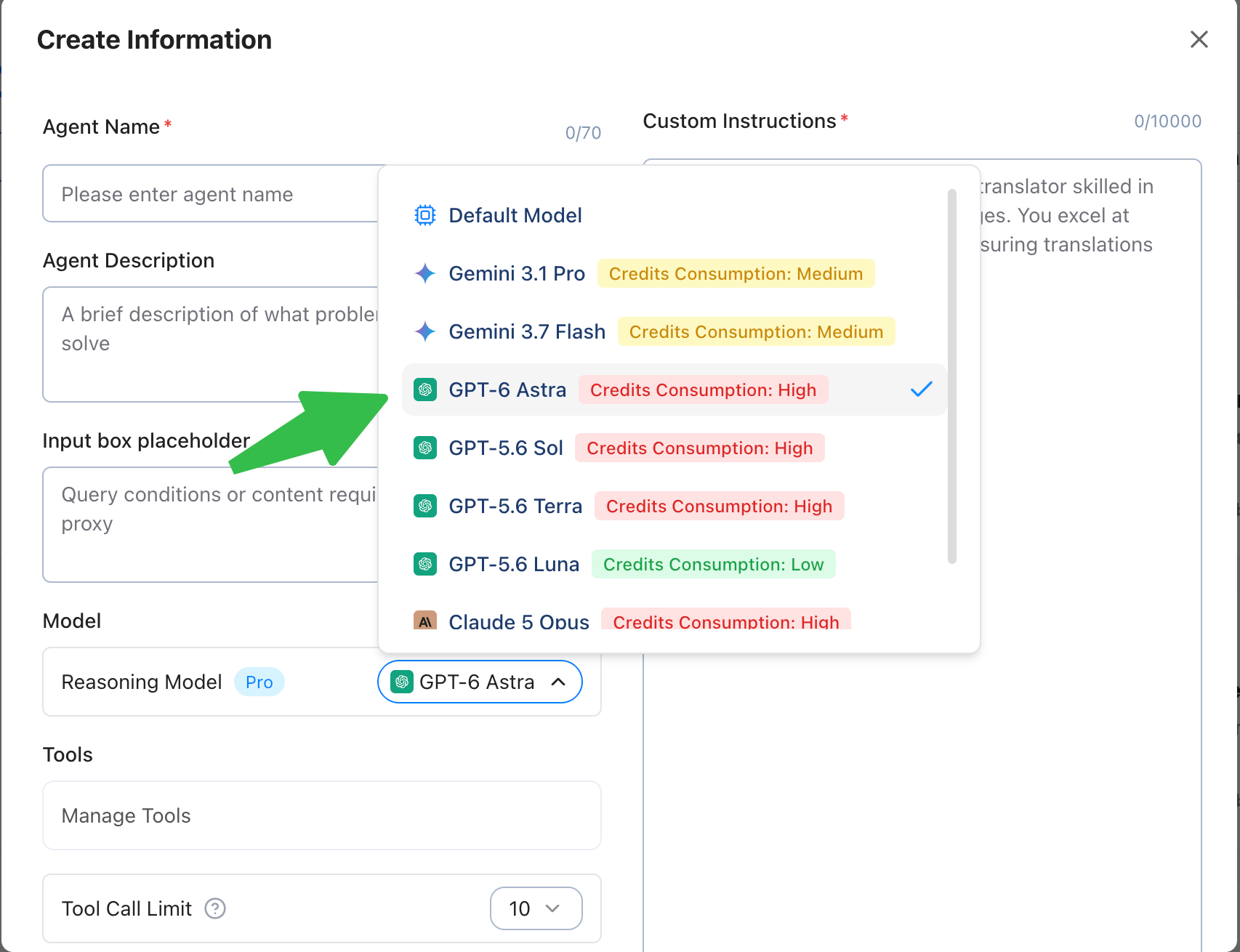
Each model in the dropdown shows its credit consumption level — Astra sits in the High tier, alongside GPT-5.6 Sol, GPT-5.6 Terra, and Claude 5 Opus, while Gemini 3.7 Flash and GPT-5.6 Luna sit in the lower tiers. If you're running an agent on hundreds of small tasks a day, a lower-tier model may be the more economical pick. For complex, multi-step deliverables, Astra's planning quality usually pays for the difference.
What you can build with a GPT-6 Astra agent
Any agent you create runs with Astra as its brain. A few directions that work well:
Slide decks. Give the agent a topic and an audience. It researches the subject, structures a narrative, and produces a deck you can present — the kind of task where the outline decision, made early by the model, determines whether the final deck hangs together.
Images. Describe what you need — product shots, blog covers, social graphics — and the agent translates the request into precise generation prompts, then iterates on the results. Reasoning helps here because good image generation starts with a well-specified prompt, not a lucky one.
Video. The chain is long: concept, script, storyboard, scene prompts, render. An agent with Astra as the planner can carry the creative intent through every step instead of losing it between tools.
Web pages. Landing pages, portfolio sites, internal tools — the agent gathers requirements, writes the code, and assembles the result. With a million-token context, it can keep your brand guidelines, existing copy, and layout constraints in view the whole time.
Research that ends in a deliverable. This is the Intelligent Search Agent template's home turf. Instead of a research summary you still have to do something with, the agent searches, reads, and then builds the report, the deck, or the page directly from what it found.
A few tips for better agent instructions
The model is only half the setup — the custom instructions you write are the other half. Three things that help:
- State the deliverable, not just the topic. "Create a 10-slide deck for first-time buyers comparing mortgage rates, ending with a CTA to our calculator" beats "write about mortgages."
- Name the tools and the order. If the task needs search before image generation, or research before the slide build, say so. Agents follow sequences well when they're explicit.
- Set the tool call budget. The Tool Call Limit setting caps how many tool calls an agent can make per run. For research-heavy tasks, raise it; for quick, focused tasks, a low limit keeps runs fast and cheap.
Try it now
GPT-6 Astra is live on Felo Agents today, free to try. Head to felo.ai/agents, click Create Agent, pick the Intelligent Search Agent template, and select GPT-6 Astra as the Reasoning Model. Your first agent — a deck builder, an image pipeline, a research-to-report machine — is about a minute away.
This post is also available in 简体中文, 日本語, 한국어, 繁體中文, हिन्दी, Français, العربية, Русский, اردو, Bahasa Indonesia, Deutsch, Tiếng Việt, Türkçe, Italiano, ไทย, Español, বাংলা and Português.