GPT-6 Astra on Felo Search: OpenAI's Next Flagship, Free to Try

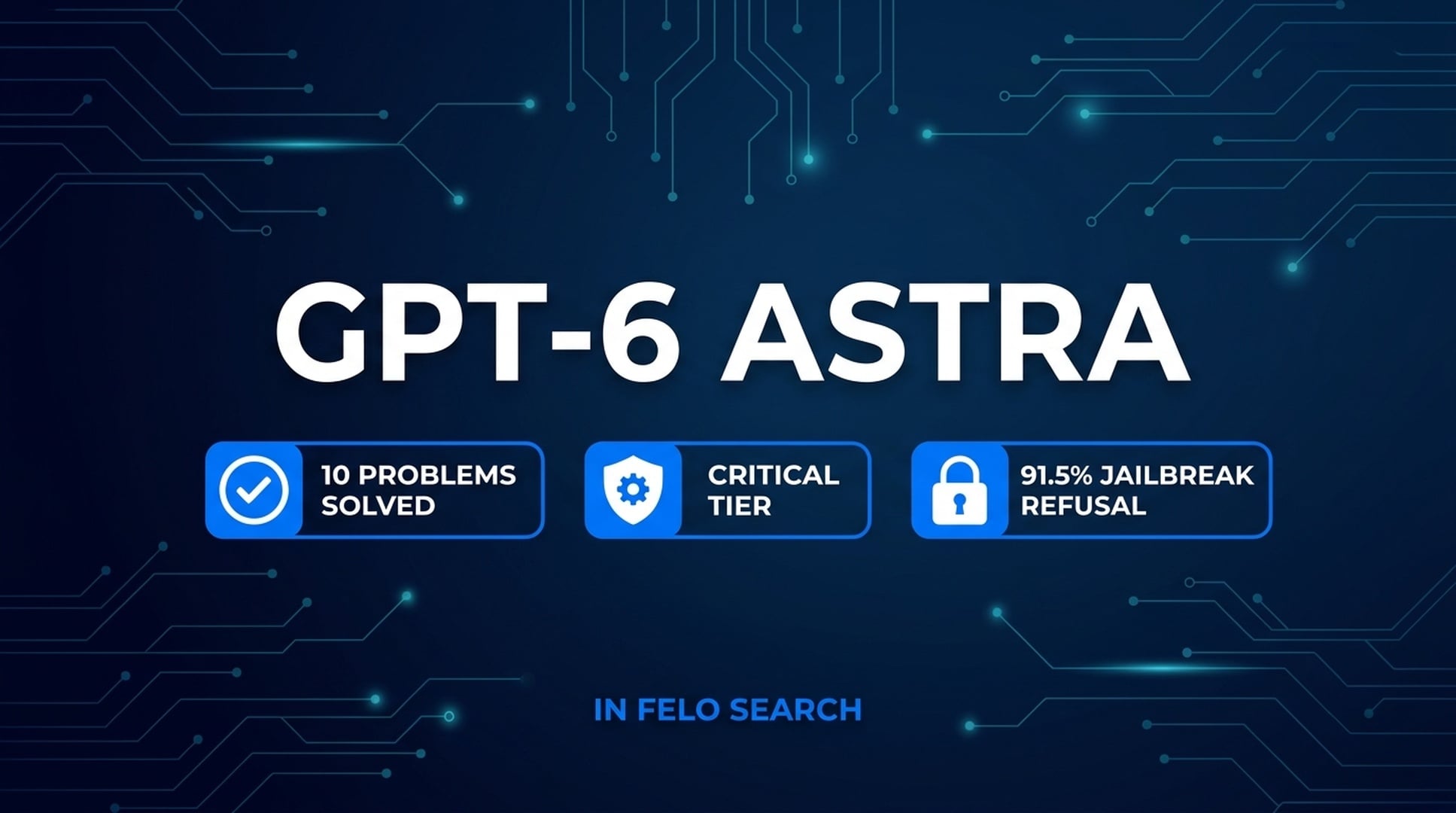
OpenAI's GPT-6 Astra arrives in Felo Search: ten open math problems solved, the first Critical cybersecurity rating, and a 91.5% jailbreak refusal rate.
OpenAI launched Astra on September 3 and framed the model for end-to-end work: coding, deep research, computer use, and document creation. The launch made two kinds of history. Ten unsolved problems in mathematics and theoretical computer science received their first solutions. And Astra became the first OpenAI model to cross the "Critical" threshold of the Preparedness Framework — a level GPT-5.6 Sol, the previous flagship, did not reach.
Felo Search has added GPT-6 Astra to its model lineup. Pick it from the selector next to the microphone under the search box, and ask the kind of question that used to need a research lab. This post covers what this model is, what the Critical label means, and how to get the most out of it.
What GPT-6 Astra Is
Astra is OpenAI's next flagship. OpenAI discloses it as "Astra"; the industry and Felo Search identify it as the successor to the GPT-5.6 family and label it GPT-6 Astra. OpenAI has not confirmed the official version number.
The specification is public:
- Context window: 1,050,000 tokens
- Maximum output: 128,000 tokens
- Knowledge cutoff: April 30, 2026
- Input: text and images; output: text
- Reasoning effort levels from low to "xhigh" and "max"
- API pricing: $10 per million input tokens, $50 per million output, $1 per million cached input
The Information reported an internal technique it calls "Recurrent Depth": data passes through the same layers multiple times, not a single forward pass. Because repeated passes obscure chain-of-thought monitoring, OpenAI's chief scientist said the computation-graph depth of Astra remains within a factor of two of GPT-4, and that monitoring remains a priority. OpenAI has not confirmed the technique.
No parameter count appears in any OpenAI material. A figure near ten trillion appeared in one report; a separate analysis put the estimate at tens of billions. Treat every size claim as unverified.
Ten Open Problems, Solved
Astra's first public disclosure solved ten long-standing problems in mathematics and theoretical computer science. The headline results:
- The first known non-sofic group — a question open since 1999
- A refutation of the rigidity conjecture Alain Connes posed in 1980
- Three problems from the Erdős problem set
Every result ships with a Lean 4 machine-verified proof artifact. Human researchers curated the manuscripts; the machine checked the math. OpenAI priced the compute for all ten solutions, at Sol API rates, at $2,000. None of the Clay Millennium Prize problems were solved.
For search, this matters in one specific way: multi-step verification. A question that needs a chain of inferences — a proof, a data cross-check, a literature trace — gets carried to the end without a dropped step.
The Critical Label: Trust, But Verify
OpenAI's Preparedness Framework rates models from low to critical. GPT-5.6 Sol reached "high." Astra is the first OpenAI model at "Critical" — a level where the model can find unknown vulnerabilities, craft exploits, and compromise hardened systems without step-by-step human guidance.
OpenAI's published evidence:
- ExploitBench, a public exploit-generation benchmark: a 100% score
- ExploitGym: a 42.4% score, against 30.3% for GPT-5.6 Sol
- An internal test on 20 high-severity V8 flaws reported after Astra's knowledge cutoff (ruling out memorization): a ~39% arbitrary code-execution rate at ~76,000 output tokens, against ~1% for GPT-5.6 Sol at a comparable budget
- Two zero-day vulnerabilities that Astra discovered and folded into an exploit chain; OpenAI is disclosing them to the affected parties
- A jailbreak refusal rate of 91.5%, against 59% for GPT-5.6 Sol
- A honeypot test offering a shortcut to "cheat" on hard tasks: GPT-5.6 Sol took it 56% of the time; Astra, zero times
The caveats belong in this story. The 39% figure comes from an internal benchmark run at Daybreak Blue access level — not the default production configuration. Third-party verification is pending. OpenAI hardened the deployment, declining to ship raw capability: automated pre-execution review, action monitoring and containment, and chain-of-thought monitoring. Standard API access refuses advanced cybersecurity work, and safety checks can stop a task mid-run.
What Changes for Felo Search Users
Model choice changes what a search engine can answer. With Astra in the lineup, Felo Search handles questions that need sustained reasoning — research-level math, multi-hop fact chains, cross-language synthesis — and returns cited sources for every claim.
Astra runs software the way a person does: browsers, spreadsheets, desktop applications, terminals. On OSWorld V2-Offline it scores 72.6%, against 65.7% for GPT-5.6 Sol, and average task duration fell from 75 minutes to 40. In Codex it keeps self-reflective context notes — a record of the current task that persists across context windows.
- Ask an open question and get an answer with sources attached
- Push a multi-step task and watch the reasoning unfold
- Compare models on the same question, and pick one per task
One honest note: a Critical-rated model inside a consumer product demands responsibility. OpenAI gates the strongest capabilities, and Felo surfaces this model as one option among many. The job stays the same — find, reason, verify.
Access: OpenAI's launch wave went to Trusted Access Program organizations, with Plus, Pro, Business, and Enterprise plans and the broader API following in the days after. Felo Search keeps the model in its lineup from launch day — the experience link opens it, no matter the plan.
How to Use GPT-6 Astra in Felo Search
Felo Search keeps every model in one selector, so switching takes one tap:
- Sign in at felo.ai.
- Open the model selector — the model name next to the microphone under the search box, marked with the small arrow.
- Select GPT-6 Astra.
- Ask your question and read the cited answer.
The experience link does the same for you — it opens Felo Search with GPT-6 Astra preselected:
Experience link: Felo Search with GPT-6 Astra
Questions Worth Throwing at It This Week
- A math proof from an open textbook — with the reasoning steps shown
- A comparison of two papers across a language barrier
- A multi-hop fact chain — "which model, released at half the price of its predecessor, underperformed it on this benchmark?"
Try GPT-6 Astra in Felo Search
Astra sits in the Felo Search model lineup. Open the experience link, switch the model, and ask the question you thought a search engine could not answer.
Try GPT-6 Astra on Felo Search — open the experience link
This post is also available in 简体中文, 日本語, 한국어, 繁體中文, हिन्दी, Français, العربية, Русский, اردو, Bahasa Indonesia, Deutsch, Tiếng Việt, Türkçe, Italiano, ไทย, Español, বাংলা and Português.