GPT-6 Luna Is Now Free on Felo Search: A Million Tokens for $0.10

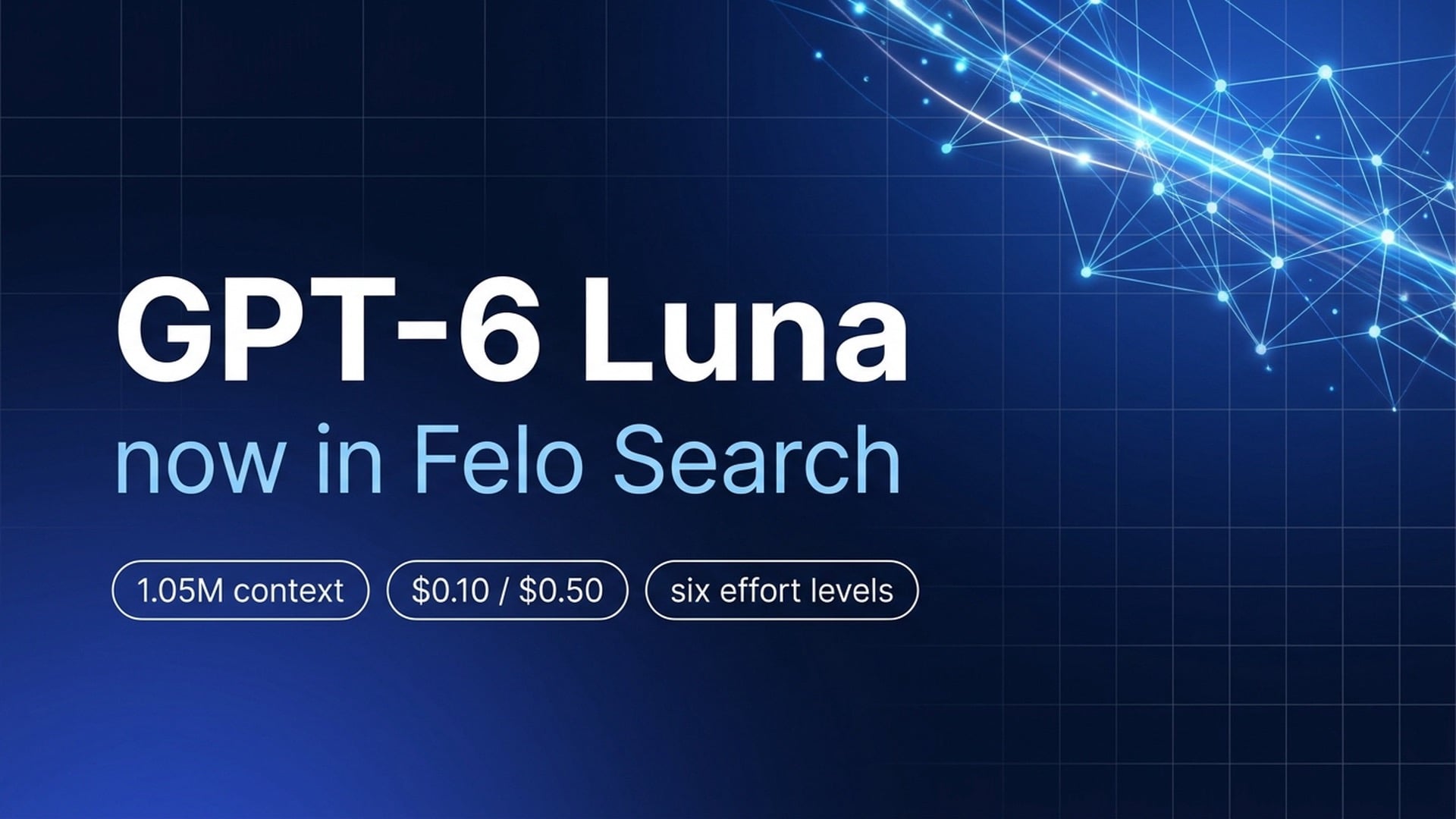
GPT-6 Luna is live in Felo Search: 1.05M context and frontier-class reading at $0.10 per million input tokens, the cheapest tier in the GPT-6 family.
OpenAI released GPT-6 Luna on September 22 alongside GPT-6 Sol. Luna is the cheapest model in the GPT-6 family by a wide margin: $0.10 per million input tokens and $0.50 per million output, about one-twentieth of what Sol costs and one-hundredth of the Astra flagship.
It is live in Felo Search now. The interesting question is not whether Luna is the smartest model you can put behind a search box. It is what becomes possible when reading a document costs almost nothing.
What GPT-6 Luna Actually Is
Luna sits at the bottom of the GPT-6 generation, below GPT-6 Sol and far below GPT-6 Astra. The naming is worth pausing on, because it runs opposite to the generation before it.
In the GPT-5.6 generation, Sol was the flagship, with Terra and Luna beneath it. GPT-6 inverts that ordering: Astra leads at $10/$50, Sol is the middle tier at $2/$10, and Luna anchors the family at $0.10/$0.50. Same three names, opposite ranking. If you are carrying assumptions over from GPT-5.6, the price is the fastest way to tell which Luna you are looking at.
| Spec | GPT-6 Luna |
|---|---|
| Model ID | gpt-6-luna |
| Maker | OpenAI |
| Released | September 22, 2026 |
| Context window | 1,050,000 tokens |
| Max input | 922,000 tokens |
| Max output | 128,000 tokens |
| Input | Text, image |
| Output | Text |
| Reasoning effort | none / low / medium (default) / high / xhigh / max |
| Price | $0.10 per million input, $0.50 per million output |
| Long context | $0.20 in / $0.75 out above 272,000 input tokens |
| Cached input | $0.01 per million tokens |
| Knowledge cutoff | May 18, 2026 |
Read the context row next to the price row. Luna carries the same 1,050,000-token window as the flagship (922,000 tokens of input, 128,000 of output) at a hundredth of Astra's input price. OpenAI did not shrink the window to hit the price point. It is the same window on a cheaper model.
Three more rows change how the model behaves on real work.
Cached input costs a cent per million tokens. Running the same source set through twenty different questions is, at that rate, free.
Six reasoning-effort settings, defaulting to medium. Luna is the only model of the four released this week with an off switch: none skips reasoning entirely for work that does not need it. That is a latency decision as much as a cost decision. For classification, extraction, and routing, the fastest correct answer is usually the one that does not think first.
Batch and Flex halve the price again. For work that does not need a live answer, fifty cents per million output tokens is the floor.
What Cheap Reading Changes
Most research budgets are not spent on synthesis. They are spent on reading: opening the forty sources to find the six that matter, then opening those six closely. That first pass is expensive because a frontier model is doing work a much cheaper one could do.
At $0.10 per million input tokens, the calculus inverts. This is now something you can actually do in Felo Search:
- Read everything before deciding what matters. Pull the full set of results into a single context and rank them by relevance to your specific question, with reasons. A hundred thousand tokens of input costs one cent.
- Run the same question across more sources than usual. The reason to read ten sources instead of three is coverage, and the reason people read three is cost. At this price the constraint moves.
- Extract before you reason. Have Luna turn forty documents into a structured table of numbers, dates, and claims, with the source attached to each row. Then hand that table, not the documents, to a stronger model.
- Route by difficulty. Send the easy half of a workload to Luna and escalate only the questions that need depth. Triage is where the savings compound.
The scores support using Luna for that first pass. OpenAI-published DeepSWE v1.1 puts it at 66.6% on long-horizon software engineering, and Agents' Last Exam at 0.51. HealthBench Professional lands at 60.8%. The SEC-Bench Pro score, 34.2%, is a reminder that finance-domain work is harder than general reading for every model at this tier.
What Luna Is Not
The honest version: Luna trades reasoning depth for cost, and the trade is real.
On the published tables it is the bottom tier of the family, and OpenAI's own figure for the default setting (medium effort) sits well below what Sol and Astra return at higher effort. The open-domain recall numbers improved substantially over the previous Luna, and they are still not the numbers you want under a final answer on a high-stakes question.
That is not a reason to avoid it. It is a reason to use it for the right half of the job: Luna reads, the stronger model decides. On Felo Search the two halves sit in the same workspace. Do the wide pass on Luna, then switch the model in the picker and ask the final question with the extracted evidence still in context.
How to Use GPT-6 Luna in Felo Search
1. Open the model picker and select GPT-6 Luna. Same search box, same sources.
2. Start wide. Ask a question that requires reading more sources than you would normally pay for: "find every published figure for this, with its source and date."
3. Ask for structure, not prose. Tables, lists, and extracted fields are what a cheap model does well. Save the written synthesis for the expensive pass.
4. Raise the effort setting when the question gets hard. Medium is the default for a reason, but high and xhigh are there when the task needs them.
5. Switch models for the final answer. Keep the evidence, change the model. The picker is a control, not a commitment.
The Other Three Models Live in Felo Search
Luna came in with three siblings, and all four are in Felo Search.
| Model | Released by | Price per million tokens | Context | Built for |
|---|---|---|---|---|
| Grok 4.7 | SpaceXAI | $2 in / $6 out | 500K | Long-horizon reasoning and knowledge work |
| Claude Opus 5.5 | Anthropic | $4 in / $20 out | 1M | Answers that survive verification |
| GPT-6 Luna | OpenAI | $0.10 in / $0.50 out | 1.05M | High-volume search at the lowest cost per call |
| GPT-6 Sol | OpenAI | $2 in / $10 out | 1.05M | Agent loops and repeat calls at mid-tier price |
Luna is the cheapest of the four by an order of magnitude, and the only one that offers a reasoning-off setting. If your instinct is that cheap models are for throwaway questions, the million-token window is the part that should change your mind.
Try GPT-6 Luna in Felo Search
GPT-6 Luna is live in Felo Search with a 1,050,000-token context window, six reasoning-effort settings, and $0.10/$0.50 pricing. It is the model that makes reading everything the cheap option.
Open GPT-6 Luna in Felo Search →
This post is also available in 简体中文, 日本語, 한국어, 繁體中文, हिन्दी, Français, العربية, Русский, اردو, Bahasa Indonesia, Deutsch, Tiếng Việt, Türkçe, Italiano, ไทย, Español, বাংলা and Português.