Grok 4.7 on the Felo API: Why 450K Output Tokens Changes Agent Design

Grok 4.7 is live on the Felo API with a 450,000-token maximum output — three and a half times the frontier norm. Here is what that ceiling changes for coding agents, self-verifying loops, and whole-package migrations.

A 450K output ceiling turns a multi-turn negotiation into a single response.
Ask which model is best for coding and you get a benchmark argument. Ask someone who runs coding agents in production and you get a different answer: it depends on how much the model can write before it stops.
xAI's new flagship, Grok 4.7, is now live on the Felo API. Its maximum output is 450,000 tokens in a single response. Most frontier routes cap output around 128K. That gap is not a spec-sheet curiosity. It decides whether an agent can finish the job in one turn or stumbles at 70% and asks for permission to continue.
What Grok 4.7 is
Grok 4.7 is xAI's flagship route on the Felo API Platform, positioned for exactly the workloads where output length and context length are the binding constraints.
| Model ID | grok-4-7 |
| Input | $1.60 per million tokens |
| Output | $4.80 per million tokens |
| Context window | 500K tokens |
| Max output | 450K tokens |
| Latency | Deep |
| Protocol | Chat Completions |
| Capabilities | Reasoning, tool calling, structured output (JSON), streaming, vision |
| Input types | Text, image, file |
| Best for | Long-running coding, self-verifying agents, knowledge work |
The interesting row is the fifth one. A 500K context window is table stakes among frontier models in 2026. A 450K output ceiling is not. It is roughly three and a half times the 128K that every GPT-6 tier and every Claude route on the same platform allows in a single response. Felo labels the route "deep" on latency, which is the honest framing: this is a model you give a big job to and check on later, not one you call inline in a UI.
The quiet bottleneck in every agent loop
Output caps rarely make headlines, and they almost never appear in launch posts. Then you ship an agent and learn about them the hard way.
Here is the failure mode. Your agent reads a module, plans a refactor, and starts writing. The refactor needs to touch four files. The first two come back clean. The third is cut off mid-function. The fourth never arrives, because the response ended at the token limit, not at a natural stopping point.
A truncated response is worse than a failed one. A failed request throws an error you can handle. A truncated response looks like a complete answer until someone reads the bottom of the file. If your pipeline applies patches without a syntax check, the broken half lands in the repo.
The workarounds all cost money or latency. You split the task into more, smaller turns. You add "continue" prompts and stitch the pieces. You ask the model to write less and hope it keeps the important half. Every one of those workarounds is a tax you pay on every run, forever, because the model could not finish a thought.
Output ceilings are also poorly correlated with how much work a task actually is. A 2,000-line service file translates to something in the range of 25,000 to 40,000 tokens of output. A cross-module migration touching six files with tests can pass 100K without breaking a sweat. On a 128K route you are one careless prompt away from the ceiling on a task that felt medium-sized when you scoped it.
At 450K, that class of task stops being a negotiation. The whole migration, the tests, and the changelog fit in one response.
Self-verifying agents need room to be wrong and recover
The second thing Grok 4.7 leans into is verification. xAI positions it for long-running software engineering tasks where the model checks its own work, and the mechanics on the Felo API support the pattern: the route is reasoning-capable and accepts tool definitions, so an agent can write code, call a test runner, read the failures, and revise, all inside one turn.
That loop is expensive in output tokens by design. A model that verifies itself writes the code, then writes the analysis of why the test failed, then writes the fix, then writes the explanation, then maybe writes the fix again. Two revision cycles and you have produced 3x the code's worth of text. On a 128K route, the third cycle is where agents start running out of room and behaving strangely: shorter answers, skipped test runs, confident summaries of work that did not happen.
The Felo API preserves reasoning metadata across turns, so when the loop does span multiple requests, the model does not have to re-derive why it made each decision the first time. Combined with the 500K context window, an agent can keep a large working set, several files, a test log, and the conversation's own history in view while it works.
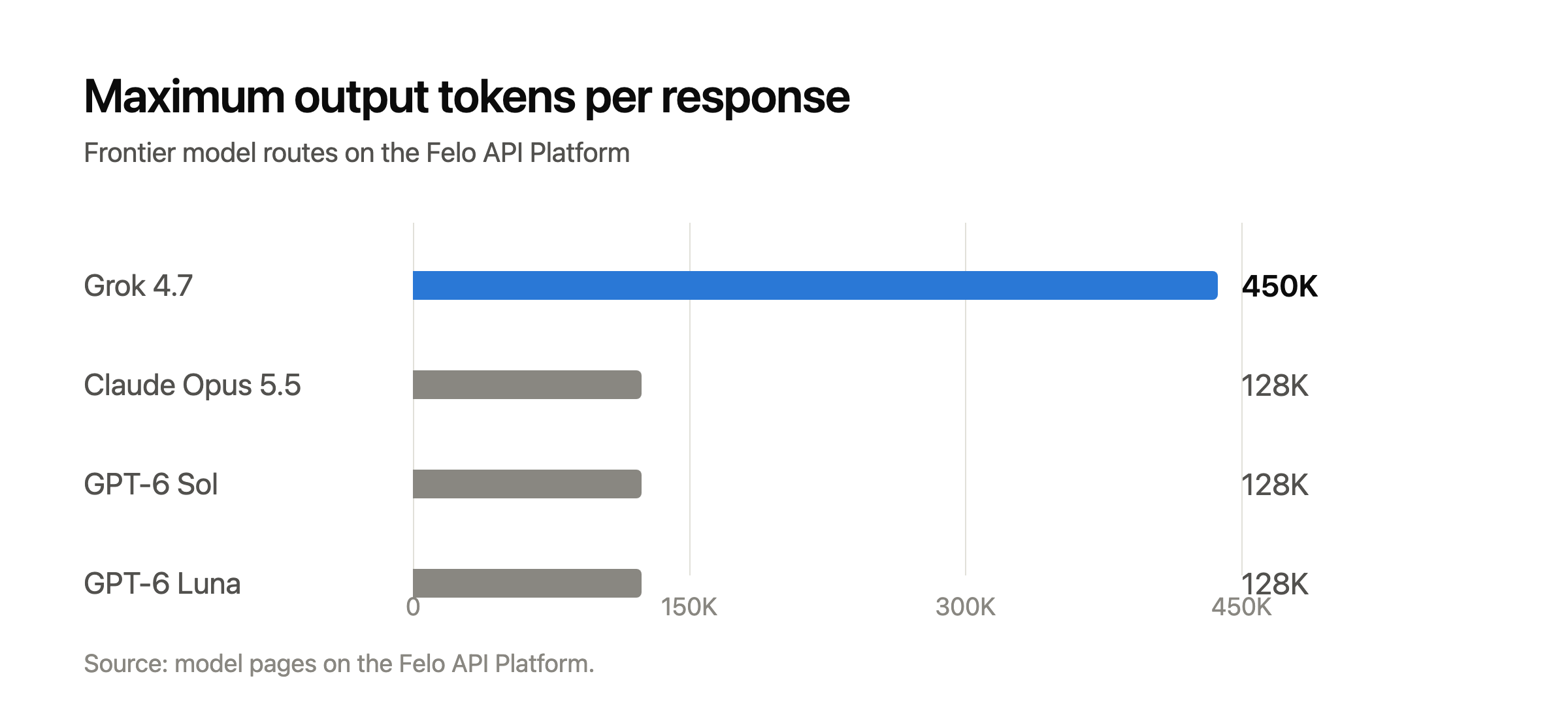
Maximum output tokens per response, Felo API Platform, September 2026.
Four things to build with a 450K output ceiling
Whole-package migrations. Hand the agent a library and let it return the entire migrated package in one response: source files, updated tests, a migration note. One response means one review pass, not four.
Test suites written in one shot. Generating tests is boring, high-volume output work, which is precisely the shape that hits output ceilings first. A model that can emit a full suite for a module keeps its own internal consistency, shared fixtures stay shared, and you avoid the "second half of the suite disagrees with the first half" problem that shows up when generation spans multiple turns.
Large-context analysis with a large deliverable. The 500K context window and 450K output are a matched pair. Feed in a codebase, a set of contracts, or a year of incident reports, and get back a structured document that is itself long: a migration plan, a risk register, an audit. Analysis tasks usually die on the input side; deliverable tasks die on the output side. This route stretches both.
Vision-to-code flows. Grok 4.7 accepts images alongside text and files. Screenshot a UI, a diagram, or a whiteboard sketch, and the model can turn it into markup or a component. That input type is one of the reasons it fits knowledge work beyond pure coding.
Calling Grok 4.7 on the Felo API
Grok 4.7 speaks the Chat Completions protocol. Felo's endpoint is OpenAI-compatible, so the official OpenAI SDK works with one changed line: the base URL.
import OpenAI from "openai";

const client = new OpenAI({
  apiKey: process.env.FELO_API_KEY,
  baseURL: "https://openapi.felo.ai/api/v1",
});

const completion = await client.chat.completions.create({
  model: "grok-4-7",
  messages: [
    {
      role: "user",
      content: "Refactor this module to async I/O and return the full files.",
    },
  ],
});
Add stream: true and the response arrives as server-sent events, which matters more here than on other routes: a 450K-token response that streams starts showing you the first file in seconds, while a non-streaming call holds everything until the last token. For interactive coding agents, stream.
The same API key also reaches the rest of the platform's surfaces, from web search to document extraction, if your agent needs tools on the same credential.
What it costs in practice
At $1.60 per million input tokens and $4.80 per million output tokens, a heavy refactor that reads 120K tokens of repository context and writes 40K tokens of code costs about $0.38. On the platform's credit system (1,000 credits = $1), that is roughly 384 credits for the run.
Standard accounts get 200 free credits every day, no credit card required, which is enough to run real tests against this model before you commit to anything. Paid plans include 15,000 credits a month.
Felo lists launch pricing on these routes that may be up to 50% lower than official provider API rates. Final cost depends on your input/output mix, cache usage, and plan.
One honest caveat
A high output ceiling is permission, not an instruction. A model that can write 450K tokens will happily write more than the task needs if the prompt is loose, and output tokens are the expensive side of the bill at every provider. Tell the agent what complete looks like, and let the ceiling be a safety net rather than a target.
Get started
Grok 4.7 is available now on the Felo API Platform. The model page has the current rates, the parameter reference, and drop-in code for Chat Completions:
Grok 4.7 on the Felo API Platform
Create a key, spend the free daily credits on a task you already have queued, and see whether one turn is enough.