LLM API Cost Comparison 2026: Claude vs GPT vs Grok Pricing

Detailed breakdown of model API pricing across Claude, GPT, and Grok, and how Felo OpenAPI gives you access to all of them at lower cost.
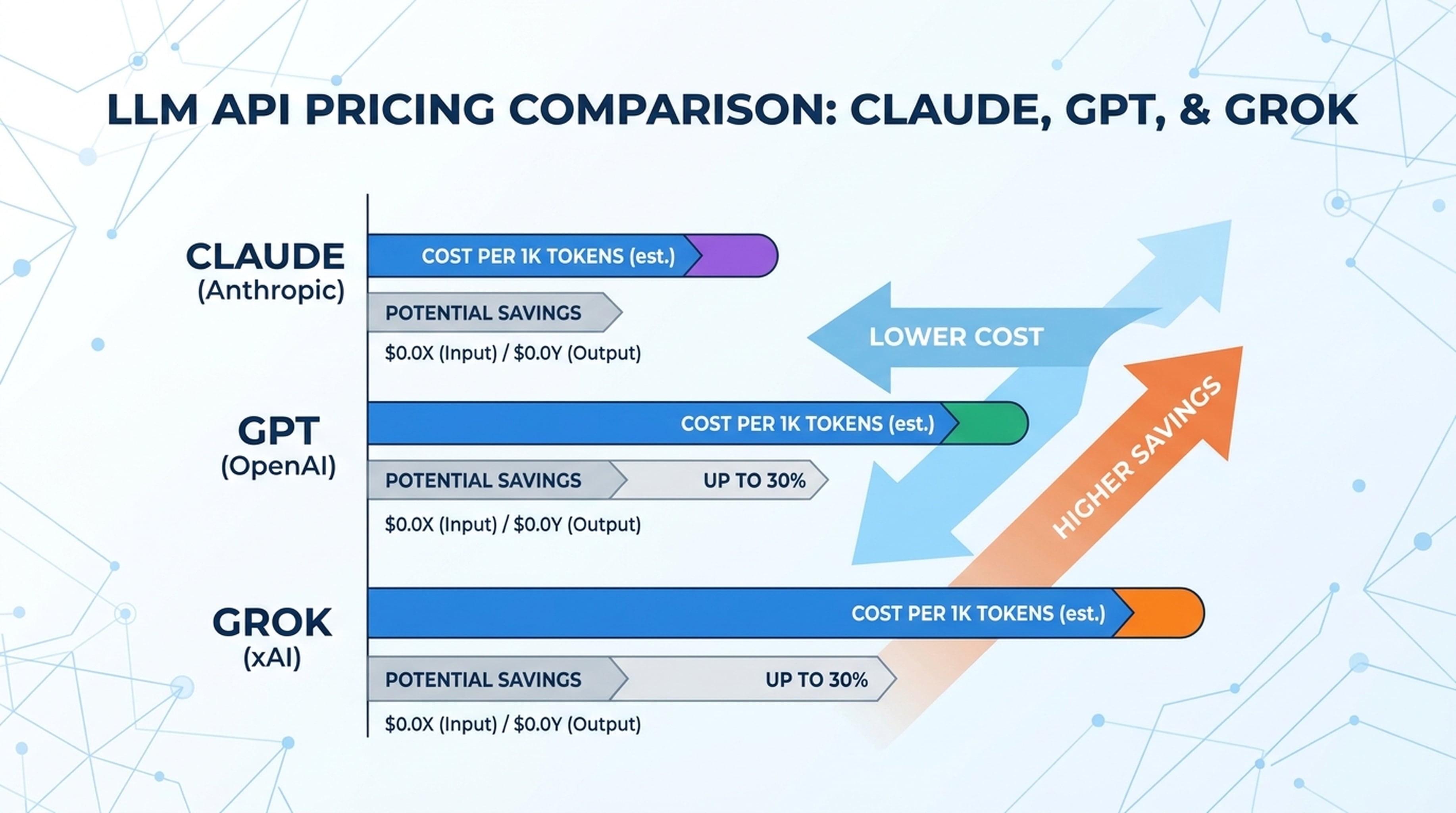
Model API costs can silently kill your AI workflows. Run an agent for a week, and the bill from repeated model calls adds up faster than you expect.
Here's a clear breakdown of what the major model APIs cost in 2026, and how to access them for less.
Why Model Costs Matter More Than You Think
When you use an AI agent, it doesn't call a model once per conversation. A single workflow might trigger:
- Planning and reasoning steps (strong model)
- Search and extraction calls (cheaper model works fine)
- Content generation (mid-tier model)
- Review and refinement (strong model again)
Five steps, five model calls, five charges. That's why per-call pricing matters more for agents than for chat.
Model API Pricing in 2026
Claude (Anthropic)
| Model | Input Cost | Output Cost | Best For | | -|-----------|------------|----------| | Claude Opus 4.8 | Highest | Highest | Complex reasoning, multi-step analysis | | Claude Sonnet 4.6 | Mid | Mid | General tasks, balanced speed and quality | | Claude Haiku 4.5 | Low | Low | Simple classification, extraction, quick answers |
Claude models are known for strong reasoning and instruction following. Opus leads on complex tasks. Sonnet is the workhorse. Haiku is fast and cheap for simple operations.
GPT (OpenAI)
| Model | Input Cost | Output Cost | Best For |
|---|---|---|---|
| GPT-5.6 Sol | High | High | Creative generation, long-form content |
| GPT-5.6 Terra | Mid | Mid | General reasoning, code, structured output |
GPT models excel at creative generation and have broad tool ecosystem support. The Responses API adds structured output capabilities that agents love.
Grok (xAI)
| Model | Input Cost | Output Cost | Best For |
|---|---|---|---|
| Grok 4.5 | Competitive | Competitive | Real-time knowledge, analytical tasks |
Grok brings competitive pricing and strong analytical capabilities. It's a solid option for tasks where cost efficiency matters without sacrificing reasoning quality.
The Hidden Cost Problem
The real issue isn't any single model's price. It's the accumulation:
- Separate accounts for each provider means separate billing, separate rate limits, separate dashboards
- Overpaying for strength — using Opus when Haiku would work, because switching models requires reconfiguring your setup
- No shared context — each provider stores its own data, so agents lose continuity when switching between models
When you're running an agent that chains 5-10 model calls per workflow, these inefficiencies compound quickly.
How Felo OpenAPI Reduces Costs
Felo OpenAPI provides access to all these models through a single platform at lower rates:
One key, all models: Claude Opus, Sonnet, Haiku, GPT-5.6 Sol, GPT-5.6 Terra, and Grok 4.5 — all under one API key.
Standard protocols: OpenAI-compatible Chat Completions, Anthropic-compatible Messages, and Responses API. Your agent connects to Felo's base URL and calls models through the protocols it already knows.
Lower per-call costs: Felo negotiates rates that are lower than going direct to each provider. When agents make many calls, the savings add up.
Smart model selection: Because all models share one base URL, agents can pick the right model for each step without reconfiguring. Use Opus for complex reasoning, Haiku for extraction, and Sonnet for everything in between.
Cost Comparison Example
Consider an agent that runs 100 workflows per day. Each workflow includes:
- 2 strong model calls (Opus/GPT-5.6 Sol level)
- 3 mid-tier calls (Sonnet/GPT-5.6 Terra level)
- 5 simple calls (Haiku level)
That's 1,000 model calls per day. At premium direct-provider rates, this gets expensive fast. Through Felo OpenAPI, the same calls cost less — and you only manage one key, one bill, one dashboard.
When to Use Which Model
Strong Models (Opus, GPT-5.6 Sol)
- Multi-step reasoning and analysis
- Complex code generation and debugging
- Strategic planning and decision-making
Mid-Tier Models (Sonnet, GPT-5.6 Terra, Grok 4.5)
- Content generation and summarization
- General Q&A and explanation
- Moderate complexity code tasks
Lightweight Models (Haiku)
- Classification and extraction
- Simple Q&A
- Formatting and validation
The agents that run most efficiently are the ones that match model strength to task complexity for every single call.
Standard Protocols Matter
Felo OpenAPI supports the protocols your agent already uses:
- OpenAI-compatible Chat Completions — drop-in replacement for OpenAI API calls
- Anthropic-compatible Messages — works with Claude-structured requests
- Responses API — for structured output and function calling
- SuperAgent SSE — streaming conversations for complex workflows
You don't need to rewrite your agent's code. Point it at Felo's base URL, add your API key, and it works.
Getting Started
- Create a free API key
- Set up your agent — Claude Code, Codex, OpenClaw, Hermes, or custom
- Test with a simple model call, then scale up
Stop paying premium rates for models you can access for less. Give your agent the right model for each step, all from one key.