MemClaw vs Mem0: Which AI Memory System Is Right for You?

MemClaw is project workspace memory for Claude Code developers. Mem0 is application-level user memory for AI app builders. They solve different problems — here's how to choose.
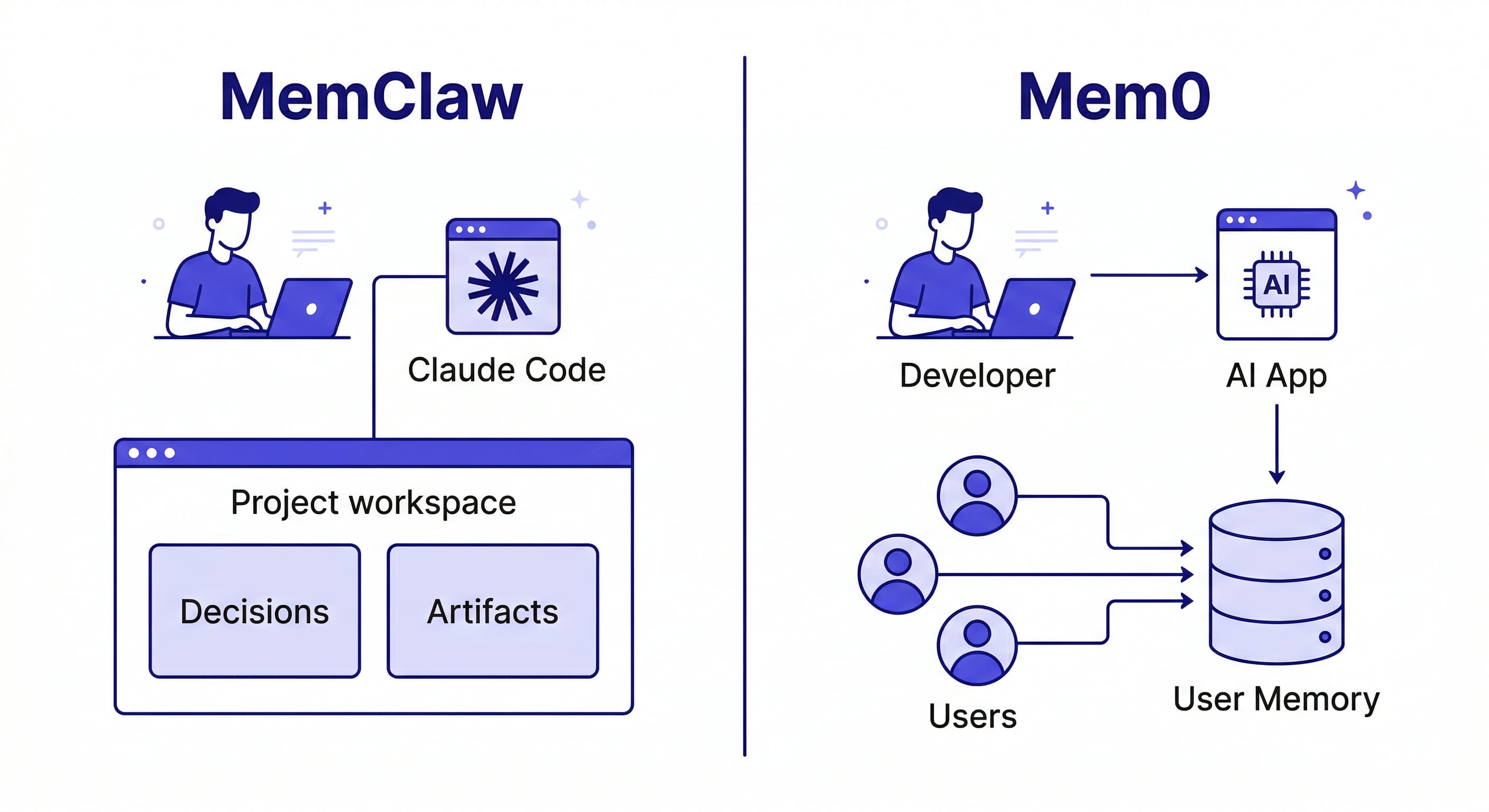
Both MemClaw and Mem0 add memory to AI systems. But they solve different problems for different users.
Short version:
- MemClaw = developer tool for Claude Code, project workspace memory, skill-based installation, zero custom code required
- Mem0 = application backend for AI memory, open-source infrastructure you embed in your own AI apps
They're not competing for the same user. Most people need one or the other — and the choice is usually obvious once you understand what each does.
What Is Mem0?
Mem0 is an open-source AI memory layer (Apache 2.0) built as infrastructure for AI application developers.
Architecture: Multi-layer storage — vector database for semantic similarity, knowledge graph for relationship modeling. Automatic memory extraction from conversations.
SDKs: Python and JavaScript. Self-hostable. REST API.
How it works: You integrate Mem0 into an AI application you're building. When a user has a conversation, Mem0 extracts and stores relevant information automatically. Future conversations retrieve relevant memories to personalize responses.
Target user: Developer building AI-powered products — support bots, learning apps, AI assistants with user accounts, multi-agent systems.
What Is MemClaw?
MemClaw is a workspace-based memory skill for AI coding agents.
Architecture: Project-scoped workspaces. Each workspace stores a living README, decision log, artifact library, and task history. Semantic search. Managed service — no infrastructure to run.
Installation: Install as a skill on Claude Code, OpenClaw, Gemini CLI, or Codex. No custom code.
How it works: You create one workspace per project. At the start of each Claude Code session, load the workspace — Claude reads the project context and is immediately oriented. As you work, save decisions, status updates, and artifacts to the workspace.
Target user: Developer (or PM, or freelancer) using Claude Code for project work who wants it to remember their projects across sessions.
Side-by-Side Comparison
| MemClaw | Mem0 | |
|---|---|---|
| What it's for | Your AI coding workflow | AI apps you're building |
| Memory scope | Per project | Per user |
| What it stores | Decisions, status, artifacts, project context | User preferences, conversation history, personal facts |
| Integration | Install as skill, natural language | Python/JS SDK, REST API, custom integration |
| Isolation | Each project isolated | Shared across user's conversations |
| Infrastructure | Managed (no setup) | Self-host or managed cloud |
| Open source | Proprietary (free tier) | Apache 2.0 |
| Best for | Multi-project developer workflows | Personalized AI apps with users |
Claude Code Integration: The Key Difference
This is where MemClaw and Mem0 most clearly diverge.
MemClaw installs as a Claude Code skill. Once installed, you interact with it entirely through natural language:
Load the Acme workspace
Add decision: using Postgres because client's DBA only supports it
Save that analysis to the workspace
What did we decide about authentication?
No configuration, no API calls, no custom code. It works within the existing Claude Code workflow.
Mem0 is designed to be embedded in applications you're building. To use it with Claude Code, you'd need to build a custom integration layer — write code to call Mem0's API, format responses appropriately, inject memories into Claude's context. It's the wrong abstraction level for a developer workflow tool.
If you want Claude Code to remember your projects, MemClaw is the right tool. Mem0 isn't designed for this use case.
When to Use Mem0
Mem0 is the right choice when you're building AI products that need to remember individual users:
- AI customer support — agent remembers each user's history, preferences, previous issues
- Personalized learning apps — tracks what each student knows, adjusts difficulty accordingly
- AI assistants with user accounts — remembers user preferences, communication style, recurring needs
- Multi-agent systems — shared memory layer across multiple agents handling the same user
- Self-hosting requirement — you need data sovereignty and can't use a managed service
- Open-source model — you need to inspect or modify the memory layer
Mem0's multi-layer storage (vector + graph) is particularly suited for applications where you need to capture complex relationships between facts about a user, not just retrieve similar text.
When to Use MemClaw
MemClaw is the right choice when you are the AI user and want Claude Code to remember your projects:
- You use Claude Code across multiple projects and context re-briefing wastes time
- You work on long-running projects where decisions made weeks ago are still relevant
- You switch between clients and need clean context isolation
- You're on a team where multiple developers need to share project context
- You want persistent memory without writing any custom code
How to build a persistent knowledge base with MemClaw →
Can You Use Both?
Yes. They operate at completely different layers and don't conflict.
MemClaw is your developer workflow tool — it handles your context as you work on projects.
Mem0 is infrastructure in the products you're building — it handles your users' context inside your AI applications.
If you're using Claude Code to build an AI product with user memory (a support bot, a learning app), you might naturally end up using both: MemClaw to remember the project you're building, Mem0 as a component inside the product you're building.
Technical Architecture
Mem0 uses multi-layer storage: a vector database for semantic similarity search plus a knowledge graph for relationship modeling between entities. It runs an extraction pass over conversations to identify and store memorable information automatically. This architecture is well-suited for complex, unstructured personal memory with rich relationships.
MemClaw uses structured workspace storage optimized for developer workflows. The workspace model maps directly to projects — not conversations or users. Semantic search without graph overhead, because developer project memory is structured (decisions, artifacts, status) rather than freeform personal history.
Neither architecture is universally better — they're optimized for different problems.
Pricing
MemClaw: Free tier for individuals. Paid plans for teams and extended storage. Get a key at felo.ai/settings/api-keys.
Mem0: Self-hosted on your own infrastructure (free, pay for infra). Managed cloud option available with usage-based pricing.
The Bottom Line
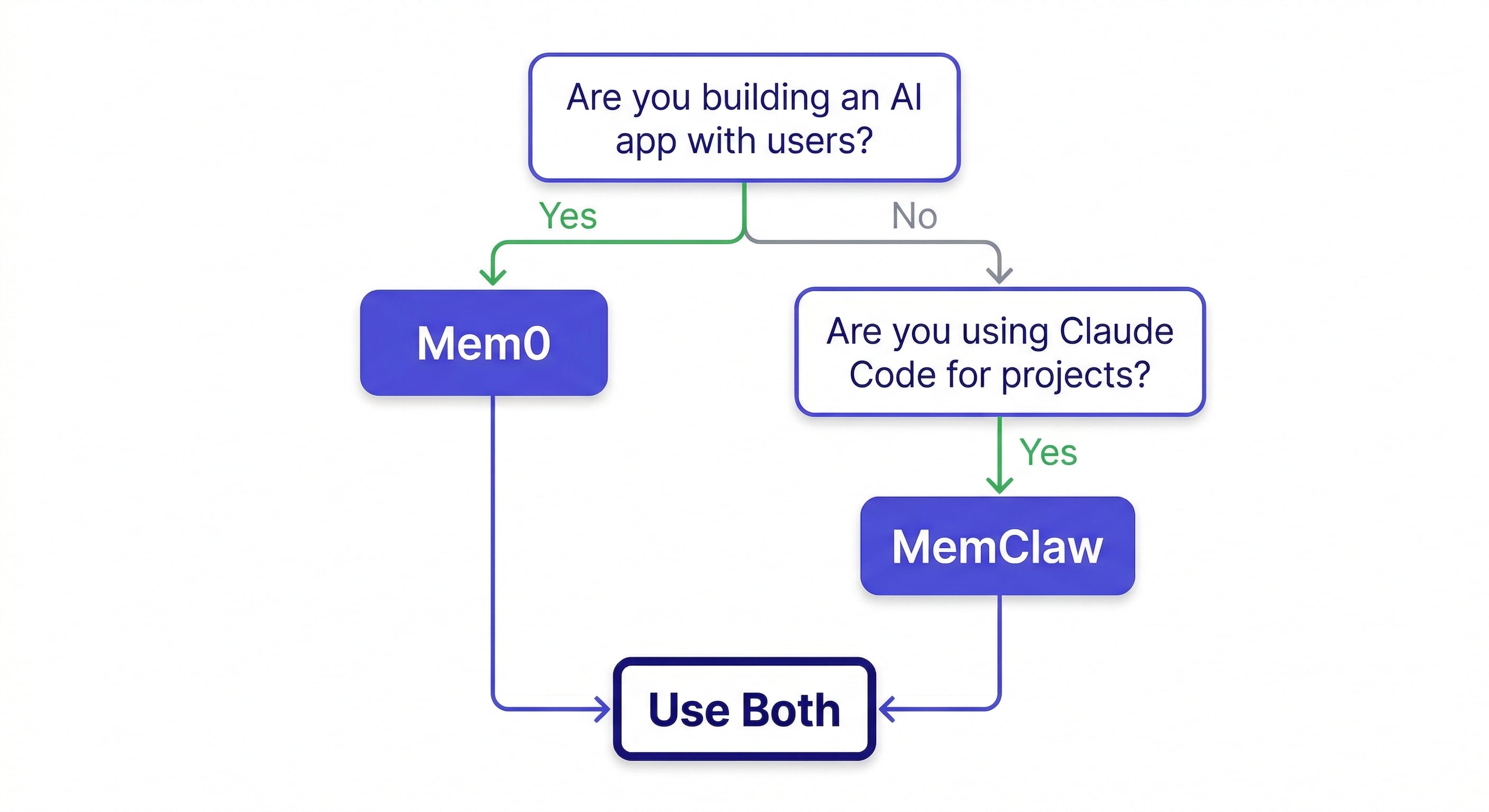
- Using Claude Code and want it to remember your projects? → MemClaw
- Building an AI application that needs user memory? → Mem0
- Doing both? → Use both, they don't conflict
The tools are designed for fundamentally different use cases. There isn't much overlap in practice.
Disclosure: This comparison was written by the Felo team, which makes MemClaw. Mem0 is represented accurately based on its public documentation and is recommended without qualification for its intended use case.
Frequently Asked Questions
Can Mem0 work with Claude Code? Not directly. Mem0 is an SDK you embed in applications you're building — it's not a Claude Code skill. To use Mem0 with Claude Code, you'd need to build a custom integration layer. MemClaw is the purpose-built solution for Claude Code memory.
Is Mem0 free? Mem0 is open-source (Apache 2.0) and free to self-host on your own infrastructure. A managed cloud option is available with usage-based pricing.
Is MemClaw free? MemClaw has a free tier for individual developers. Get your API key at felo.ai/settings/api-keys.
Can I use both MemClaw and Mem0 at the same time? Yes. They operate at different layers and don't conflict. MemClaw handles your developer workflow (your context as you build). Mem0 handles your users' context inside the product you're building.
Which is better for Claude Code users? MemClaw. Mem0 is infrastructure for AI app builders, not a developer workflow tool. If you want Claude Code to remember your projects across sessions, MemClaw is the right choice.