MiMo V2.6 Pro Is Now on Felo OpenAPI: Xiaomi's Top Open-Weights Model

Xiaomi's MiMo V2.6 Pro, the top open-weights model on the Artificial Analysis index, is live on Felo OpenAPI at $0.43/$0.87 per million tokens.
Xiaomi released MiMo V2.6 Pro on September 22, and it landed at the top of the open-weights table: 46 on the Artificial Analysis Intelligence Index, ahead of Kimi K3 and Qwen3.8 Max. Xiaomi shipped the weights, the technical report, and the training code alongside it.
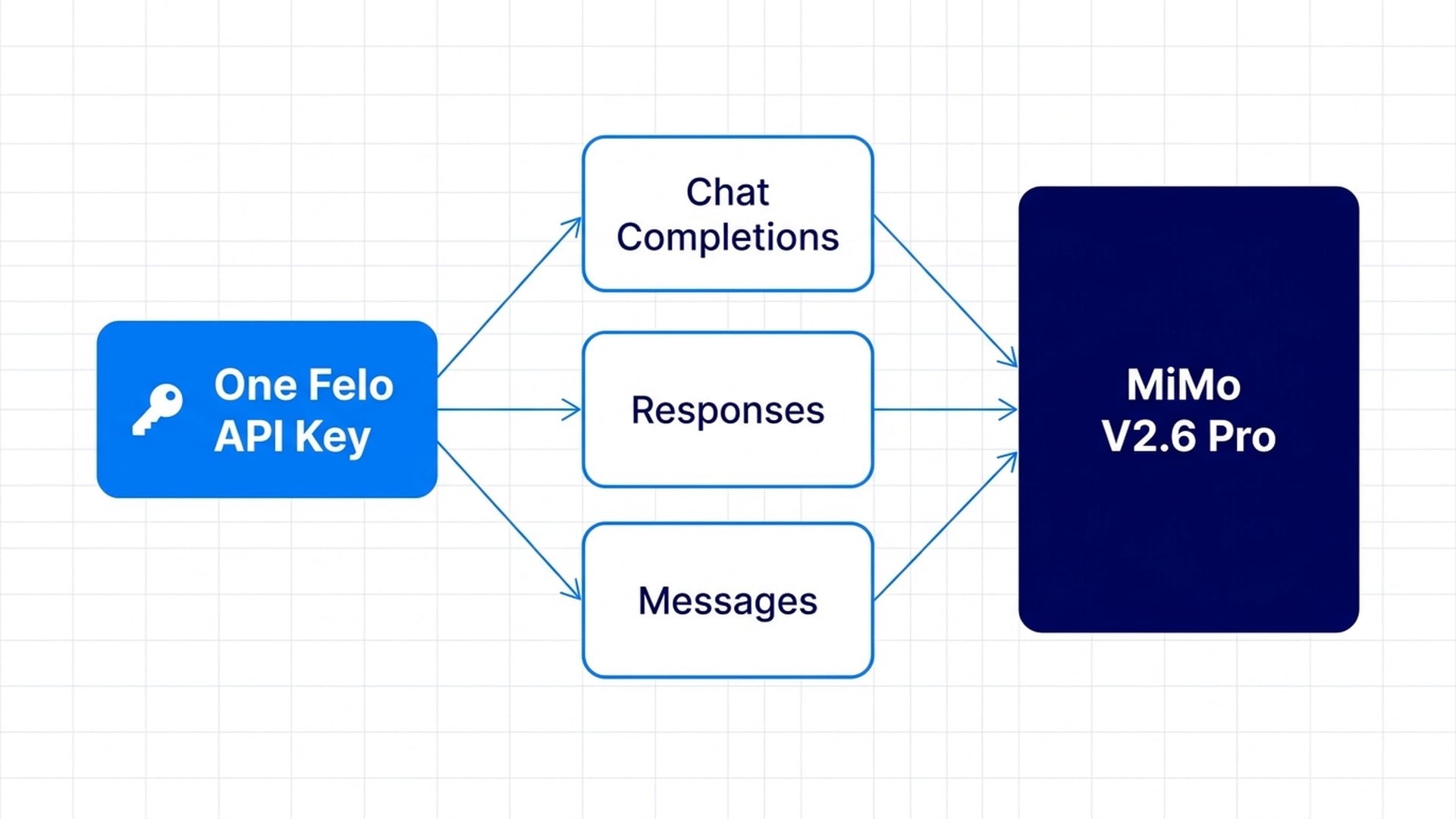
As of today, mimo-v2.6-pro is live on Felo OpenAPI. Same key you already use for Claude, GPT, and Grok routes. Same base URL. One line changed in your config.
What makes this release worth a second look is the price tag sitting next to the benchmark number. Near-frontier reasoning at $0.43 per million input tokens and $0.87 per million output tokens changes what an agent loop can afford to do.
What Xiaomi Actually Shipped
The announcement is unusually candid for a flagship launch, which makes it easier to summarize honestly.
MiMo V2.6 Pro is Xiaomi's trillion-parameter flagship, and it is the strongest open-weights model on the board right now. Xiaomi states that plainly, then states the counterpoint itself: there is still a gap between it and the strongest closed models, Claude Fable 5.1 and GPT-6 Astra. On most agent benchmarks, Xiaomi claims parity with Claude Opus 5 and GPT-5.6 Sol.
That is a vendor's own scoreboard. Treat it the way you would treat any launch table, as a claim rather than a result. But two things about this release are checkable in a way benchmark claims usually are not.
The weights are public. MiMo V2.6 Pro and Flash both shipped with open weights, a technical report, and the reinforcement learning code that produced them. You can self-host, fine-tune, or verify.
The training run was public, too. Xiaomi ran the RL phase live over roughly six days. Pro and Flash completed 30 training steps each, collecting close to 750,000 trajectories between them; the Pro run alone is reported at about $2.62 million. On DeepSWE v1.1, an out-of-sample long-horizon software engineering benchmark, the Pro model moved from 48.8 to 65.7.
Alongside the weights, Xiaomi open-sourced more than 7,000 reinforcement learning task environments spanning software engineering, vulnerability reproduction, knowledge-intensive work, and web design — the training material, not just the result.
The Spec Sheet
| Spec | MiMo V2.6 Pro |
|---|---|
| Model ID | mimo-v2.6-pro |
| Maker | Xiaomi |
| Scale | Trillion-parameter flagship |
| Context window | 1,000,000 tokens |
| Max output | 128,000 tokens |
| Input | Text, image, video, audio |
| Output | Text |
| Capabilities | Reasoning, tool calling, structured output, streaming |
| Intelligence Index | 46 (Xiaomi reports 46.32) |
Two rows deserve attention.
The input side is omni-modal. Text, images, video, and audio all enter the same prompt. Most models at this price point read text and maybe a screenshot. Feeding a screen recording, a stack of frames, or an audio track without a transcription step in between is a different kind of task, and it is where the model's training effort went.
The context window is a million tokens. The training run itself used 1M-token context rather than bolting the window on afterward, and Xiaomi positioned the model for multimodal, multi-agent, and multi-harness work. Codebase-wide questions, year-long document sets, and long agent threads fit without a compression step.
Xiaomi also demonstrated the model on work that is easy to verify after the fact. It produced a full Lean 4 formalization of the main theorem in Period Three Implies Chaos, over 6,000 lines of source whose proof the Lean kernel checks with no unproven placeholders. Separately, it worked alongside Xiaomi's materials researchers to design metal-organic framework candidates for capturing PFAS pollutants. Benchmarks can be gamed. A proof that compiles cannot.
What Felo OpenAPI Adds
Calling a model is the easy part. The reason to run MiMo V2.6 Pro through Felo OpenAPI rather than wiring up another provider account is that the model lands inside a stack that is already connected.
One key, three protocols. Felo OpenAPI exposes the model on every surface your client might speak:
| Surface | Endpoint | Use it for |
|---|---|---|
| Chat Completions | https://openapi.felo.ai/api/v1/chat/completions | OpenAI-compatible apps and agents |
| Responses | https://openapi.felo.ai/api/v1/responses | Agent and workflow requests |
| Messages | https://openapi.felo.ai/api/v1/messages | Anthropic-compatible clients |
Point an existing OpenAI SDK at https://openapi.felo.ai/api/v1, or a Claude-style client at https://openapi.felo.ai/api, and set the model ID. There is no separate account, no second billing relationship, and no provider-specific SDK to learn.
It drops into the agents you already run. Felo OpenAPI lists MiMo V2.6 Pro as usable with Claude Code and Codex, the same way the Claude and GPT routes are. If you have an agent pointed at Felo today, adding this model is a config change.
The model is not alone. This is the part that separates a gateway from a platform. Search, web fetch, X search, YouTube subtitles, PPT generation, mindmaps, LiveDocs memory, and SuperAgent workflows sit behind the same key. A model with a million-token context and omni-modal input is only useful if it can also reach fresh information and produce something at the end. On Felo it can.
The previous generation, mimo-v2.5-pro, is already on the platform. V2.6 is the upgrade, and switching between them costs nothing but an edit.
What that looks like end to end
A competitive brief is a good test case, because it needs every capability at once. On Felo OpenAPI, one key covers the whole loop:
- Web Fetch pulls three competitor pricing pages as Markdown.
- Search fills in what the pages do not say — funding, headcount, recent launches.
- MiMo V2.6 Pro reads all of it in a single 1M-token context, alongside a screenshot of each pricing table, and reasons across text and image together rather than over an OCR transcription.
- PPT API turns the conclusion into a deck.
The alternative is four vendors, four keys, four invoices, and a glue layer you maintain yourself. That glue is the tax this stack removes, and it is usually the reason an agent demo never becomes an agent product.
Quick Start
Three steps from zero to a response.
1. Get an API key from your Felo API Platform account and export it.
export FELO_API_KEY="YOUR_API_KEY"
2. Make your first request. The model ID is mimo-v2.6-pro.
curl https://openapi.felo.ai/api/v1/chat/completions \
  -H "Authorization: Bearer $FELO_API_KEY" \
  -H "Content-Type: application/json" \
  -d '{
    "model": "mimo-v2.6-pro",
    "messages": [
      {"role": "user", "content": "Summarize the tradeoffs between sparse and dense attention."}
    ]
  }'
Or through the OpenAI SDK, with nothing changed but the base URL:
import os
from openai import OpenAI

client = OpenAI(
    api_key=os.environ["FELO_API_KEY"],
    base_url="https://openapi.felo.ai/api/v1",
)

completion = client.chat.completions.create(
    model="mimo-v2.6-pro",
    messages=[{"role": "user", "content": "Explain the tradeoffs between sparse and dense attention."}],
    max_tokens=1024,
)
print(completion.choices[0].message.content)
3. Turn on streaming by adding stream: true.
curl -N https://openapi.felo.ai/api/v1/chat/completions \
  -H "Authorization: Bearer $FELO_API_KEY" \
  -H "Content-Type: application/json" \
  -d '{
    "model": "mimo-v2.6-pro",
    "stream": true,
    "messages": [{"role": "user", "content": "Hello"}]
  }'
One practical note for multi-turn work: this is a reasoning model. If your protocol or route exposes reasoning controls, keep the reasoning metadata that comes back and pass it forward when you continue the conversation. Dropping it mid-thread is the most common way to make a reasoning model look worse than it is.
The Cost Math
This is where MiMo V2.6 Pro earns its place. Published Felo OpenAPI rates, per million tokens:
| Model | Input / M | Output / M |
|---|---|---|
| GPT-6 Astra | $10.00 | $50.00 |
| Claude Opus 5.5 | $4.00 | $20.00 |
| GPT-6 Sol | $2.00 | $10.00 |
| MiMo V2.6 Pro | $0.43 | $0.87 |
| DeepSeek V4.1 Flash | $0.15 | $0.60 |
| GLM 5.3 Flash | $0.15 | $0.50 |
Those are Felo OpenAPI's published rates across the whole catalog, which makes the comparison fair: same platform, same key, same invoice. For MiMo V2.6 Pro, the number matches Xiaomi's own list price, $0.435 input and $0.87 output. The route passes the model through at list rather than marking it up.
Now run the arithmetic on a realistic agent workload. Say your loop reads a 200,000-token repository slice, produces 20,000 tokens of changes, and runs 50 times a day:
- 10M input tokens per day, 1M output tokens per day
- On GPT-6 Astra: $100 + $50 = $150 per day
- On Claude Opus 5.5: $40 + $20 = $60 per day
- On MiMo V2.6 Pro: $4.30 + $0.87 = $5.17 per day
That is roughly 29x cheaper than GPT-6 Astra for the same shape of work, on a model Xiaomi claims sits near Claude Opus 5 and GPT-5.6 Sol on agent benchmarks. The claim is the vendor's; the price is a fact. If the claim holds even two-thirds true, the economics of running agents change.
The second-order effect matters more than the saving itself. When a loop costs $5 a day instead of $150, you stop trimming context to save money. You stop downgrading to a weaker model for the boring steps. You let it run again with a bigger prompt. Most agent quality problems are budget problems in disguise.
Where It Fits, and Where It Doesn't
Reach for it when you need multimodal reasoning over images, video, or audio; long-context analysis where the whole document has to stay in view; agentic tasks that burn tokens all day; video understanding; or anything where you want an open-weights model whose behavior you can inspect and whose weights you can self-host later.
Do not reach for it when you need the absolute ceiling on the hardest reasoning and cost is not the constraint. Xiaomi says it themselves: Claude Fable 5.1 and GPT-6 Astra are still ahead. If you are running one high-stakes task a day, pay for the frontier.
One expectation to set before you switch a latency-sensitive endpoint over: Felo classifies this route's latency as deep, meaning it reasons before it answers. That is the right trade for analysis and agent planning, and the wrong one for autocomplete or real-time chat, where a fast tier serves you better.
The short version: this is the model you run when you want most of the quality without most of the bill. The bill is what compounds.
Common Questions
Is MiMo V2.6 Pro the same as MiMo V2.6 Flash? No. Flash is the cheaper, faster sibling from the same release, and it is not currently on Felo OpenAPI. Pro is the flagship route.
Which endpoint should I call?
If you are already using an OpenAI SDK, use Chat Completions at https://openapi.felo.ai/api/v1/chat/completions. If you are on a Claude-style client, use the Anthropic-compatible surface at https://openapi.felo.ai/api. The Responses endpoint suits agent and workflow requests.
Does it support tool calling and structured output? Yes. Felo OpenAPI lists reasoning, tools, JSON, streaming, and vision as supported capabilities for this route. Tool definitions follow the compatible schema, so existing tool-calling code carries over.
Can I still self-host it? That is the point of open weights. Xiaomi published the weights and the technical report, so a route through Felo today does not lock you in tomorrow.
How does it compare to the closed flagships? Xiaomi's own framing is the fair one: ahead of every other open-weights model, still behind Claude Fable 5.1 and GPT-6 Astra, roughly level with Claude Opus 5 and GPT-5.6 Sol on most agent benchmarks. The column worth reading is the last one: capability per dollar.
Try MiMo V2.6 Pro
Get a key from the Felo API Platform, point your base URL at https://openapi.felo.ai/api/v1, set the model to mimo-v2.6-pro, and run the workload you have been rationing. The model page has the full spec, current pricing, and copy-paste samples in TypeScript, Python, cURL, and Claude Code.
Explore MiMo V2.6 Pro on Felo OpenAPI →
This post is also available in 简体中文, 日本語, 한국어, 繁體中文, हिन्दी, Français, العربية, Русский, اردو, Bahasa Indonesia, Deutsch, Tiếng Việt, Türkçe, Italiano, ไทย, Español, বাংলা and Português.