OpenClaw Memory vs Mem0: Which AI Memory Tool Is Right for Developers?

Comparing OpenClaw memory (MemClaw) and Mem0 for developers. Which tool gives Claude Code better persistent memory? Honest feature comparison.
OpenClaw Memory vs Mem0: Which AI Memory Tool Is Right for Developers?
Both OpenClaw memory (MemClaw) and Mem0 solve the same core problem: AI assistants forget everything between sessions. But they solve it differently, for different audiences, with different trade-offs. If you're a developer trying to decide which one to use with Claude Code, this comparison will save you the trial-and-error.
The Short Version
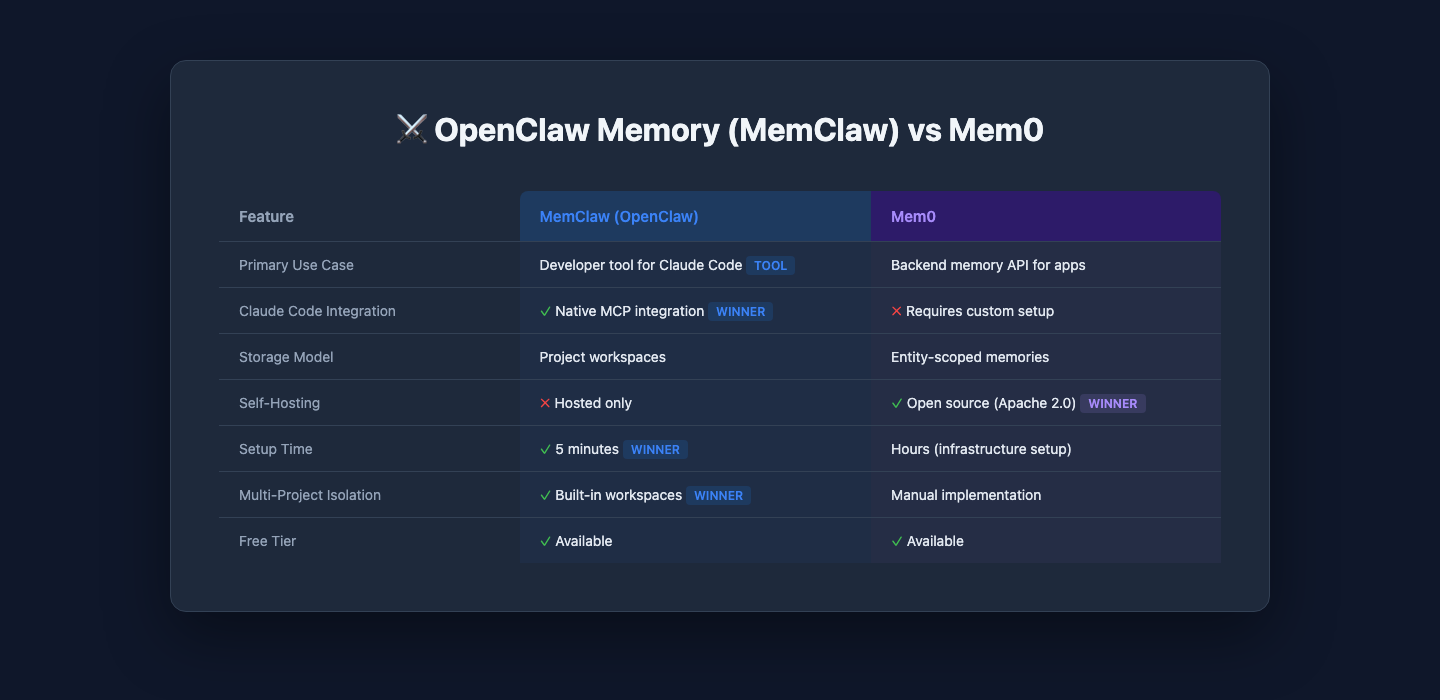
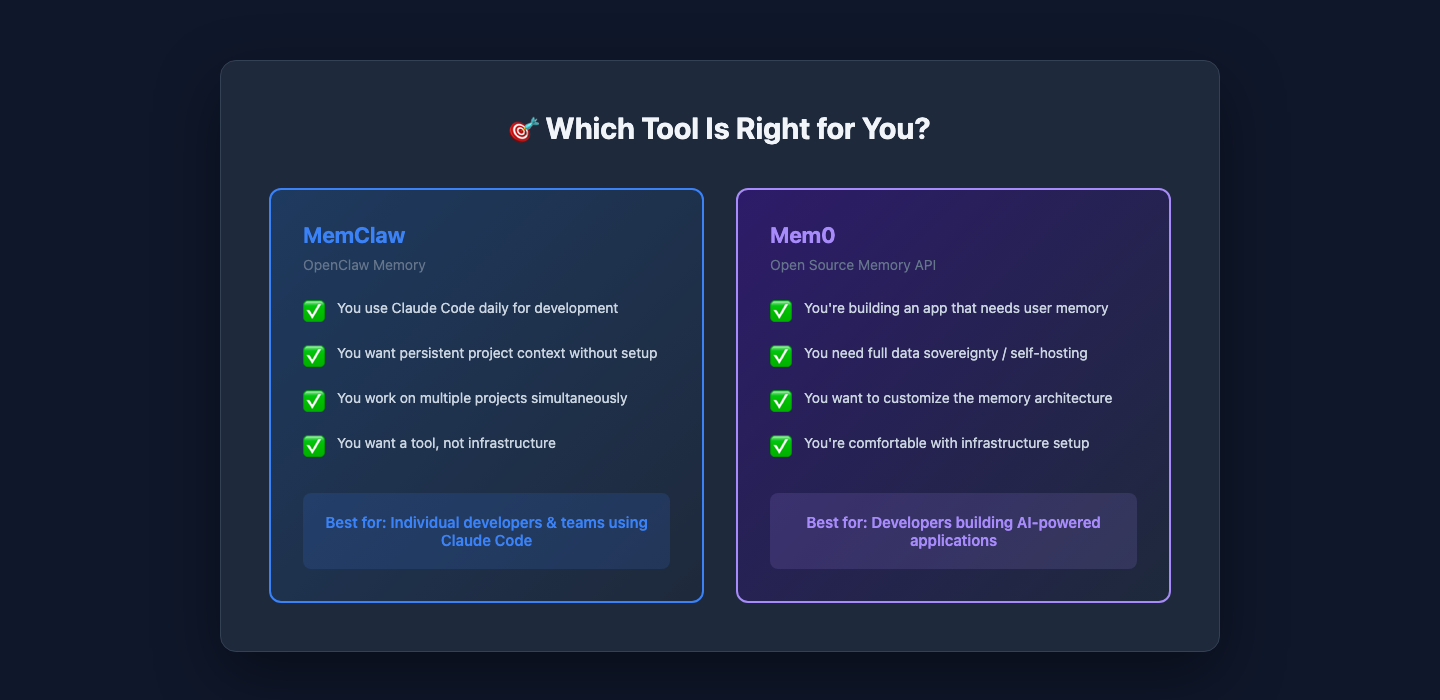
Use MemClaw (OpenClaw memory) if: You're a developer using Claude Code and want persistent project context with minimal setup. You think in terms of projects and workspaces. Use Mem0 if: You're building an application that needs user-level memory as a backend service. You want an API you can call programmatically to store and retrieve memories. They're not really competing for the same user. But if you're a developer who's evaluated both, here's the full picture.
What Is Mem0?
Mem0 is an open-source memory layer for AI applications. It's designed to be embedded into products — you call the Mem0 API to store memories when users interact with your app, and retrieve them when you need context. It's infrastructure. You build on top of it. Mem0 supports multiple storage backends (vector databases, graph databases, key-value stores), has SDKs for Python and JavaScript, and can be self-hosted or used as a managed service. Primary audience: Developers building AI-powered applications who need user memory as a feature.
What Is OpenClaw Memory (MemClaw)?
MemClaw is a workspace-based memory tool for developers using Claude Code. You create workspaces for your projects, store context in them, and connect them to Claude Code via MCP. Claude reads from your workspace at session start and on demand. It's a tool, not infrastructure. You use it directly. Primary audience: Developers using Claude Code who want their AI assistant to remember their projects.
Feature Comparison
Claude Code Integration
This is where MemClaw has a clear advantage for Claude Code users. MemClaw is built specifically for the Claude Code workflow. The MCP integration means Claude can query your workspace mid-session without any extra prompting. You configure it once, and it works. Mem0 doesn't have a native Claude Code integration. You could build one — write a custom MCP server that wraps the Mem0 API — but that's engineering work on top of the tool you're trying to use. If your primary goal is "make Claude Code remember my project," MemClaw is the faster path.
Storage Model: Workspaces vs. Memories
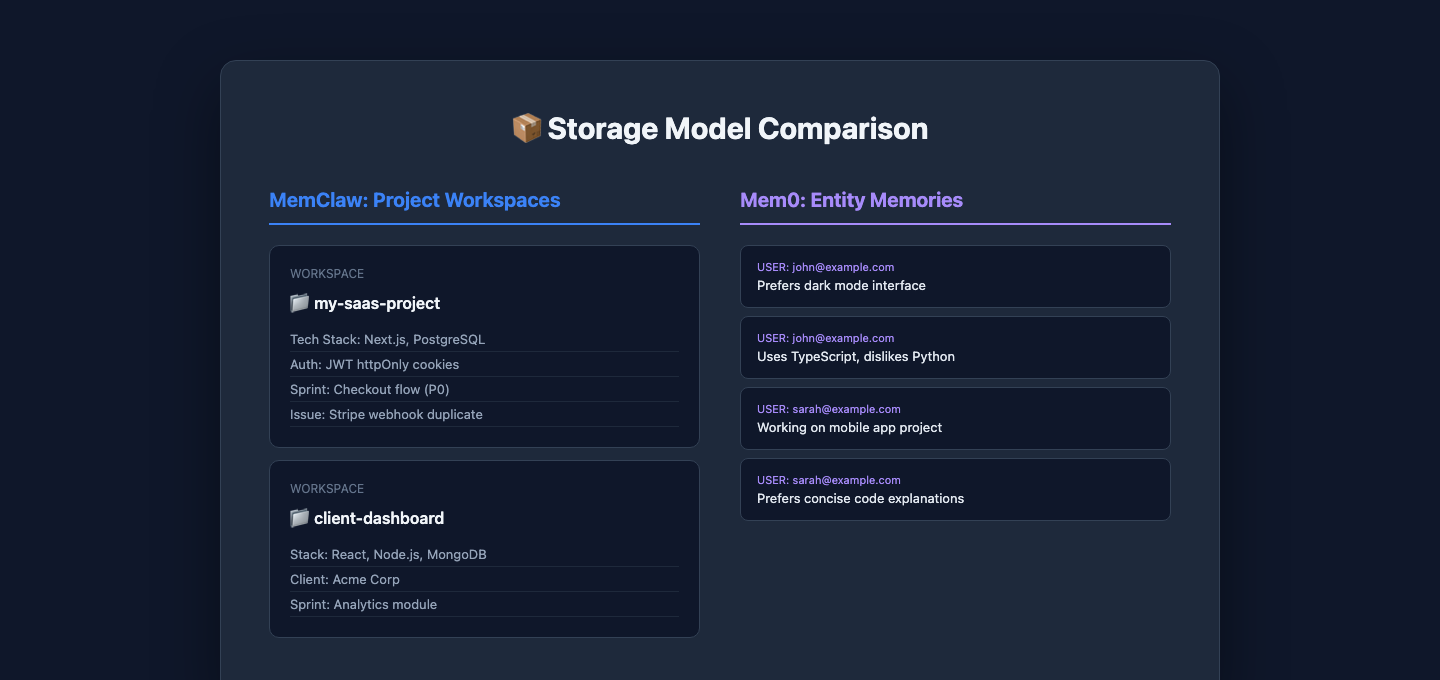
The conceptual difference matters for how you think about your data. MemClaw workspaces are project-scoped containers. You put everything related to a project in one workspace: architecture notes, decisions, conventions, conversation history. Switching projects means switching workspaces. It maps naturally to how developers think about their work. Mem0 memories are entity-scoped facts. The system extracts and stores discrete memories ("user prefers Python over JavaScript," "project uses PostgreSQL") and retrieves relevant ones based on the current query. It's more granular and more automatic — but also less predictable. For a developer who wants to explicitly control what Claude knows about their project, workspaces are more intuitive. For an application that needs to automatically learn user preferences over time, Mem0's approach is more powerful.
Self-Hosting and Open Source
Mem0 is open source (Apache 2.0). You can run it entirely on your own infrastructure, inspect the code, and modify it. For teams with strict data residency requirements or who want full control, this matters. MemClaw is a hosted service. Your data lives on MemClaw's servers. There's no self-hosting option currently. If data sovereignty is a hard requirement, Mem0 wins by default.
Pricing Reality
Both have free tiers. Both have paid plans for heavier usage. Mem0's pricing is API-call based — you pay per memory operation. For a developer using it personally with Claude Code (via a custom integration), costs are low. For an application with many users, costs scale with usage. MemClaw's pricing is workspace/feature based. For individual developers, the free tier covers basic usage. Team features and larger workspaces require paid plans. Neither is expensive for individual use. Evaluate based on your actual usage pattern.
The Honest Recommendation
For most developers reading this: start with MemClaw. The Claude Code integration works out of the box. The workspace model matches how developers think about projects. Setup is under 15 minutes. You don't need to write any code to get persistent memory working. If you later find yourself building an application that needs user-level memory as a feature, evaluate Mem0 for that use case. It's genuinely better infrastructure for that problem. They're tools for different jobs. Use the right one for yours. Try MemClaw free at memclaw.me