Try Ox Alpha Free in Felo Search: A New Frontier AI Model

Ox Alpha is now available in Felo Search. The mystery frontier model with a 1M-token context is free to use - try it at felo.ai/search right now.
This week, a frontier AI model appeared out of nowhere. Nobody will claim it.
Ox Alpha surfaced on August 20 as a stealth model with serious benchmark results and no official owner. It processes 1 million tokens of context at once, reads text, images, and video, and costs nothing during its preview period. As of today, it is also available right inside Felo Search.
You can chat with Ox Alpha in your browser without an API key, without a subscription, and without ever seeing a billing page. Here is what it is and how to try it.
What Is Ox Alpha?
Ox Alpha is a reasoning model built for heavy lifting: efficient coding, sustained agentic work, and production-grade workloads. It shipped as a stealth release with no named lab behind it, which is why its real maker is still a guessing game. Rumors point at Chinese labs, at a rebranded open model, and at a few small teams with big compute. None of it is confirmed, and the mystery is genuinely part of the fun.
What matters to you is what the model can do:
| Feature | Details |
|---|---|
| Context window | 1,048,576 tokens. Feed it an entire codebase or a full research stack. |
| Inputs | Text, images, and video (outputs text) |
| Reasoning | Built for long-horizon reasoning on complex tasks |
| Tool use | Function calling for agentic workflows |
| Data privacy | Zero data retention. Your prompts are not used for training. |
A model that can take a million tokens in one go is not a bigger autocomplete. It can hold your entire project in its head: the code you wrote last month, the papers you are comparing, the whole thread of a research problem, all of it visible at once. Then it reasons over everything in a single pass.
Developers are already posting what they do with that space. One engineer wrote a GPU-accelerated fluid simulation as a single 1,000-line HTML file, in one shot. His earlier models needed multiple rounds just to approach it. Those are early, individual reports, but they describe a pattern: this model does its best work when you hand it the whole problem instead of feeding it piece by piece.

Why Ox Alpha Is Worth a Spin in Felo Search
Felo Search is built on a simple idea: ask a question, get a synthesized answer. No link hunting, no tab forests, no sorting through the same ten results everyone else sees. Swapping in Ox Alpha changes the tier of answer.
It is the trickiest questions where the difference shows. Ox Alpha's reasoning is tuned for problems with many moving parts. "Compare the privacy trade-offs of federated learning and on-device AI for health apps" used to be a dozen separate searches. Now it comes back as one coherent answer, with the caveats argued out instead of skipped.
Size matters too. Paste in a long legal document, a GitHub issue thread, or an afternoon of meeting transcripts. The million-token window means Felo does not have to compress anything away. Follow-up questions stay grounded in the original material instead of whatever a summary box still remembers.
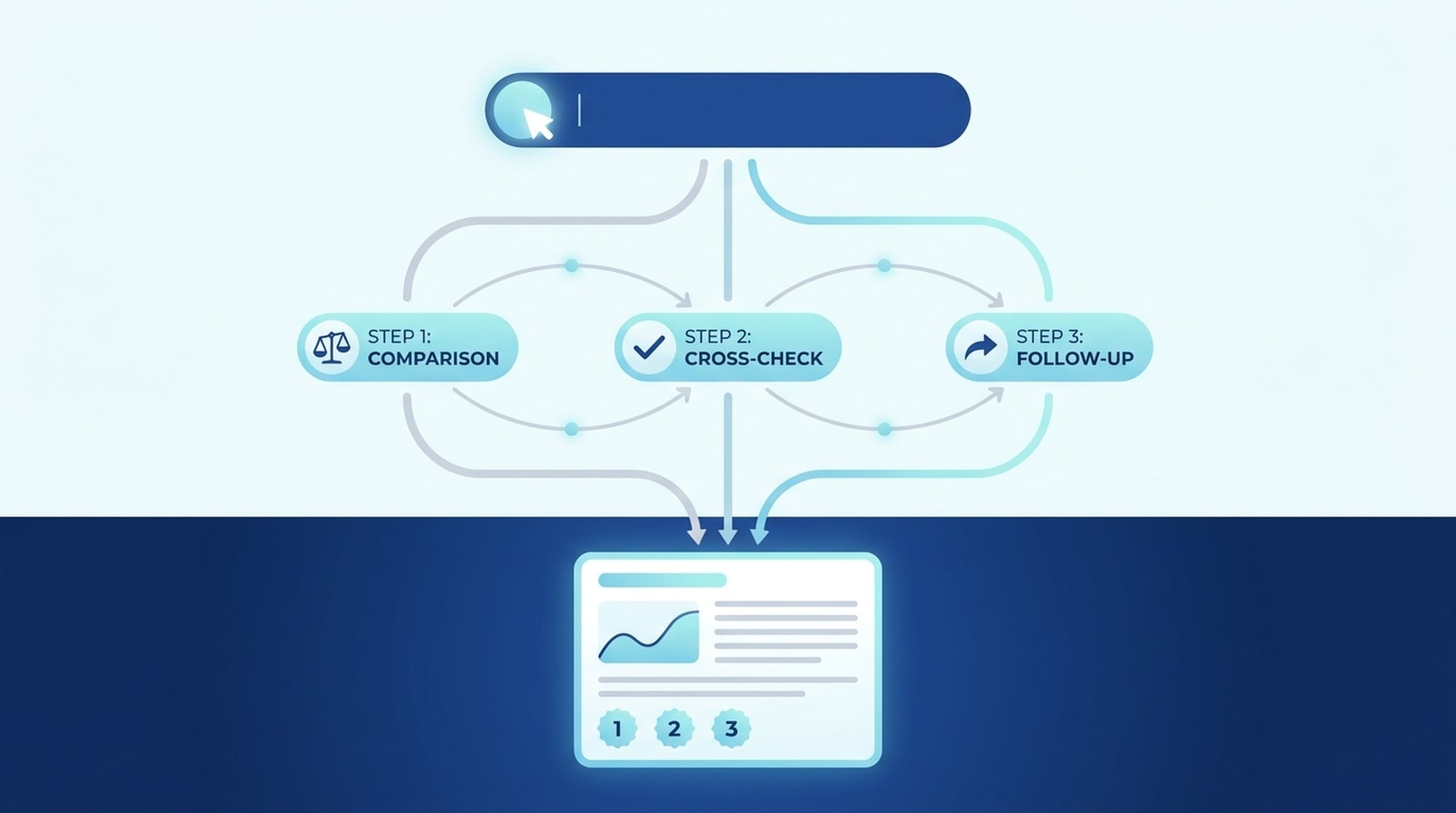
And Ox Alpha is built to plan and iterate, which pairs naturally with Felo's multi-step search agents. Research chains checks, comparisons, and follow-ups, rather than stopping at the first passable answer. Felo Search's multilingual core still applies on top of that: ask in English, Japanese, Chinese, or any of the other languages Felo supports, and Ox Alpha answers in kind.
All of this is free right now. The benchmark hype around Ox Alpha deserves some skepticism, which is worth unpacking below, but at zero cost, a few minutes of curiosity is a fine investment.
Who Should Try It First
Three kinds of questions make Ox Alpha earn its keep.
The everything-at-once question. Researchers: drop a dozen papers' worth of notes into one query and ask for the contradictions. The million-token window keeps every detail on the table, including the ones that fight your hypothesis. That is where thesis statements get saved.
The trace-and-context question. Developers: stack the crash log, the failing test fixture, and the three pull requests that touched the offending file, then ask what the actual bug is. Give it the entire story and it argues with the stack trace like a colleague who already read the whole repo.
The two-versions-of-the-truth question. Analysts: two data sources disagree, and reconciling them normally takes a meeting. Say both versions out loud in one prompt and ask where the discrepancy comes from. Ox Alpha will walk through which number is wrong and why.
There is one more audience worth calling out: anyone who never finishes long reports. Paste the 80-page PDF and ask which parts actually change your decision. Then challenge it on every page. It remembers the whole document, so the argument stays honest.
That last point is the one people underestimate. A search engine that forgets turns every query into a transaction: ask, get, re-ask. A front end built on this context window holds the thread from question to follow-up to cross-check. Conversation instead of queries.
How to Use Ox Alpha in Felo Search
Around ten seconds, start to finish:
-
Go to felo.ai/search.
-
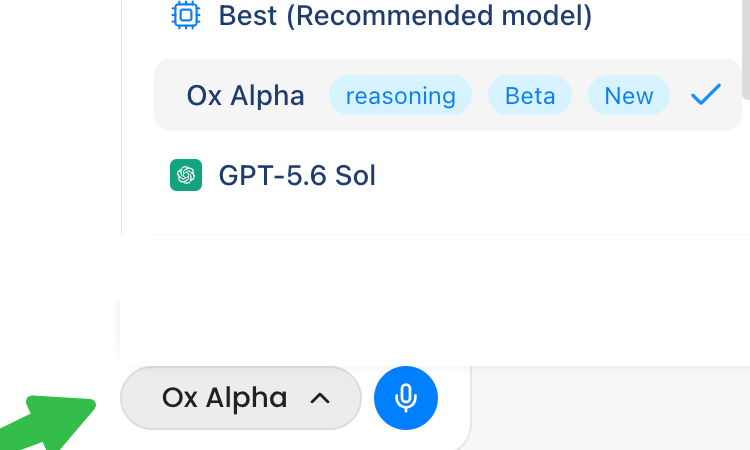
Look for the model name right next to the microphone button, just below the search input. Click it to open the model panel. Ox Alpha sits at the top of the list under "Best (Recommended model)" with
reasoning,Beta, andNewbadges — it may already be selected. Or skip straight to it via this direct link: -
Ask your question in any language. Felo Search is multilingual, so Ox Alpha works in English, Chinese, Japanese, and dozens more.
No signup for the model, no free-trial clock, no credit card. If Ox Alpha is not what you need, click back to any other model. Felo Search still lets you choose whichever fits the question, which means you can run the same prompt through two models and A/B test them yourself.
Everything else you like about Felo Search works the same way: cited sources on every answer, follow-up prompts, and responses that stay in the language you asked with.
About Those Benchmarks: Read With Caution, Try With Confidence
Ox Alpha is getting a lot of buzz, and some of it is deserved. A viral claim said it beat GPT-5.6 Sol and Claude Fable on the DeepSWE coding benchmark, but that came from a 10-question test, not an audited leaderboard. One developer's in-house ranking put it at 87.5%, second only to GLM 5.3 and ahead of Claude Opus 4.8 and Qwen 3.8 Max. Another measured about 63% on a DeepSWE subset and called it pareto-optimal among open models, just shy of Grok 4.6 against the closed ones.
Impressive, and still preliminary. The samples are small, the leaderboard is unaudited, and the author is anonymous. People building production stacks should wait for verification. That is the right instinct.
Here is the good news: you do not have to wait, and you do not have to bet. The model is free inside a search engine you probably already use. Bring your own hardest real-world question and put the claim on trial. It is the honest way to judge a mystery model anyway: ask it something you already know, and see what it comes up with.
Try Ox Alpha for Free Today
Ox Alpha showed up this week with frontier-grade specs and no shortage of hype. It is now live in Felo Search, and it costs nothing to use: no API keys, no subscriptions, no trials.
Ask it to untangle the thing you have been putting off. Paste in the document that is too long to read. See what a million-token reasoning model does with the question you cannot seem to answer.
This post is also available in 简体中文, 日本語, 한국어, 繁體中文, हिन्दी, Français, العربية, Русский, اردو, Bahasa Indonesia, Deutsch, Tiếng Việt, Türkçe, Italiano, ไทย, Español, বাংলা and Português.