Please create a highly completed, high information density 'Isometric Micro-World Archive' visual image suitable for serialized publishing based on the [Theme].
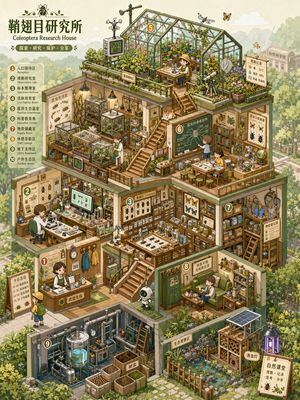
This is not an ordinary room illustration, nor a simple architectural drawing, but a thematic space overview combining 'isometric view + architectural cross-section structure + multi-level functional space + high-density thematic props + miniature model feel + game scene concept art feel'. The image should look like a sliced-open miniature world, a management simulation game scene, a dollhouse model, or a world-building concept art, allowing viewers to understand the overall structure at a glance while repeatedly observing the small details.
[Basic Settings]
Theme: [Theme, e.g., Insect Research Institute / Future Survival Base / Magic Potion Workshop / AI Automation Company / Plant Factory / Children's Learning Center / Space Supply Station]
Space Name / Brand Name: [Brand name or space name, can be empty]
Worldview Direction: [Reality / Sci-Fi / Fairy Tale / Magic / Post-Apocalyptic / Museum / Laboratory / Management Simulation / Campus / Natural Ecology]
Building Type: [Cabin / Base / Factory / Lab / Shop / Museum / Underground Space / Spaceship / Multi-story Studio]
Core Function: [What is this space mainly used for, e.g., research, production, display, living, training, trading, learning, maintenance, planting]
Main Color Tone: [Main color tone, e.g., light blue, mint green, cream yellow, pink, orange-green, purple-blue, white-blue tech color]
Secondary Color: [Secondary color, can be empty]
Accent Color: [Accent color, can be empty]
Aspect Ratio: [1:1 / 3:4 / 4:5 / 9:16]
Information Density: [Medium-High / High / Ultra-High]
Overall Vibe: [Healing, cute, precise, childlike, educational, futuristic, retro, refreshing, exploratory]
If some fields are not filled, please automatically and reasonably deduce them based on the [Theme], do not leave the image empty. All content must be generated uniformly around the theme, avoiding irrelevant elements.
[Image Structure]
Adopt a clear isometric view / axonometric view. The main subject is a sliced-open multi-story thematic building or functional base. Viewers can simultaneously see the front, side, top, and internal space of the building. The overall building is located in the center of the image, occupying the main area, with the background environment moderately faded to highlight the subject.
The interior of the building needs to be divided into multiple functional areas, each with a clear purpose, rather than randomly stacked decorations. It can include:
1. Main workspace / Core operation area
2. Display area / Collection area / Specimen area
3. Research area / Experiment area / Control area
4. Storage area / Shelf area / Supply area
5. Living area / Rest area / Small residential area
6. Energy area / Machine area / Pipeline area
7. Planting area / Cultivation area / Ecological area
8. Entrance area / Transport area / Maintenance area
9. Spatial connection structures like stairs, platforms, corridors, railings, ladders, etc.
Clear spatial relationships must be formed between various areas through stairs, corridors, platforms, pipes, bridges, or cables, making the image look like a real, operable small system.
[Props and Details]
Generate a large number of related props based on the [Theme] and distribute them in different functional areas. Props need to be specific, recognizable, and thematically relevant, not just general decorations. Every small object should be clearly readable like a game asset, with a clickable, interactive, and collectible feel.
Prop types can include:
- Thematic equipment: machines, instruments, tools, consoles, containers, screens, workbenches
- Living objects: tables and chairs, bookshelves, beds, cups, boxes, cabinets, lamps
- Display objects: specimens, models, posters, explanation boards, glass cabinets, display racks
- Connection structures: pipes, wires, ladders, stairs, conveyor belts, slide rails, platforms
- Ecological elements: plants, water tanks, incubators, soil, branches, rocks, specimens
- Character elements: a small number of tiny people, small animals, robots, or thematic creatures to provide a sense of scale and story
The number of props should be rich but orderly. All props should serve the spatial function and thematic worldview.
[Style Requirements]
The overall style is a clear, cute, precise hand-drawn cartoon isometric illustration. Clean lines, slightly rounded edges, bright and soft colors, with an overall relaxed, healing, and exploratory feel. The image should have the feel of a management simulation game, children's educational picture book, miniature model, or concept art page.
Avoid excessive realism, strong dark lighting, heavy oil painting feel, and complex noise. The focus is on being clear, exquisite, layered, and highly readable.
[Color and Lighting]
Use soft color schemes with high brightness and low to medium saturation. The main color tone should be unified, secondary colors used to distinguish different spaces, and accent colors used to highlight key equipment and small props. Do not use dead black for line art; use soft outlines like dark gray, blue-gray, or brown-gray.
Keep lighting lightweight, no need for strong realistic shadows. Establish layers through color blocks, structures, lines, and local highlights. Treat the background with light colors and low contrast to make the main building stand out more.
[Composition and Reading Path]
The main subject of the image is centered or slightly upwards, with the building presenting a multi-story cross-section structure. The visual reading path should start from the overall building outline, then enter the functional areas on each floor, and finally observe the detailed props. Sightlines can be guided through elements like stairs, platforms, corridors, pipelines, and tracks.
The overall image should be full but not crowded, rich but not chaotic. Every room, platform, and corner should have content, but still maintain clear spatial boundaries.
[Background Environment]
The background can include a weakened external environment based on the theme, such as forests, cities, streets, underground rock layers, experimental parks, seabed, space, campus, factory exterior walls, etc. The background should not overpower the subject; it is recommended to use light colors, low opacity, and low contrast treatments to form an effect of 'clear subject, receding background'.
[Final Effect]
The final image should look like a complete thematic space concept art, possessing the structural feel of an architectural cross-section, the detailed feel of game scene assets, and the cute exploratory feel of a miniature dollhouse. It should be suitable for serialized visual creation, IP worldview display, game scene concept art, brand space concept art, educational content covers, or Xiaohongshu/Pinterest style visual publishing.
Please ensure the image:
1. Has a clear isometric view
2. Has a clear architectural cross-section structure
3. Has complete multi-story functional areas
4. Has rich and thematically unified props
5. Has soft and bright colors
6. Has clear and clean line art
7. Has a weakened background and prominent subject
8. Has high information density but is not chaotic
9. Has a miniature world feel that is explorable, operable, and repeatedly observable