01
Hold the whole context
A 1M-token window and a June 2026 knowledge cutoff, so a long thread, a full repository, or a document set can stay in one task.
Anthropic released Opus 5.5 on September 22, 2026
The first model in Anthropic's Claude 5.5 family. It performs at the level of Claude Fable 5.1 on most work, costs 40% less to run than Opus 5, and generates output more than 30% faster.
Now in Felo Search
Claude Opus 5.5 is available in Felo Search for work that spans long inputs: reconciling figures across files, tracing a claim back to its source, and returning an answer you can hand to someone else.
01
A 1M-token window and a June 2026 knowledge cutoff, so a long thread, a full repository, or a document set can stay in one task.
02
In Anthropic's internal test, 16 of 18 reports cleared its quality bar on a task where one invented figure or quote would have failed the run.
03
Anthropic rewrote how the model communicates: the most important information comes first, and the report states plainly what is done, what was found, and what is still open.
Quick walkthrough
Claude Opus 5.5 appears in the model picker alongside the other leading models on your account.
The Opus 5.5 difference
Anthropic's own framing is efficiency rather than a higher benchmark number: fewer tokens per task, a lower price per token, and a 40% lower cost on typical workloads. That is what makes long-running agent work affordable to leave running.
01
Anthropic reports an early tester auditing and fixing a 200,000-line codebase in under three hours, where Opus 5 took over 20 hours and 2.5x as many tokens.
02
Deloitte reported that at its lowest effort setting Opus 5.5 caught 72% of known bugs in code review, against 56% for Opus 5 at high effort, with fewer false alarms.
03
Its writing is shorter and better structured. Box reported answers 40% less verbose without losing accuracy, and a third of the tokens Opus 5 used.
Model selection
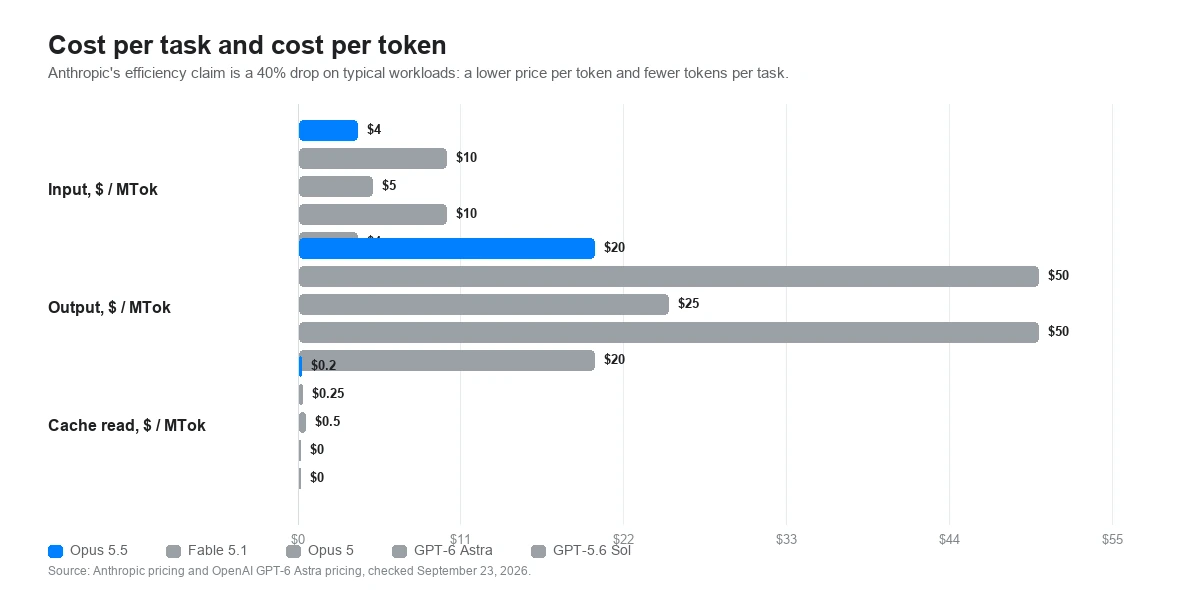
Prices below are official public API rates per million tokens, not Felo subscription or usage prices. The effort row matters as much as the price row: the same prompt can cost very different amounts depending on where each model starts.
Public API rates and defaults checked against Anthropic's Claude Opus 5.5 announcement, the Claude Platform model pages, and OpenAI's GPT-6 Astra page on September 23, 2026. Token price is only one part of total task cost; Anthropic's own efficiency claim is a 40% drop on typical workloads, which combines a lower price per token with fewer tokens per task.
Anthropic's published results
Anthropic published its own numbers beside Fable 5.1, Opus 5, GPT-6 Astra, and GPT-5.6 Sol. Two of the four charts below are accuracy against cost per task rather than accuracy alone, because that is the comparison Anthropic is making.
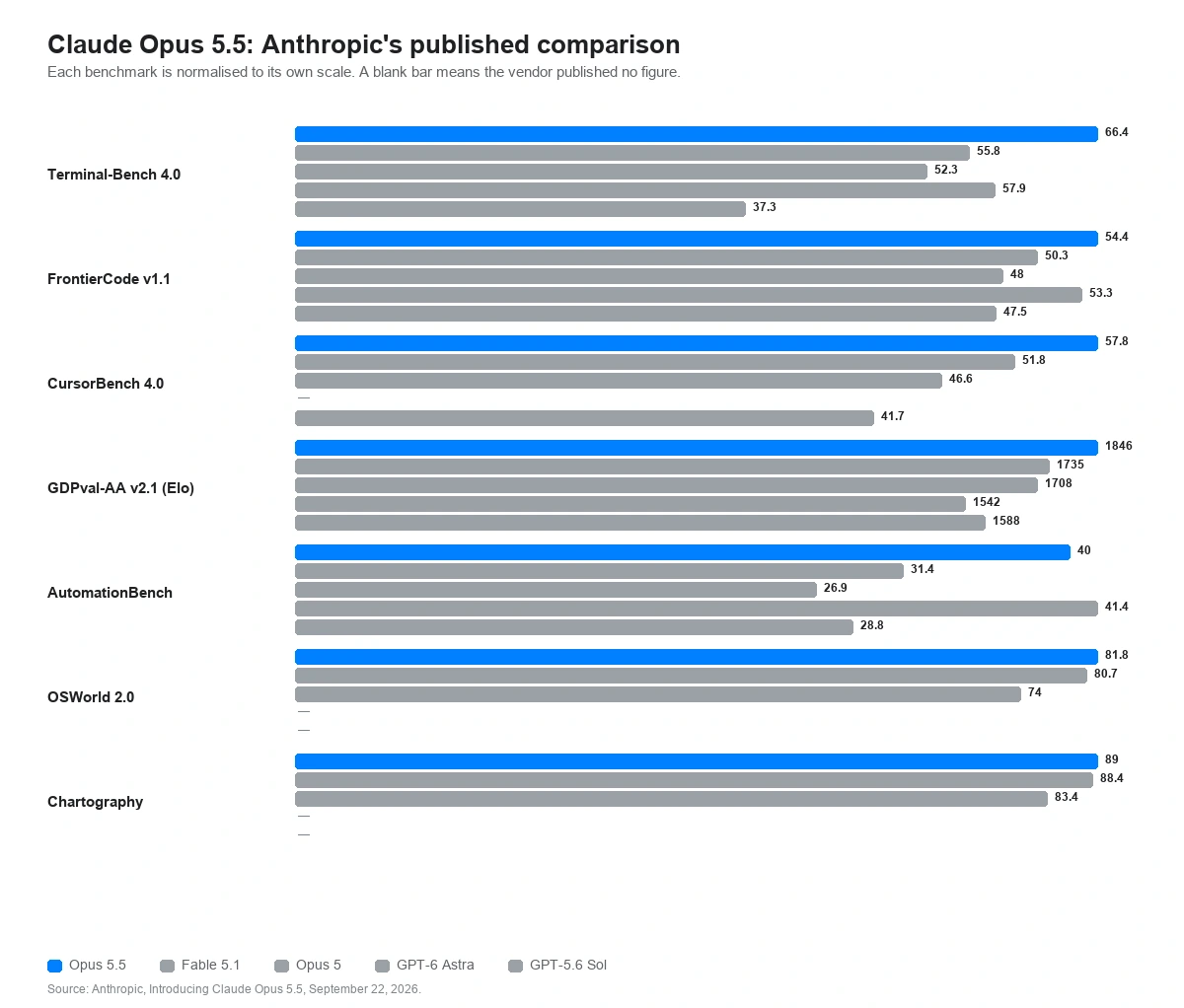
The full published comparison
Agentic coding, knowledge work, business workflows, multidisciplinary reasoning, scientific research, computer use, and visual chart recognition, across all five models Anthropic measured.
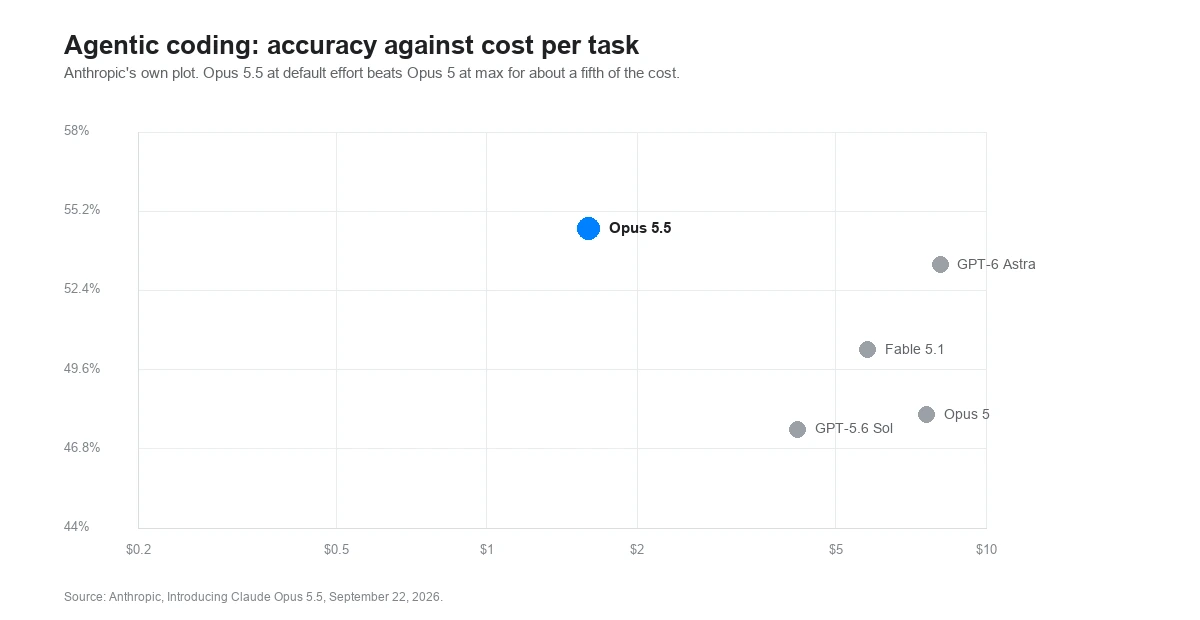
Agentic coding
Terminal-Bench 4.0, FrontierCode v1.1, and CursorBench 4.0, plotted as accuracy against cost per task.
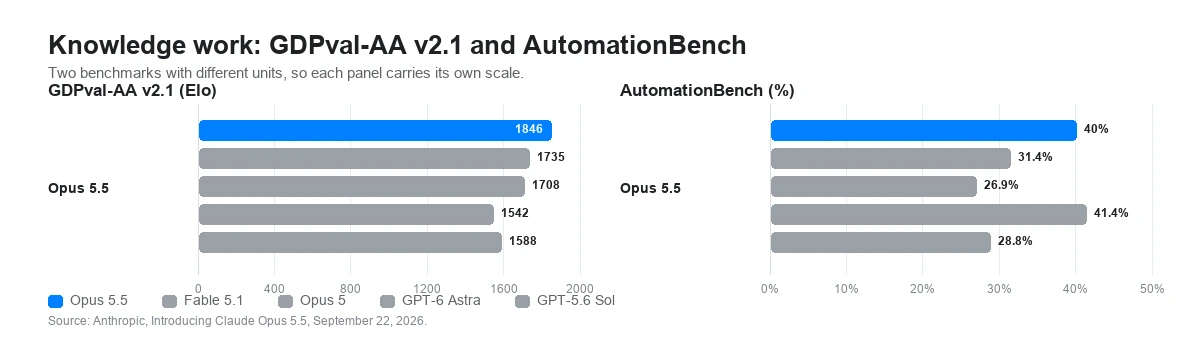
Knowledge work
GDPval-AA v2.1 across 44 occupations, AutomationBench, and Perplexity's WANDR data-collection benchmark.
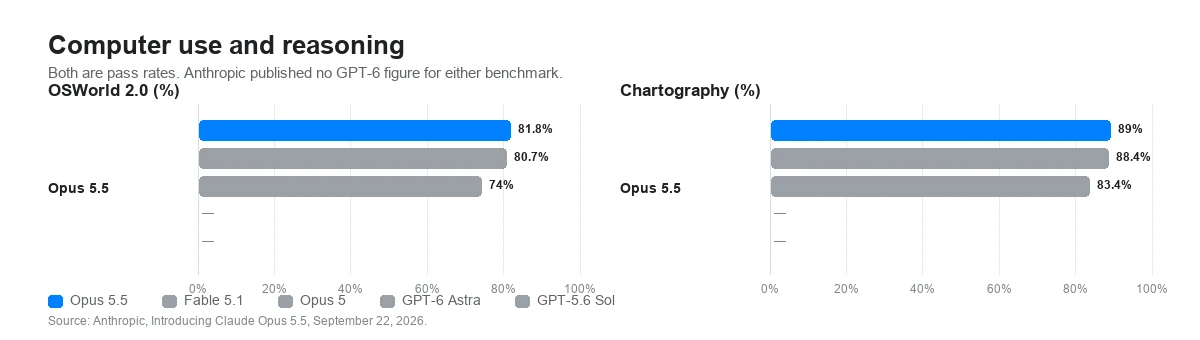
Computer use and reasoning
OSWorld 2.0, Humanity's Last Exam, and Chartography, the last of which measures reading values off a chart.
Accuracy against cost per task
Anthropic's central claim is not a higher score at any price, but the same or better score at a fraction of the cost per attempt.
Vendor-published results. Unless noted otherwise, Anthropic ran Opus 5.5 with adaptive thinking at max effort, and evaluated it with production safeguards enabled; when those safeguards intervened, cybersecurity tasks were completed by Opus 4.8 and biology tasks by Opus 5, which likely lowers the published Opus 5.5 figures on those benchmarks. GPT-6 Astra and GPT-5.6 Sol figures are as reported by OpenAI. Treat cross-vendor benchmark margins as a weak guide to real-world differences, which is what Anthropic itself says about these numbers.
If you already run Opus 5
Anthropic lists four breaking changes for integrations already running on Claude Opus 5, plus a fifth change that alters the response shape without failing any request. They are worth reading before you swap the model ID, because three of them return a 400 error rather than degrading quietly.
01
On Opus 5, thinking could be disabled at high effort or below. On Opus 5.5 it is always on, and both the disabled form and a manual token budget return a 400 error. Effort is now the only control, and its default is medium rather than high.
thinking: {"type": "disabled"} -> 400 invalid_request_error
02
tool_choice set to "any" or to a named tool returns a 400 error, including on the token counting endpoint. Use auto with strict tool use or structured outputs, and say in the prompt when the tool applies.
tool_choice: {"type": "tool", "name": "..."} -> 400 invalid_request_error
03
Each thinking block records the model that produced it. Opus 5.5 reads blocks from Opus 5 and earlier Opus, Sonnet, and Haiku models, but not from Fable or Mythos. A router that moves a conversation to any other model runs the later turns without the earlier reasoning.
Opus 5.5 -> Fable 5.1 / Mythos 5.1 keeps thinking; any other model drops it
04
On the Claude API and Google Cloud, the computer_20251124 tool returns a 400 error. Declare the computer_toolset_20260801 toolset instead, drop the beta header, and update the agent loop for member tool_use blocks. On Amazon Bedrock the older tool still works.
computer_20251124 -> computer_toolset_20260801
Because thinking cannot be disabled, effort is what you tune. Opus 5.5 supports all five levels and defaults to medium, one level below Opus 5. Anthropic's guidance is to run a fresh sweep on your own evaluations rather than carrying a setting over, and to set a large max_tokens at the higher levels, since thinking counts against it even when the thinking text is not returned.
Effort is a behavioral signal rather than a hard token budget: at a lower level the model still thinks on genuinely difficult problems, just less than it would at a higher one. Anthropic also notes that Opus 5.5 tends to think more per turn than Opus 5 at the same level, most of all at xhigh and max, so a setting carried over from Opus 5 will produce longer and more expensive turns.
Where it fits
Opus 5.5 earns its place when a task runs for hours, spans more files than one person can hold, or produces something a second person has to check. These are the jobs Anthropic and its early testers describe, not generic chat prompts.
Carry a change through a large repository until the tests pass, rather than stopping at the first plausible patch. Anthropic reports a 680,000-line migration finished in under a day by one tester.
Anthropic's tester Column reported it catching a bug by checking external documentation for a third-party integration that had been modeled wrong several commits earlier.
Build the model, then the one-page summary, and keep the caveats intact. Anthropic reports a merger analysis finished in 63 minutes against 93 for Opus 5, at half the cost.
It delegates to subagents and paces its work against a time budget. Anthropic's guidance is to give a multi-agent harness an elapsed-time signal so it parallelizes instead of serializing.
01
Add the repository, the documents, and the requirements that a useful answer has to account for. The 1M-token window is the point.
02
Say what has to be true before the work counts as done. Anthropic's own guidance for unattended runs is to keep the task's parts in a checklist the model updates.
03
Run the same task across Opus 5.5, Opus 5, and Fable 5.1 in Felo. Compare the tests, the caveats, and the token count, not only the answer.
Select Claude Opus 5.5 when it is available in your account's live model picker.
Try Opus 5.5 in FeloClaude Opus 5.5 is Anthropic's model for long-running agentic coding and knowledge work, released on September 22, 2026 as the first model in the Claude 5.5 family. Anthropic says it performs at the level of Claude Fable 5.1 on most work while costing 40% less to run than Claude Opus 5.
Put Claude Opus 5.5 beside the other leading models in Felo, then test it on the job you have been putting off because it takes hours.
Try Opus 5.5 in FeloStart in Felo AI Search and select the model where available.