GPT-6 SolOpenAI's $2 coding and agentic model
GPT-6 Sol is the middle tier of OpenAI's GPT-6 generation, released on 22 September 2026 alongside GPT-6 Luna. It is built for complex coding and agentic workflows, and OpenAI prices it at $2 per million input tokens and $10 per million output — a fifth of the GPT-6 Astra flagship and half of GPT-5.6 Sol. It runs on Felo AI Search and the Felo API.
Live on the OpenAI API as gpt-6-sol since September 22, 2026 at $2 / $10 per million tokens — roughly one-fifth of GPT-6 Astra.
Released 22 September 2026 · Available now on Felo AI Search and the Felo API
Model card
GPT-6 Sol at a glance
- Model ID
- gpt-6-sol
- Released
- September 22, 2026
- Price vs. GPT-6 Astra
- one-fifth of Astra's $2 / $10
- Context window
- 1,050,000 tokens
- Position
- Mid-tier, one step below Astra
$2 / $10
Input price
Per million tokens, standard rate.
1.05M
Context window
922,000 max input, 128,000 max output.
September 22, 2026
Released
Shipped alongside GPT-6 Luna.
gpt-6-sol
API model ID
The string to send in the model field.
Where Sol sits in the GPT-6 family
Sol is the middle tier of OpenAI's GPT-6 generation, released two and a half weeks after Astra and priced at a fifth of it. The ordering is inverted from GPT-5.6, which is the detail most write-ups get backwards.
Astra on top, Sol beneath it
GPT-6 Astra is the flagship: released 3 September 2026 at $10 input / $50 output per million tokens, and the first OpenAI model rated Critical under the Preparedness Framework. Sol sits one tier below at $2 / $10, aimed at the same coding and agentic work at a fifth of the price per call.
The tiers are inverted from GPT-5.6
In the GPT-5.6 generation Sol was the top model, with Terra and Luna beneath it. GPT-6 reverses that order: Astra leads, Sol is the middle tier, and GPT-6 Luna sits at the bottom at $0.10 / $0.50. Same three names, opposite ranking, so the version number is the only thing that tells the two Sols apart.
Shared API surface with Astra
Sol takes the same request format, tool-calling schema, 1,050,000-token context window and reasoning-effort scale as its flagship sibling, so moving a workload between the two is a model-ID change rather than a rewrite.
What the tier is built for
Four things GPT-6 Sol is built around, and where it deliberately gives ground to the flagship.
Agent loops that call the model repeatedly
Planning, tool selection and retries burn tokens at every step. At a fifth of the flagship's rate, Sol is what makes a long agent run affordable; keep Astra for the plans that need the hardest reasoning.
Cheaper per unit of work
Against Astra's $2 / $10 per million tokens, Sol costs $2 in and $10 out — a fifth of the price, and half of GPT-5.6 Sol. For pipelines measured in millions of calls, that gap decides whether the job runs at all.
Built for coding and agentic loops
OpenAI describes Sol as built to power complex coding and agentic workflows. It supports the full reasoning-effort scale from none to max, so a routine step can run cheap and a hard one can think longer.
Tuned for the work that repeats
Astra wins on the hardest single-shot reasoning and on computer use. Sol is tuned to hold its quality across many calls in a row, and the comparison tables below set out exactly where the two diverge.
How GPT-6 Sol performs
OpenAI and Anthropic have both published numbers for the models on this page. These are those figures, side by side, with the source named under each chart.
Price per million tokens
Standard API rates for the GPT-6 family, with Claude Opus 5.5 and GPT-5.6 Sol for reference.
Model
Input
Output
GPT-6 Sol
$2
$10
GPT-6 Luna
$0.10
$0.50
GPT-6 Astra
$10
$50
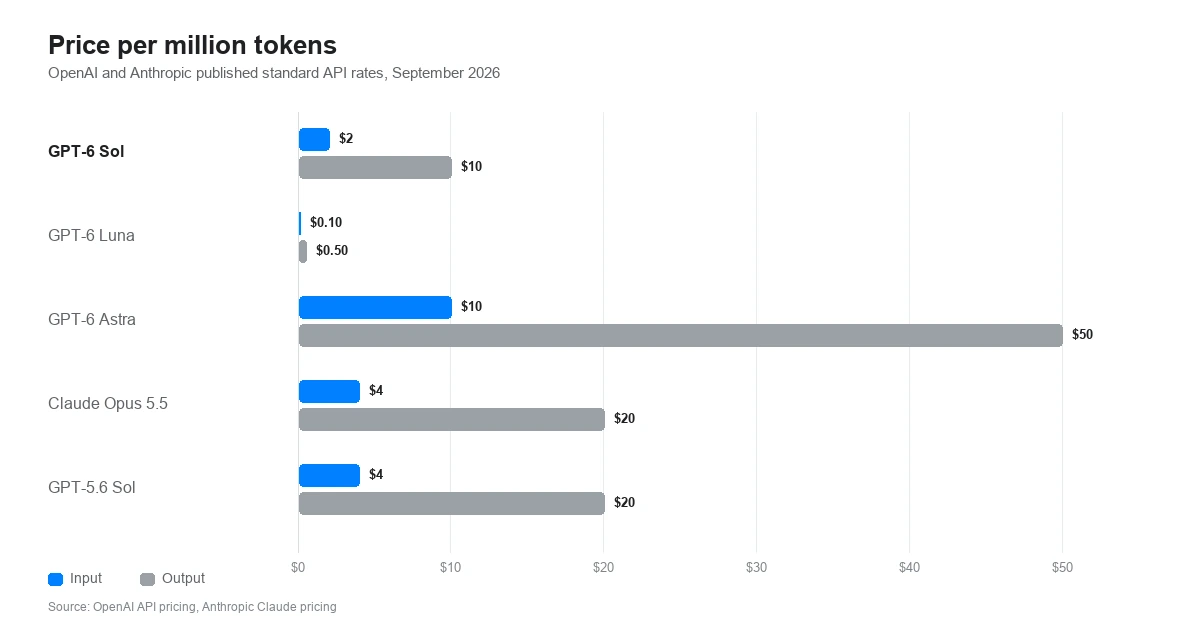
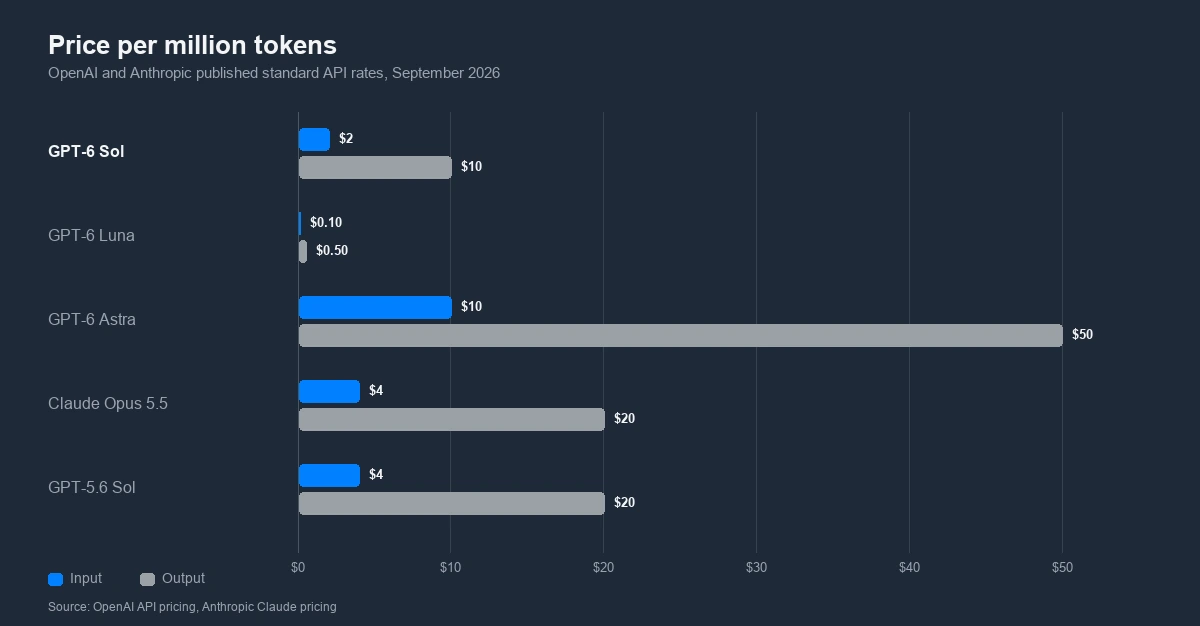
Price per million tokens, GPT-6 family and Claude Opus 5.5
Input and output rates per million tokens. GPT-6 Sol is $2 in and $10 out, a fifth of GPT-6 Astra at $10 in and $50 out, and half of GPT-5.6 Sol at $4 in and $20 out. Claude Opus 5.5, released the same day, matches GPT-5.6 Sol at $4 in and $20 out. Bars start at zero.
Source: OpenAI API pricing and Anthropic Claude pricing, September 2026
Coding and agentic benchmarks
Anthropic published these on the Claude Opus 5.5 announcement, reproducing OpenAI's own GPT-6 Astra figures beside them. GPT-6 Sol has no published score on these four, so it is absent rather than estimated.
Benchmark
GPT-6 Astra
Claude Opus 5.5
Agentic coding
Terminal-Bench 4.0
57.9%
66.4%
FrontierCode v1.1 (Main)
53.3%
54.4%
Business workflows and science
AutomationBench
41.4%
40.0%
Terminal-Bench-Science 0.1
64.6%
58.7%
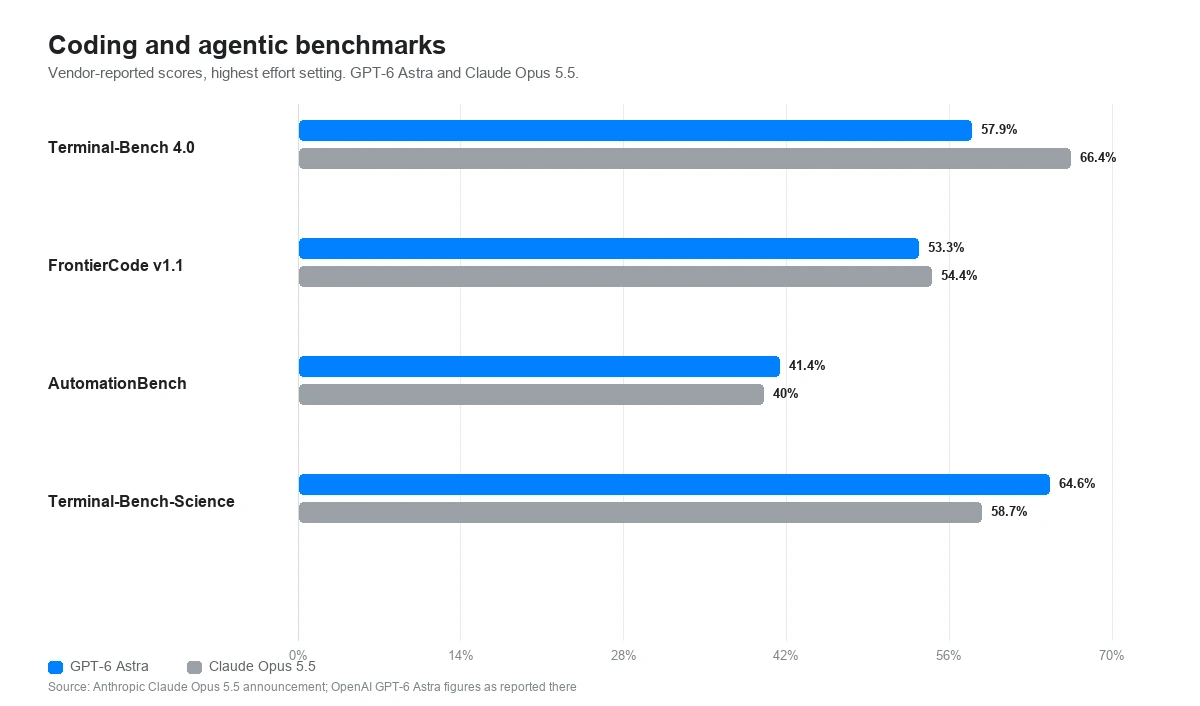
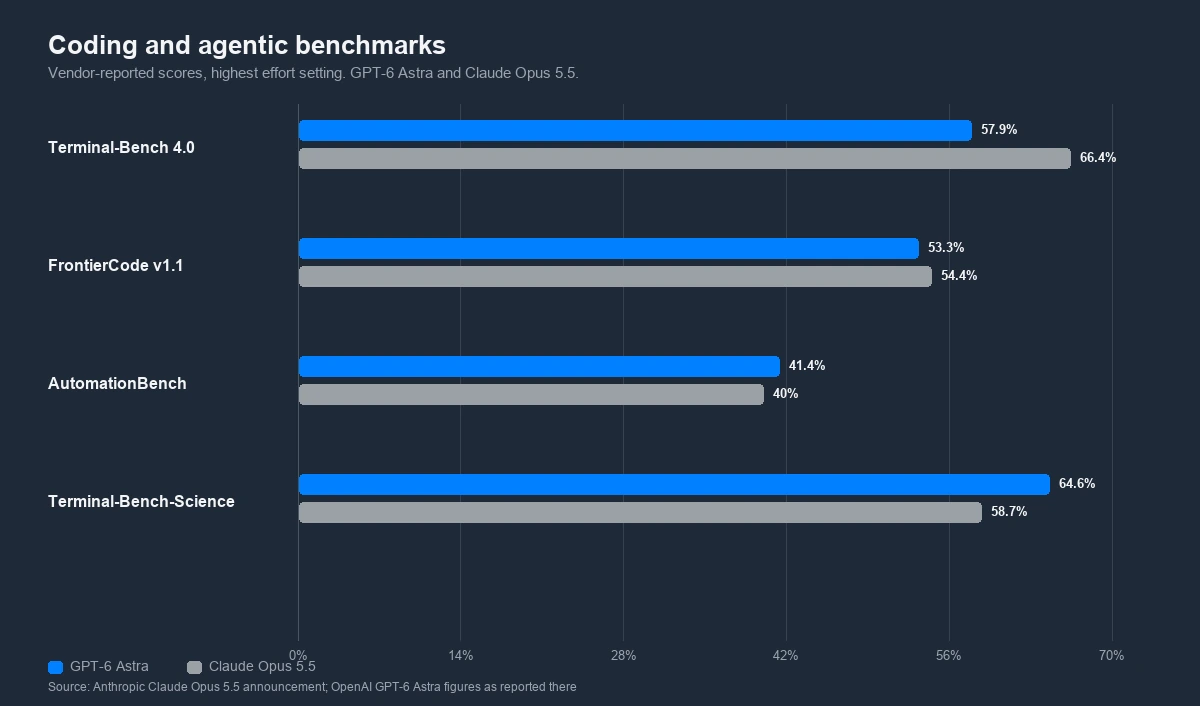
Coding and agentic benchmarks, GPT-6 Astra against Claude Opus 5.5
Four benchmarks where both vendors have published a figure. Claude Opus 5.5 leads Terminal-Bench 4.0 at 66.4% against Astra's 57.9% and FrontierCode v1.1 at 54.4% against 53.3%; Astra leads AutomationBench at 41.4% against 40.0% and Terminal-Bench-Science at 64.6% against 58.7%. Bars start at zero.
Source: Anthropic Claude Opus 5.5 announcement, September 2026
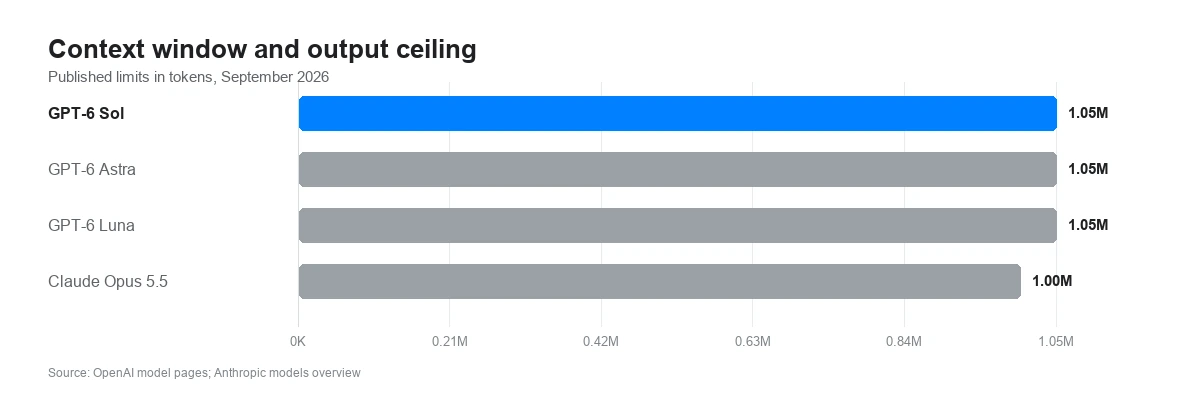
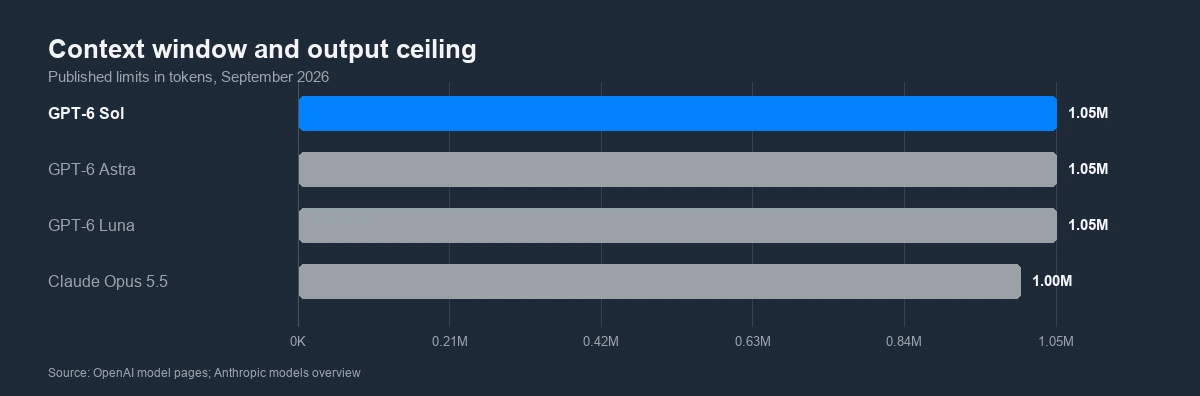
Context window, GPT-6 family and Claude Opus 5.5
All three GPT-6 models carry a 1,050,000-token context window with a 922,000-token maximum input and 128,000-token maximum output. Claude Opus 5.5 carries 1,000,000 tokens with the same 128,000-token output ceiling. Bars start at zero.
Source: OpenAI model pages and Anthropic models overview, September 2026
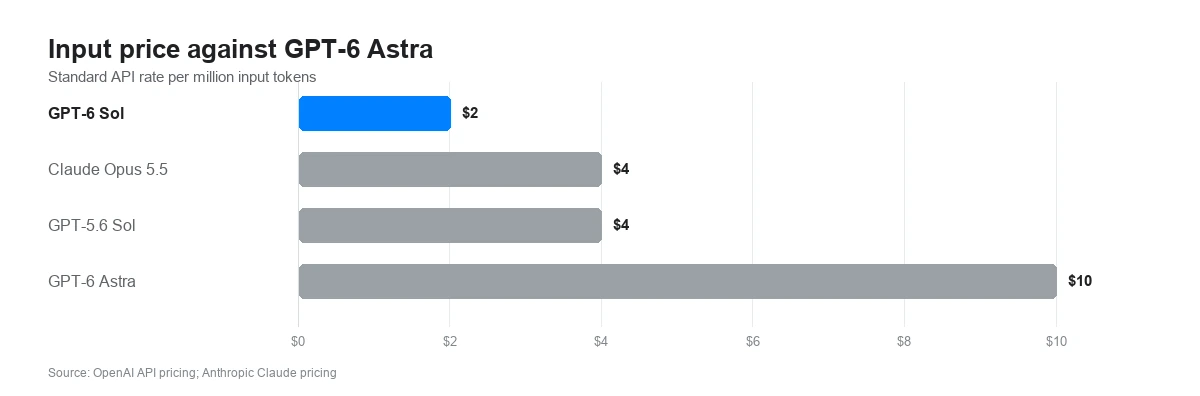
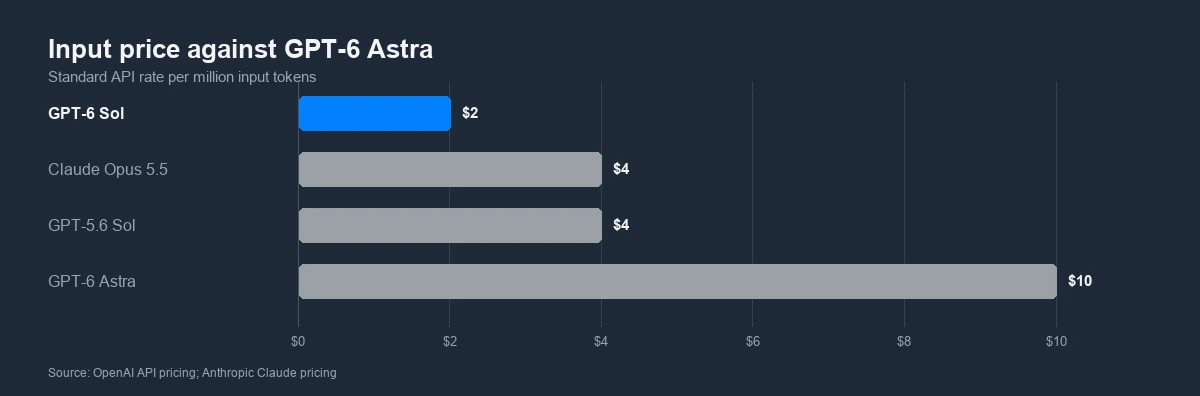
Input price against GPT-6 Astra
The headline gap, per million input tokens. GPT-6 Sol at $2 is a fifth of GPT-6 Astra at $10, and half of GPT-5.6 Sol and Claude Opus 5.5, both at $4. Bars start at zero.
Source: OpenAI API pricing and Anthropic Claude pricing, September 2026
Vendor-reported scores at each model's highest effort setting. GPT-6 Astra figures are as reported by OpenAI and reproduced by Anthropic. Claude Opus 5.5 was evaluated with its production safeguards enabled.
How GPT-6 Sol became public
Sol was visible in API traffic for six days before OpenAI confirmed it. This is how it surfaced, in order.
3 September 2026
OfficialGPT-6 Astra launches
OpenAI ships GPT-6 Astra, its first model rated Critical for cyber capability, establishing the generation that Sol would join. It is the only GPT-6 release OpenAI had made at this point.
6 September 2026
ReportThe first GPT-6 Sol claim
The @kimmonismus account posts that OpenAI "appears to be preparing the release of GPT-6 Sol", framing Astra as the flagship with "Sol, Terra, and Luna still to come". The post carries no screenshot or changelog entry, but the same account had pulled the GPT-5.6 family names out of the Codex app weeks before OpenAI confirmed them, which is why the claim travelled.
16 September 2026
Reportgpt-6-sol appears in live traffic
Developers report seeing gpt-6-sol where they expected gpt-5.6-sol. One capture shows a Codex request for gpt-5.6-sol returning a model_id of gpt-6-sol; others routing through a proxy report gpt-5.6-luna requests answered by an upstream string beginning gpt-6-. That was the first hard signal that a model existed rather than a name being rumoured, and it is the same run of tests that produced the speed measurements on this page.
22 September 2026
OfficialOpenAI releases GPT-6 Sol and Luna
OpenAI ships GPT-6 Sol and GPT-6 Luna on the API, confirming the model ID that had been appearing in traffic. Sol lands at $2 input / $10 output per million tokens, half of GPT-5.6 Sol and a fifth of Astra, with a 1,050,000-token context window. Anthropic releases Claude Opus 5.5 the same day.
The two Report entries were unconfirmed when they were posted. They are kept here because they are how the model became public before OpenAI confirmed it.
Specifications
What OpenAI has published for GPT-6 Sol, next to the flagship it sits beneath.
Price
GPT-6 Sol costs $2 per million input tokens and $10 per million output, a fifth of GPT-6 Astra's $10 / $50 and half of GPT-5.6 Sol's $4 / $20.
Pricing
GPT-6 Sol: $2 input / $10 output per million tokens.
GPT-6 Astra: $10 input / $50 output per million tokens.
Standard rates on the OpenAI API. Cached input is $0.20, cache writes $2.50, and Batch and Flex are half price. Prompts above 272K input tokens are billed at 2x input and 1.5x output.
Context window
GPT-6 Sol: 1,050,000 tokens, 922,000 max input, 128,000 max output.
GPT-6 Astra and GPT-6 Luna: 1,050,000 tokens each.
Availability
Live on the OpenAI API as gpt-6-sol, and on Felo AI Search and the Felo API.
Lineup position
Mid-tier of the GPT-6 generation, one step below GPT-6 Astra and one above GPT-6 Luna. Released 22 September 2026.
Knowledge cutoff
20 April 2026, the most recent cutoff of the three GPT-6 models. Astra's is 30 April 2026 and Luna's is 18 May 2026.
Input handling
Sol shares the GPT-6 generation's input handling, so a prompt written for Astra carries across unchanged.
Text in, text out
The baseline for every model in the family. Sol's published window is 1,050,000 tokens with a 922,000-token maximum input.
Image input
Screenshots, diagrams and scanned documents go in directly. Text and image in, text out, on both the Responses and Chat Completions APIs.
Long documents in one pass
A 1,050,000-token window takes whole repositories and document sets rather than excerpts, so the retrieval layer that used to sit in front of the model can come out.
What to run on Sol
The jobs OpenAI built the tier for, and where the price makes the difference.
High-volume batch work
Summarising, classifying and extracting across large document sets, where the per-token price decides whether the job is worth running at all.
Agent loops that call the model repeatedly
OpenAI positions Sol for complex coding and agentic workflows. Planning, tool selection and retries burn tokens quickly, and a cheaper tier is what makes long agent runs affordable.
Everyday drafting
Email, docs, tickets and commit messages, the work that does not need a flagship and where waiting on one is the wrong trade.
Front-end and visual generation
Front-end and interface generation, where Sol's price makes it practical to iterate many times on the same screen.
Backend defaults
The model behind an application's routine requests, with the flagship reserved for the hard ones.
Tool and API integration
Structured output at volume for pipelines, where cost per call and latency set the ceiling on what you can build.
Run the GPT-6 family on Felo
Start with GPT-6 Sol
The mid-tier model, live as gpt-6-sol since September 22, 2026: $2 in and $10 out per million tokens, with a 1,050,000-token context window and sources attached to every answer.
Open GPT-6 SolMove up to GPT-6 Astra
The flagship, rated Critical under OpenAI's Preparedness Framework and released 3 September 2026. Switch when a task needs the deepest reasoning or the strongest computer use rather than the lowest cost per call.
Open GPT-6 AstraFrequently asked questions
GPT-6 Sol is OpenAI's mid-tier GPT-6 model, released on 22 September 2026 alongside GPT-6 Luna and positioned one step below the Astra flagship. It is built for complex coding and agentic workflows, where the per-token price matters more than peak reasoning depth. It has been live on the API as gpt-6-sol since September 22, 2026.
Try GPT-6 Sol on Felo
OpenAI's mid-tier GPT-6 model: $2 in and $10 out per million tokens, a 1,050,000-token context window, and sources attached to every answer.
Available on Felo AI Search and the Felo API