01
Trace the real question
Work through the constraints behind an ambiguous request instead of stopping at the first plausible interpretation.
Anthropic released Opus 5 on July 24, 2026
Since launch, Felo PRO users can try Claude Opus 5 free for 7 days.
Now in Felo Search
Claude Opus 5 is now available in Felo Search for questions that need deeper investigation, stronger source synthesis, and a final answer checked against the evidence.
01
Work through the constraints behind an ambiguous request instead of stopping at the first plausible interpretation.
02
Bring competing sources and claims into one investigation, then identify where the evidence does and does not agree.
03
Use the answer as a decision-ready starting point, with the reasoning, caveats, and open questions still visible.
Quick walkthrough
Open the model picker, select Claude Opus 5, then start your task in the same workspace.
Jul 24
2026 release
Anthropic's newest Opus model
$5 / $25
API input / output
Per 1M tokens, same base price as Opus 4.8
~2.5x
Fast mode speed
Available at 2x the base price on Anthropic's platform
Verify + revise
Long-running work
Planning, tool use, checks, and iteration
The Opus difference
Anthropic positions Opus 5 for work where sustained judgment matters: identify the underlying issue, validate the result, and revisit the work when the evidence does not hold up.
01
For difficult bugs and ambiguous assignments, start with evidence, constraints, and the actual root cause rather than a surface-level patch.
02
Use a model that can inspect its own output, test assumptions, and catch an issue before a person has to discover it later.
03
Bring code, source material, tool results, and new constraints into one longer task without reducing the job to disconnected prompts.
Model selection
Prices below are official public API rates, not Felo subscription or usage prices. They make the trade-off visible without pretending that unrelated vendor latency tests are directly comparable.
Official public API pricing checked July 25, 2026. Total task cost also depends on output length, cached input, effort settings, tool calls, retries, and human review.
Official benchmark charts
These official charts plot model performance against reported evaluation cost at different effort levels. They are useful context for a cost decision, but they are vendor-published results rather than independent Felo testing.
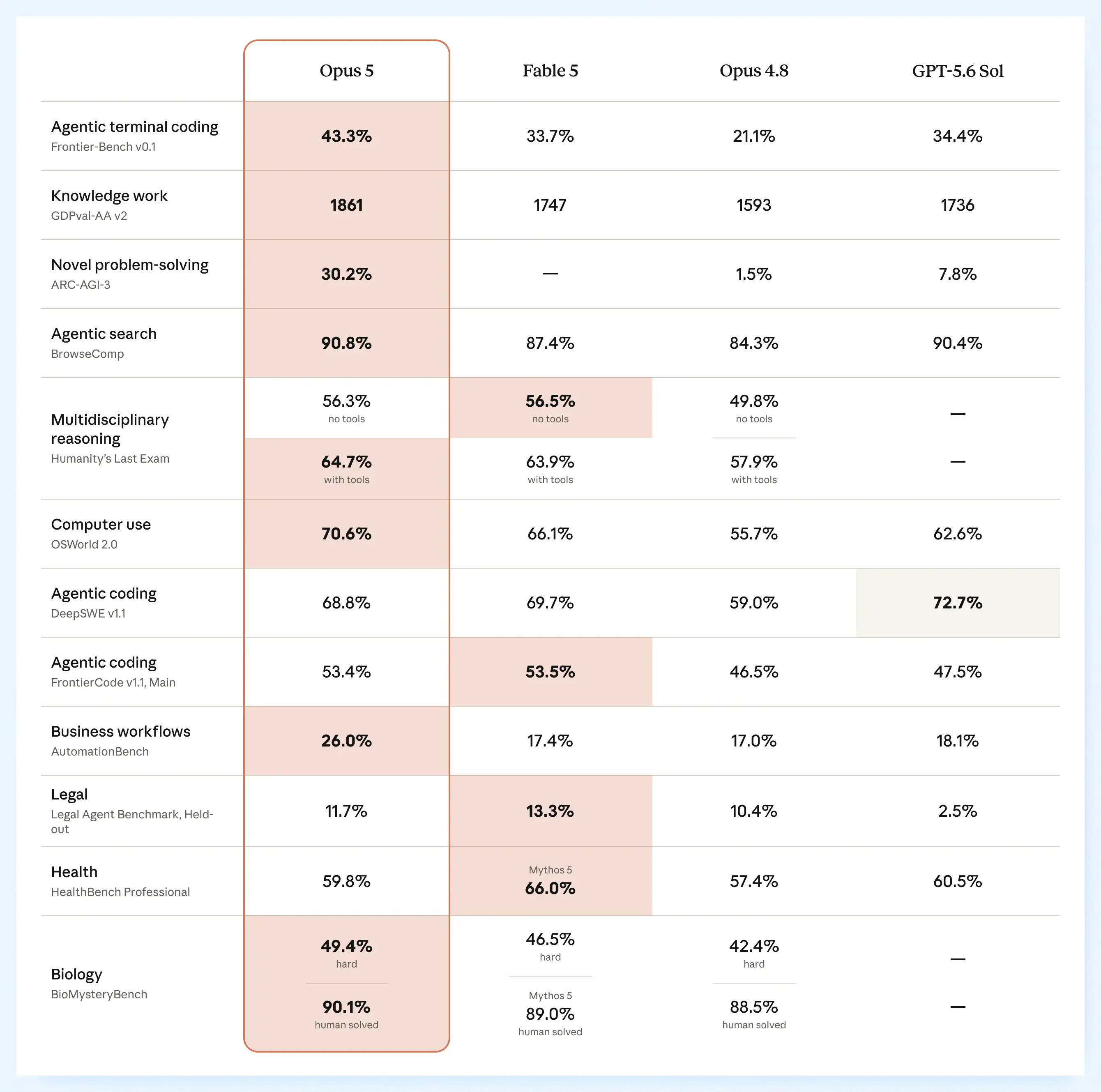
Official capability overview across benchmark families
Anthropic's cross-task matrix compares the published results for Opus 5, Fable 5, Opus 4.8, and GPT-5.6 Sol across coding, knowledge work, search, computer use, business workflows, and more.
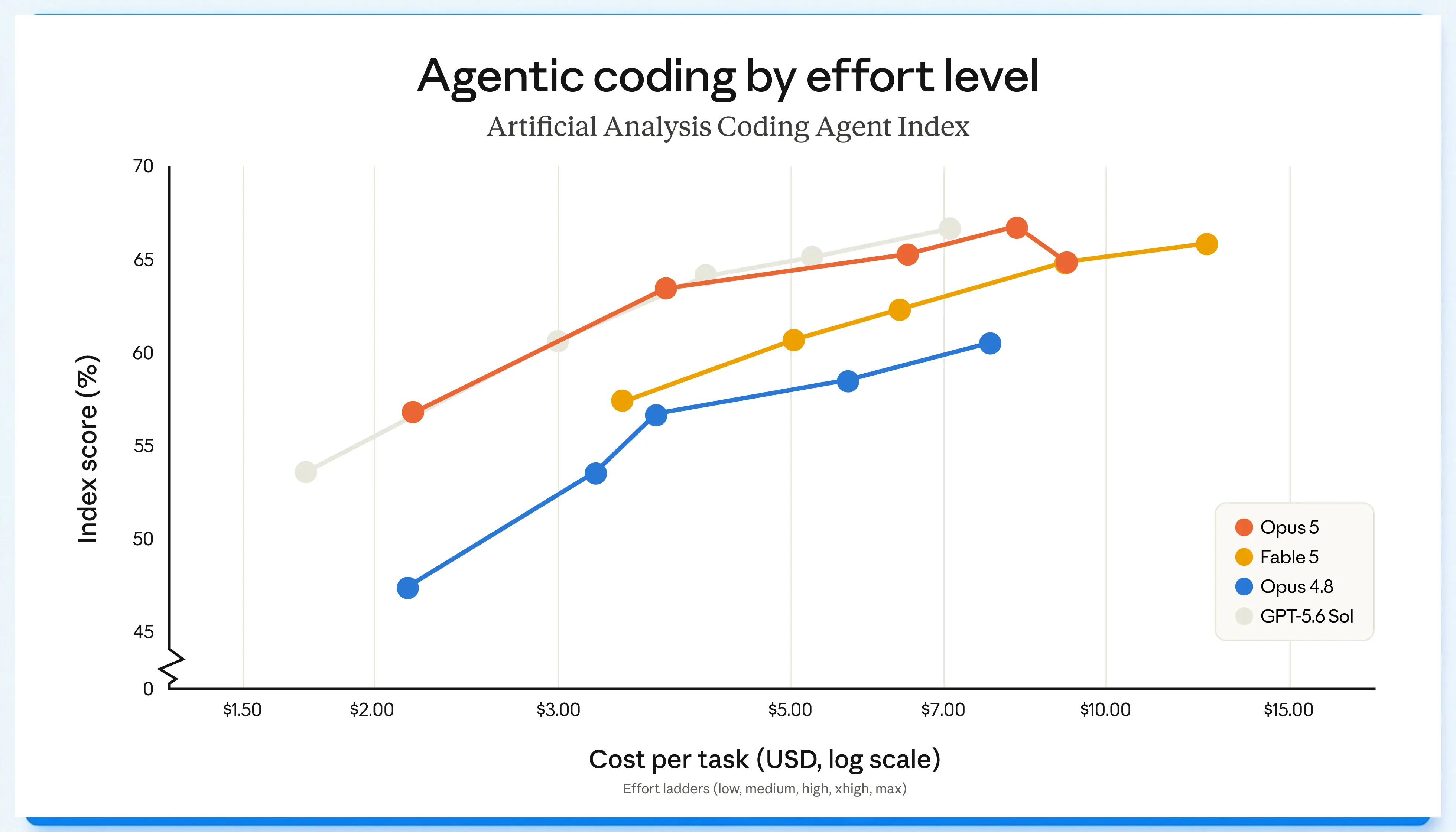
Agentic coding by effort level
Artificial Analysis Coding Agent Index: the official chart compares score with reported cost per task across the available effort settings.
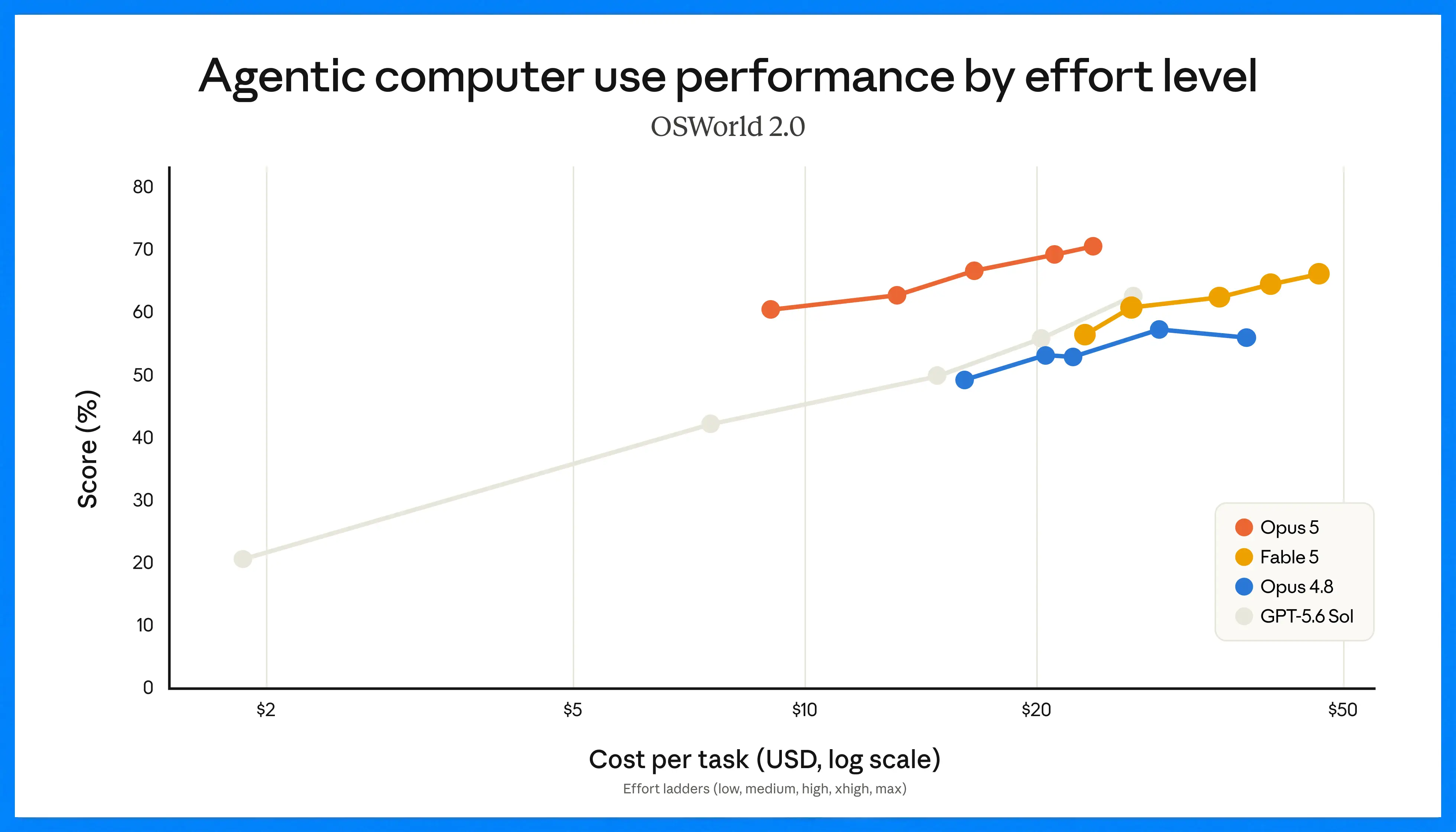
Agentic computer use by effort level
OSWorld 2.0: the official chart compares computer-use performance with reported cost per task across effort settings.
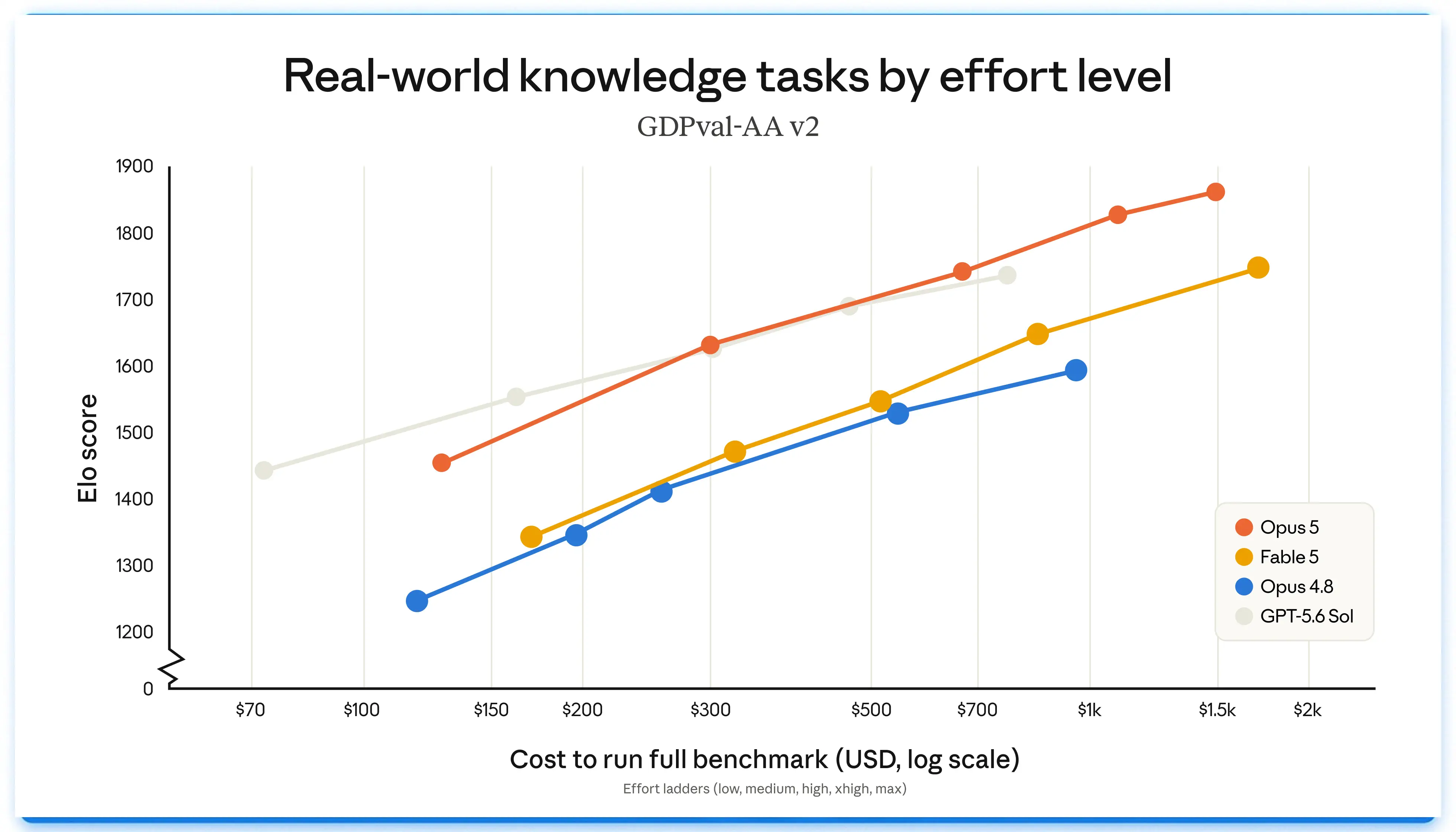
Real-world knowledge tasks by effort level
GDPval-AA v2: the official chart compares Elo score with reported full-benchmark cost across effort settings.
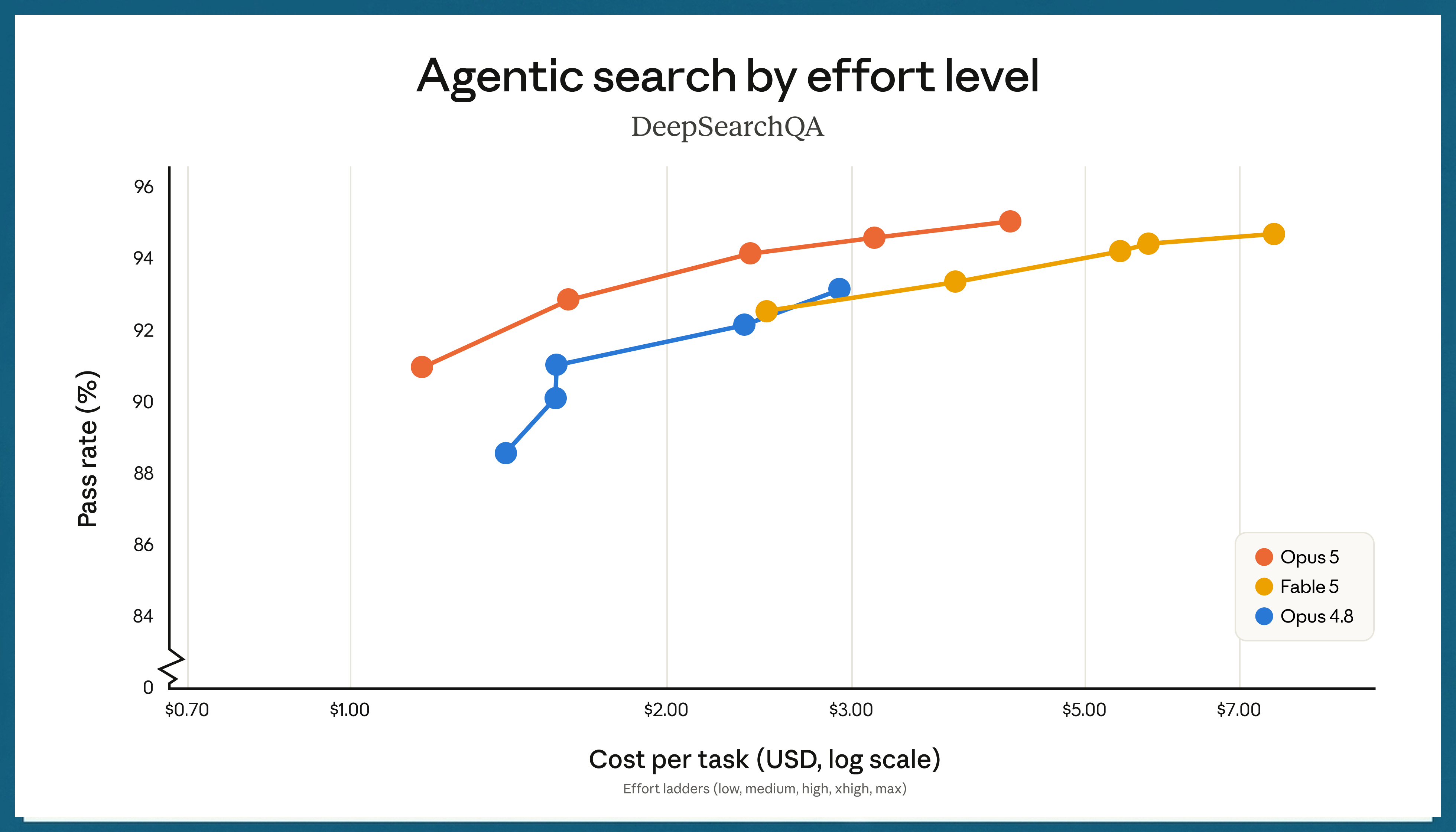
Agentic search by effort level
DeepSearchQA: the official chart compares search-task pass rate with reported cost per task across available effort settings.
Charts and benchmark labels are from Anthropic's Claude Opus 5 announcement. Felo added only the outer presentation frame; chart contents are preserved as published.
A better starting point
The model earns its place when verification changes the result. These are not generic chat prompts; they are multi-step jobs where a missed dependency, unsupported claim, or untested edge case costs time later.
Investigate a regression, reproduce it, inspect the surrounding code, implement a focused fix, and test the paths a quick patch tends to miss.
Reconcile tables, test assumptions, compare source documents, and produce a recommendation with the evidence and caveats intact.
Read competing sources, expose open questions, weigh the evidence, and distinguish a confident answer from an answer that is actually supported.
Use tools, preserve the task constraints, recover from partial results, and keep moving through a larger assignment with deliberate checkpoints.
01
Add the code, documents, requirements, and evidence that a useful answer must account for.
02
Specify what must be checked before the work is considered complete, not only what to produce.
03
Use the same task across leading models in Felo. Review not only the answer, but the tests, caveats, and judgment behind it.
Select Claude Opus 5 when it is available in your account's live model picker.
Open Felo LLM PlaygroundClaude Opus 5 is Anthropic's Opus-tier model released on July 24, 2026. Anthropic positions it for long-running agents, complex software engineering, professional knowledge work, and tasks that benefit from verification and careful iteration.
Put Claude Opus 5 beside the other leading models in Felo, then test it on the task where a plausible answer would not be enough.
Try Opus 5 in FeloStart in Felo AI Search and select the model where available.