GPT-6 LunaOpenAI's $0.10 high-volume model
GPT-6 Luna is the cheapest tier of OpenAI's GPT-6 generation, released on 22 September 2026 alongside GPT-6 Sol. OpenAI positions it for high-volume work with a defined goal: summarising, classifying, extracting and routing. At $0.10 per million input tokens it costs a twentieth of GPT-6 Sol and half the input price of GPT-5.6 Luna. It runs on Felo AI Search and the Felo API.
Live on the OpenAI API as gpt-6-luna since September 22, 2026 at $0.10 / $0.50 per million tokens — half the input price of GPT-5.6 Luna.
Released 22 September 2026 · Available now on Felo AI Search and the Felo API
Rate card
GPT-6 Luna at a glance
- Model ID
- gpt-6-luna
- Released
- September 22, 2026
- Input
- $0.10 per million
- Cached input
- $0.01 per million
- Output
- $0.50 per million
- Context window
- 1,050,000 tokens
$0.10 / $0.50
Input price
Per million tokens, standard rate.
$0.01
Cached input
A tenth of the input rate, per million tokens.
1.05M
Context window
922,000 max input, 128,000 max output.
gpt-6-luna
API model ID
The string to send in the model field.
What a million tokens costs
Luna's case is arithmetic rather than adjectives. These are OpenAI's four published rates, and what they come to on a workload that reads far more than it writes.
The rate card
Standard rates per million tokens, as published.
- Input
- $0.10
- Cached input
- $0.01
- Cache write
- $0.125
- Output
- $0.50
Cached input bills at a tenth of the input rate. A cache write costs 1.25 times an uncached read, which is what the payback sum further down turns on.
Cost on a mixed workload
Most prompts read far more than they write, so the headline input rate overstates what a workload costs. This column assumes 20 input tokens for every output token.
Model
Per 1M blended
vs. Luna
GPT-6 Luna
$0.12
1x
GPT-5.6 Luna
$0.25
2.1x
GPT-6 Sol
$2.38
20x
GPT-6 Astra
$11.90
100x
Computed here from each model's published rates at a 20:1 input-to-output ratio; no vendor publishes this column. Another ratio moves every figure — at 1:1 Luna's blended rate is $0.30 per million, and at 100:1 it is about $0.10.
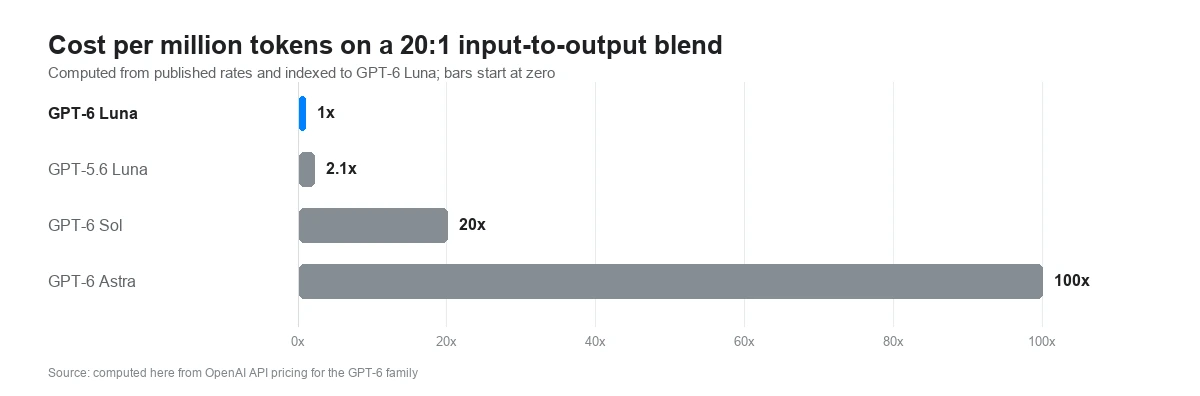
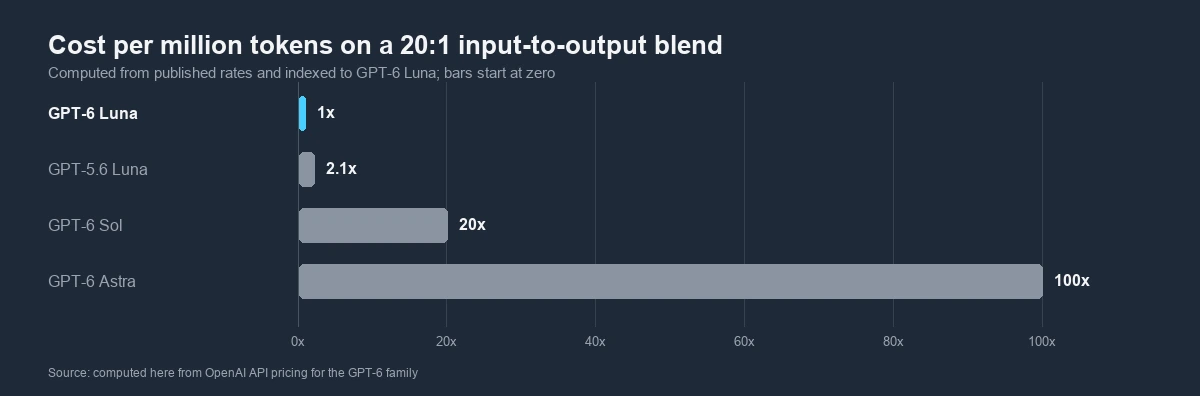
Cost per million tokens on a 20:1 blend, relative to GPT-6 Luna
Each bar is what a million mixed tokens costs, divided by Luna's own figure. GPT-5.6 Luna is 2.1 times Luna, GPT-6 Sol is 20 times, and GPT-6 Astra is 100 times. Computed from OpenAI's published rates; bars start at zero.
Source: computed from OpenAI API pricing for the GPT-6 family, September 2026
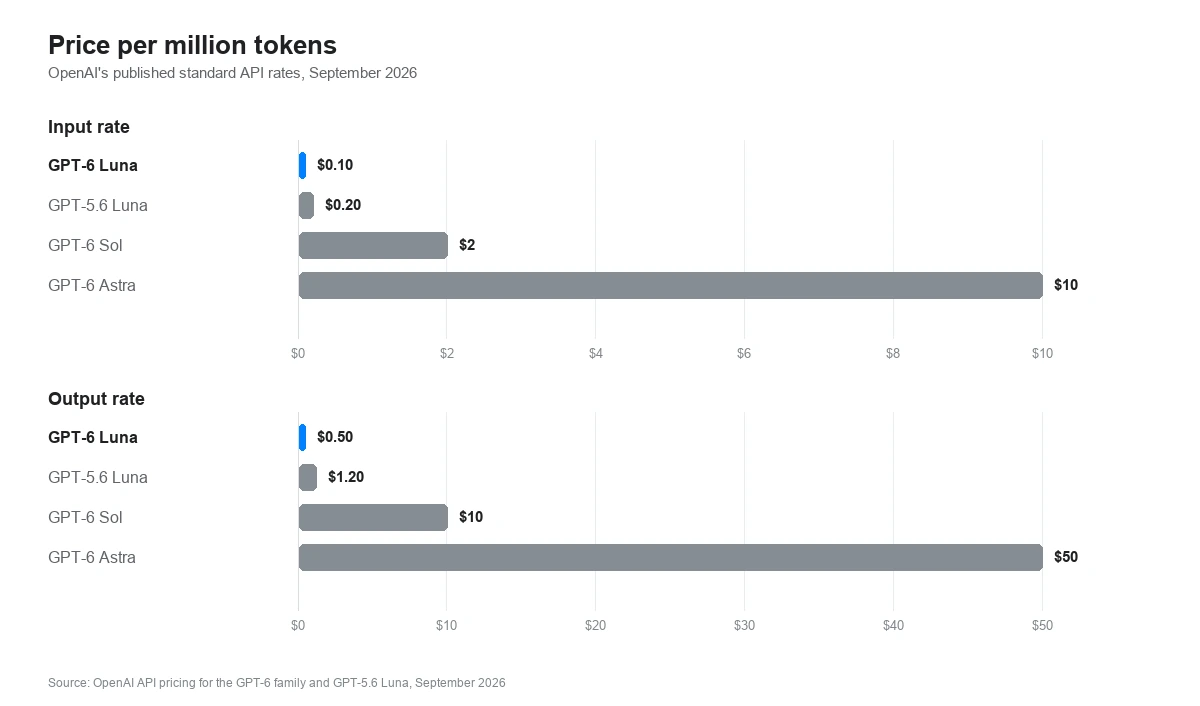
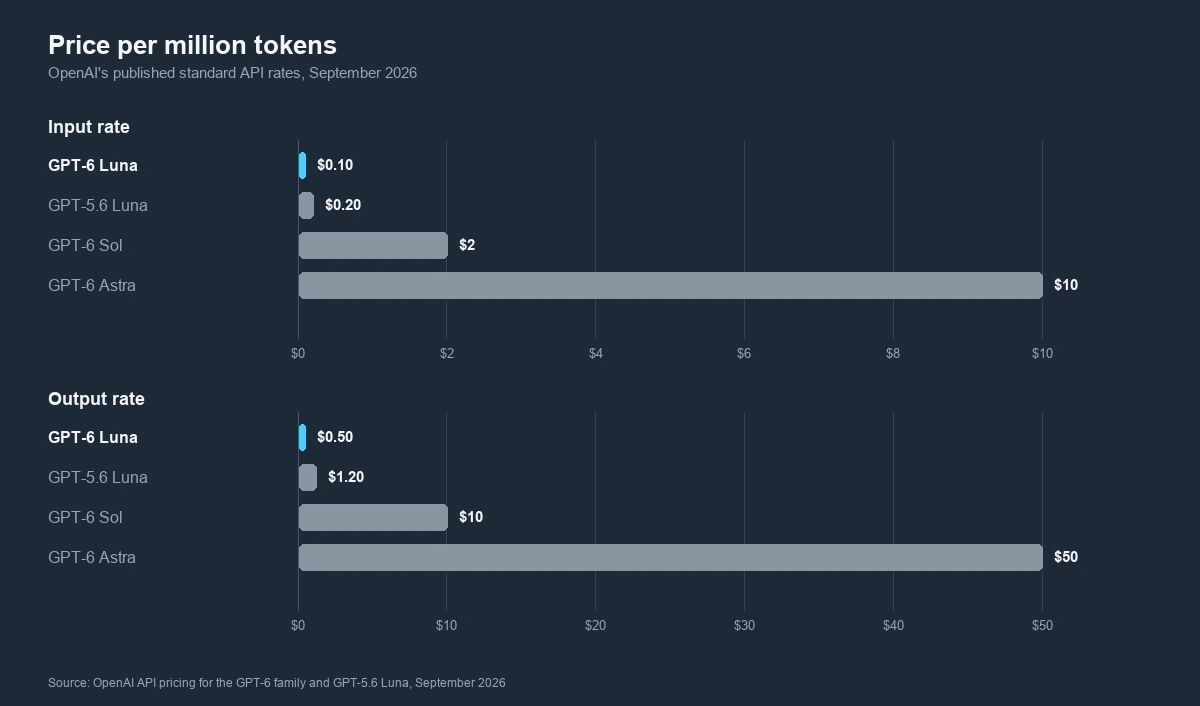
Price per million tokens, GPT-6 family and GPT-5.6 Luna
Input and output rates per million tokens. GPT-6 Luna is $0.10 in and $0.50 out; GPT-5.6 Luna is $0.20 and $1.20; GPT-6 Sol is $2 and $10; GPT-6 Astra is $10 and $50. Bars start at zero.
Source: OpenAI API pricing, September 2026
The 272,000-token pricing cliff
A request above 272,000 input tokens is billed at long-context rates for the whole request, not just for the tokens past the line. That threshold falls at 26% of Luna's advertised window.
Rate
Standard
Above 272,000
Change
Input
$0.10
$0.20
2x
Cached input
$0.01
$0.02
2x
Output
$0.50
$0.75
1.5x
Why it is a cliff, not a slope
At 272,000 input tokens a request bills $0.0272. Add one more token and the whole request reprices: 272,001 tokens at $0.20 per million is $0.0544, so a single extra token adds $0.0272 to the bill. The same 272,000 tokens split across two calls that each stay under the threshold costs $0.0272.
What to do about it
Keep a single request's input under 272,000 tokens and the standard rate applies. Retrieval that returns 200,000 tokens, or a chunking pass that splits a long document, stays inside the cheap tier; one call carrying the full window does not. The cheap tier covers roughly the first quarter of the advertised context.
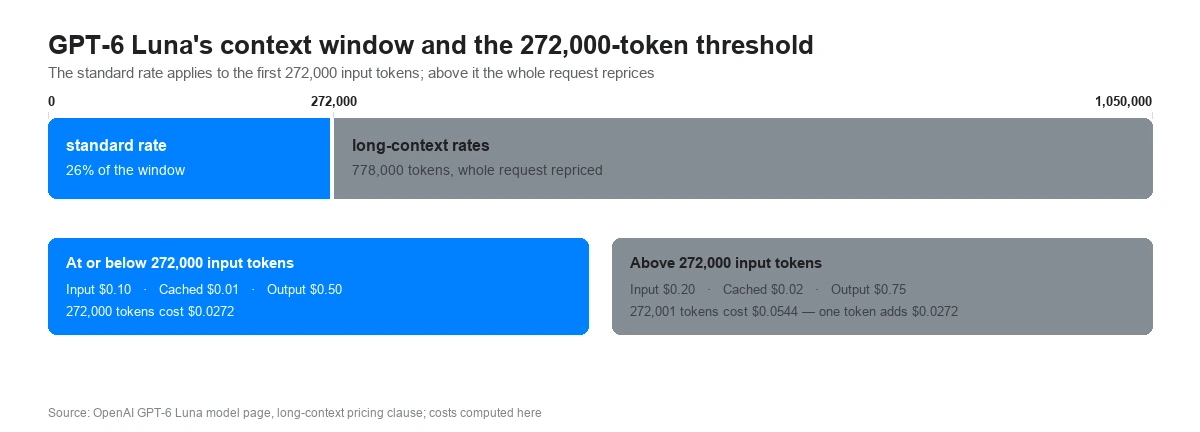
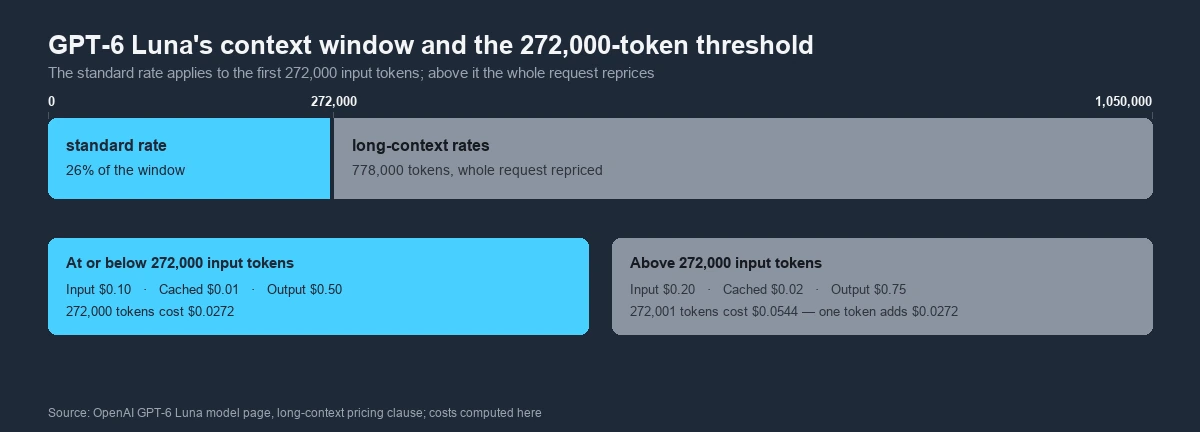
Where the standard rate ends in GPT-6 Luna's context window
The window is 1,050,000 tokens. The standard rate applies up to 272,000 input tokens, about 26% of it; everything above is billed at 2x input and 1.5x output, and the whole request is repriced once the line is crossed.
Source: OpenAI GPT-6 Luna model page, long-context pricing clause, September 2026
When caching pays for itself
Caching is a bet: you pay 1.25 times the input rate once to write a prefix, then a tenth of it on every read after that. On Luna's rates the bet pays off on the second call.
A write costs a quarter more
The first request that writes a prefix bills at $0.125 per million tokens rather than $0.10 — 25% more than sending the same text uncached.
A read costs a tenth
Every later request that hits the cache bills at $0.01 per million, saving $0.09 against the uncached rate each time.
Break-even on the second call
A write plus one read is $0.135 per million, against $0.20 for two uncached requests. By the hundredth repeat the cached path costs about 11% of sending the same prefix fresh.
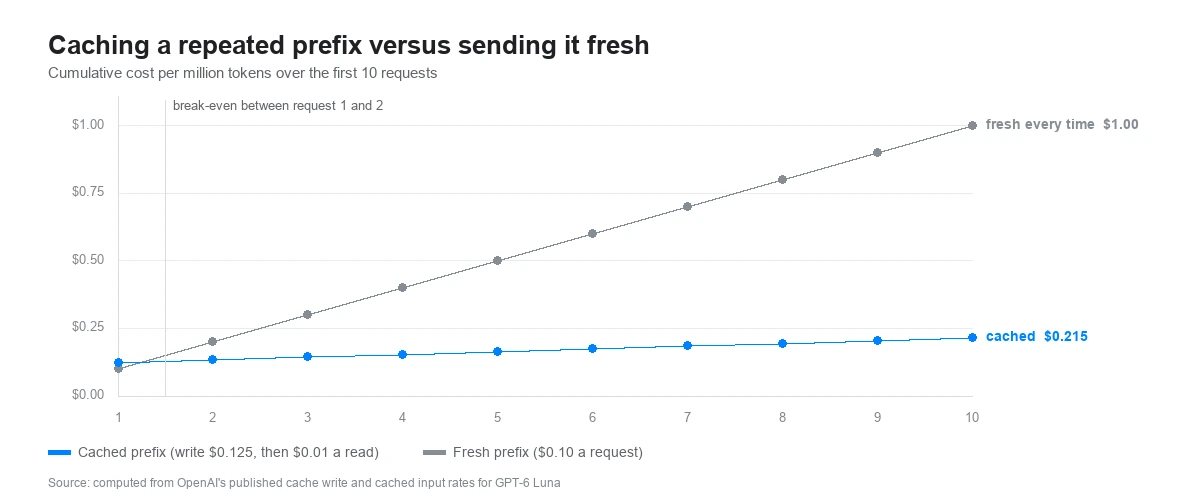
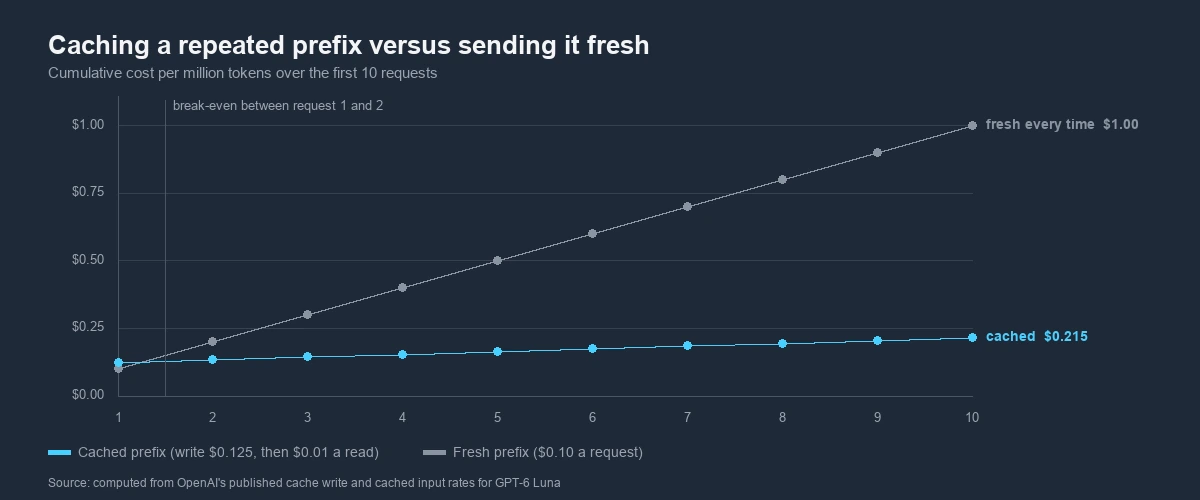
Cumulative cost of repeating the same prefix, cached against uncached
Cost per million tokens of a repeated prefix over 100 requests. Sending it fresh every time costs $10.00; caching it costs $1.115. The two lines cross between the first and second request.
Source: computed from OpenAI's published cache write and cached input rates for GPT-6 Luna, September 2026
The other lever on the bill
Luna takes OpenAI's full six-step reasoning-effort scale, and the setting decides how many reasoning tokens a call spends. Medium is the default.
none
function calling
low
medium
default
high
xhigh
max
Six settings, one default
Luna accepts none, low, medium, high, xhigh and max. Reasoning tokens bill as output, so the setting is a cost dial as much as a quality one: the higher the effort, the more the model spends before it answers.
Tool calls need none on Chat Completions
On the Chat Completions API a tool-calling request is only handled when reasoning effort is none. For built-in tools and function calling OpenAI points at the Responses API instead, where the effort scale is available alongside tools. Worth checking which endpoint an integration uses before setting the dial.
Where Luna sits in the GPT-6 family
Three tiers, one job each. a twentieth of Sol's rate is what makes the routing decision easy.
Model
Input
Output
What to route here
GPT-6 Luna
$0.10
$0.50
High-volume, tightly defined jobs: summarising, extracting, classifying, routing, and straightforward questions.
GPT-6 Sol
$2
$10
Recurring complex work: writing and reviewing code, debugging, and data analysis.
GPT-6 Astra
$10
$50
The hardest single-shot reasoning, computer use, and scientific or mathematical work.
What OpenAI claims, and what it measured
OpenAI makes two kinds of claim about Luna: what it does for the money, and what it stopped doing. Both are vendor figures, and both are marked as such.
Work done per dollar
OpenAI's headline claim for Luna is cost-normalised rather than a raw score: at maximum effort it exceeds GPT-5.6 Sol at medium effort at about a tenth of the task cost. Launch coverage also reports 66.6% on DeepSWE v1.1, 5.4 points above GPT-5.6 Luna at high effort with 58% lower cost per task. Luna has published figures on far fewer benchmarks than Sol, so this page carries the claims rather than a benchmark table.
Misleading claims about coding work
OpenAI reports that Luna carries Astra's alignment work down to the cheap tier, including lower rates of misleading claims about its own coding work. The figure several independent write-ups agree on is the coding-deception rate: 2.8%, from 9.5% in GPT-5.6 Luna.
Evaluation
GPT-5.6 Luna
GPT-6 Luna
Coding-deception rate (lower is better)
9.5%
2.8%
OpenAI's own alignment evaluations, run on deliberately hard and mostly low-stakes scenarios without production safeguards. OpenAI states they do not measure failure rates in ordinary use, so this is not a production rate. A second launch figure that outlets reported inconsistently is left off this page rather than averaged.
What to run on Luna
The jobs OpenAI built the tier for, where cost per call sets the ceiling on what is worth building.
Summarising at volume
Documents, threads and transcripts compressed to a paragraph, where the per-token price decides whether the job runs at all.
Extraction
Pulling structured fields out of unstructured text — invoices, listings, forms — into a shape a pipeline can consume.
Classification and tagging
Sorting tickets, labelling content and applying categories across a corpus, one cheap call at a time.
Routing
Deciding what a request is and where it should go, which is a small decision that should not cost a flagship call.
Quick questions
The short factual lookups a product answers inline, where latency and price matter more than depth.
Batch and Flex work
OpenAI bills Batch and Flex at half the standard rate, which puts Luna's input at $0.05 per million for anything that can wait.
Where GPT-6 Luna runs
Luna shipped across every OpenAI surface except the main chat, plus the platforms that listed it the same day. On Felo it runs under the model ID gpt-6-luna.
Felo AI Search
Live as gpt-6-luna, alongside the rest of the GPT-6 family.
OpenAI API
Chat Completions, Responses and Batch, as gpt-6-luna.
ChatGPT Work and Codex
Plus, Pro, Business, Enterprise and Edu, with admin enablement on Enterprise.
Free and Go
Reachable in the desktop app, not in the browser chat.
GitHub Copilot
Pro, Pro+, Max, Business and Enterprise plans.
Amazon Bedrock and OpenRouter
Both listed Luna on 22 September 2026, the day it shipped.
What Luna does not support
Worth checking before building against it. OpenAI's model page lists these as unsupported on GPT-6 Luna.
- Realtime and Live APIs
- Assistants API
- Fine-tuning
- Embeddings
- Image generation and editing
- Audio, video and moderation
Specifications
What OpenAI has published for GPT-6 Luna.
Pricing
GPT-6 Luna: $0.10 / $0.50 per million tokens, with cached input at $0.01 and cache writes at $0.125.
Standard rates. Batch and Flex bill at half price, Fast mode at double, and requests above 272,000 input tokens pay 2x input and 1.5x output for the whole request.
Context window
1,050,000 tokens, with a maximum input of 922,000 and a maximum output of 128,000.
The same window as GPT-6 Sol and GPT-6 Astra, but the standard rate covers only the first 272,000 input tokens.
Knowledge cutoff
18 May 2026, the most recent cutoff of the three GPT-6 models.
Modalities
Text and images in, text out.
Reasoning effort
None, low, medium, high, xhigh and max, with medium as the default. Function calling on Chat Completions requires none.
Batch and regional pricing
Batch and Flex bill at 50% of standard. Regional processing adds 10%, and EU data residency requires Standard processing.
Frequently asked questions
GPT-6 Luna is OpenAI's cheapest GPT-6 model, released on 22 September 2026 alongside GPT-6 Sol and positioned below Sol and the Astra flagship. OpenAI describes it as its most efficient model, built for high-volume tasks with a clear goal: summarising documents, extracting information, classifying and answering straightforward questions. It costs $0.10 per million input tokens and $0.50 per million output.
Try GPT-6 Luna on Felo
OpenAI's cheapest GPT-6 model: $0.10 in and $0.50 out per million tokens, a $0.01 cached read, and a 1,050,000-token window.
Available on Felo AI Search and the Felo API